The Master of Veronese Gothic: The Life and Legacy of Altichiero da Zevio
In the twilight of the fourteenth century, as the rigid structures of the Byzantine tradition began to soften under the influence of a new, more humanistic vision, there emerged a painter whose brushwork would define the soul of the Veronese School. Altichiero da Zevio, born near the quiet town of Zevio in Verona around 1330, was not merely a chronicler of sacred events but a pioneer of the Venetian Gothic style. While the biographical shadows surrounding his early years remain somewhat dense, the vibrant frescoes he left behind act as a luminous window into his creative spirit. Scholars often trace the lineage of his genius back to Florence, suggesting that he breathed the same artistic air as Giotto. This connection, likely forged through an intimate study of Giotto’s pupils like Taddeo Gaddi, allowed Altichiero to infuse his work with a profound sense of volume, weight, and narrative clarity that was revolutionary for his time.
The evolution of Altichiero’s artistry is best understood through his monumental contributions to the civic and religious landscapes of Verona and Padua. His early ascent to prominence was marked by the prestigious commission for the Sala del Podestà within the della Scala palace. Here, around 1364, he embarked on an ambitious cycle depicting scenes from Josephus's Wars of the Jews. This project was far more than a decorative endeavor; it was a masterclass in historical storytelling. Through these frescoes, Altichiero demonstrated an uncanny ability to organize complex, multi-layered compositions, transforming cold stone walls into theatrical stages where history and drama converged. His mastery of the narrative fresco established him as a premier storyteller of the Trecento, capable of guiding the viewer's eye through intricate battle scenes and emotional confrontations with seamless grace.
A Symphony of Color and Devotion in Padua
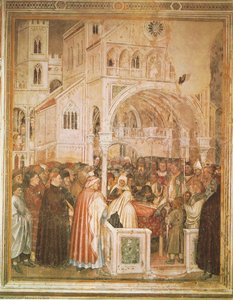
As his reputation expanded beyond the borders of Verona, Altichiero’s journey led him to the intellectual and artistic heart of Padua. It was here that his collaboration with Jacopo d'Avanzi reached its zenith, producing some of the most breathtaking examples of late Gothic art in existence. In the chapel of Saint James at the Basilica of Sant’Antonio, the duo breathed life into the hagiography of Saint James the Elder. These works are characterized by a unique visual dynamism, where religious iconography is wedded to an emerging interest in naturalism and emotional depth. The frescoes do not merely depict saints; they inhabit a world of palpable atmosphere, where the drapery of robes and the expressions of the faithful suggest a reality that is both divine and deeply human.
Perhaps even more intimate is his contribution to the Oratorio di San Giorgio. Often whispered about in the same breath as the Scrovegni Chapel, this small, sacred space serves as a testament to Altichiero’s ability to scale his monumental vision down to a poignant, personal level. Working within this family mausoleum, he and his workshop created a vibrant tapestry of devotion that continues to transport modern visitors back to the dawn of the Renaissance. His work in Padua represents a crucial bridge in art history—a moment where the decorative elegance of the Gothic era began to embrace the structural innovations and psychological complexity that would soon define the Italian Renaissance.
The Enduring Echo of a Venetian Pioneer
Though Altichiero da Zevio passed away around 1390, his influence did not fade with his final breath. He left behind a legacy etched into the very architecture of Northern Italy, providing a foundation upon which future generations of Venetian and Veronese painters would build. His significance lies in his role as a transitional figure; he took the inherited language of the Middle Ages and began to rewrite it with a new vocabulary of space, movement, and human emotion. To study Altichiero is to witness the slow, beautiful metamorphosis of European art, moving away from the static icons of the past toward a more breathing, living world.
The enduring importance of his oeuvre can be summarized through several key artistic pillars:
- Narrative Innovation: His ability to transform historical and biblical texts into sweeping, cinematic fresco cycles.
- Stylistic Synthesis: The successful blending of Florentine Giottesque naturalism with the decorative elegance of the Venetian Gothic.
- Architectural Integration: A profound mastery of using fresco to expand the perceived space of chapels and civic halls.
- Foundational Legacy: Establishing the Veronese School as a distinct and powerful force in the Italian artistic landscape.
Perguntas e Respostas
Qual é o local e o ano de nascimento de Altichiero Da Zevio?
Altichiero Da Zevio nasceu em Zoveo bei Verona, em 1330.
Como a carreira de Altichiero Da Zevio é dividida em períodos?
Um relato cronológico da obra de Altichiero Da Zevio está disponível na página Crônica do artista, onde as obras de arte passam em ordem de criação, capítulo por capítulo.
De onde é Altichiero Da Zevio?
Altichiero Da Zevio nasceu em Italy.