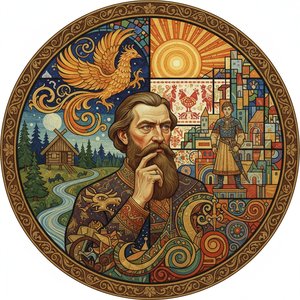
The Law and the Brush
The path toward the canvas begins not in a studio, but in the lecture halls of Moscow State University. Born into a merchant family, Dmitry Anfimovich Shcherbinovsky follows the expectations of his parents into the study of law. He graduates in 1891, a man trained in the logic of statutes, yet his focus has already drifted toward the influence of Vasily Polenov. The transition from legal theory to visual expression is swift. He moves from the university to the Imperial Academy of Arts, entering the orbit of Pavel Chistyakov and Ilya Repin. It is under Repin’s guidance that Shcherbinovsky finds his footing. In 1896, a single painting of lawyers during their recess secures his title as an Artist and provides the stipend necessary to cross the European continent.
Paris becomes the next setting. At the Académie Julian, he works under Tony Robert-Fleury, absorbing the light and technique of the French tradition. This period marks a departure from his formal legal training, cementing his identity as a painter. By 1900, he returns to Saint Petersburg, settling into a life of both creation and instruction. He teaches at the studio of Princess Maria Tenisheva, refining his own understanding of form through the act of teaching.
The Peredvizhniki and the Pedagogue
The movement known as the Peredvizhniki claims him in 1914. He participates in their 42nd, 44th, 45th, and 46th exhibitions, aligning himself with a tradition of Russian realism and impressionism. His work is characterized by the sensibilities of a Russian Impressionist, a style that balances the weight of subject matter with the fluidity of light. His influence extends through his students, most notably Boris Grigoriev, who studies under him at the Stroganov Moscow State University of Arts and Industry. His pedagogical skill is recognized with the Order of St. Anna, a distinction for his efforts in shaping the next generation of artists.
The social landscape shifts violently with the Revolution. Amidst the upheaval, Shcherbinovsky continues to teach, finding work in handicraft schools and workers' associations. He becomes a member of the Council of Trade Union Painters (SOZHIV), navigating the new realities of the Soviet era while maintaining his commitment to art education. He remains active in the instructional sphere until his death in Moscow in 1926.
Perguntas e Respostas
Como a arte de Dmitry Shcherbinovsky evoluiu ao longo do tempo?
A Linha do tempo de Dmitry Shcherbinovsky é uma linha do tempo interativa que apresenta as obras do artista em ordem cronológica, organizadas em capítulos por períodos de sua carreira.
Em que cidade e país Dmitry Shcherbinovsky nasceu?
Dmitry Shcherbinovsky nasceu em Petrovsk, em Russia.
Posso visitar um museu virtual das obras de Dmitry Shcherbinovsky?
É possível fazer uma visita virtual: a página Galeria 3D de Dmitry Shcherbinovsky apresenta as obras do artista em uma galeria tridimensional.
Onde posso ver as obras de Dmitry Shcherbinovsky em ordem cronológica?
A página de Linha do tempo das obras do artista apresenta as obras de Dmitry Shcherbinovsky ordenadas por data, ano a ano.