The Master of the Genoese Baroque
In the golden age of the seventeenth century, few names resonated through the grand halls and sacred sanctuaries of Genoa as powerfully as Domenico Piola. A titan of the Baroque period, Piola was not merely a painter but the beating heart of a vast, creative ecosystem known as Casa Piola. Born in Genoa in 1627, his life was inextricably linked to the flourishing maritime republic, where his brushwork helped define the very visual language of the era. His journey began under the tutelage of his brother-in-law, Stefano Camogli, and continued through the guidance of Pellegrino Piola, eventually leading him to study under Giovanni Domenico Cappellino. This rigorous foundation allowed him to emerge as a versatile virtuoso, capable of navigating the complexities of draughtsmanship, printmaking, and design with unparalleled grace.
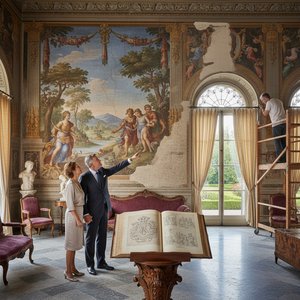
The essence of Piola’s artistry lies in his ability to transform architectural spaces into celestial realms. As the leading figure of the Genoese school in the latter half of the 17th century, he specialized in the breathtaking medium of ceiling frescoes. These works were not merely decorations but immersive experiences designed to draw the viewer's gaze upward toward the divine. Working alongside contemporaries like Gregorio De’ Ferrari, Piola executed monumental cycles for prestigious locations such as the Palazzo Rosso. In these grand commissions, his ability to balance the heavy drama of the Baroque with a certain lyrical lightness—inspired by the works of Giovanni Benedetto Castiglione—created a sense of movement and light that seemed to dissolve the very boundaries of stone and plaster.
The Legacy of Casa Piola
What truly distinguished Domenico Piola from his peers was the sheer scale of his influence, facilitated by the prolific nature of his family studio. Casa Piola functioned as a highly organized workshop that streamlined the production of complex decorative schemes, ensuring that the aesthetic of Genoa remained cohesive and magnificent for nearly a century. This collaborative spirit allowed the studio to extend its reach far beyond the canvas, providing essential designs for sculptors and master craftsmen working in wood, ceramics, and metalwork. Through this multidisciplinary approach, Piola’s vision permeated every facet of Genoese aristocratic life, from the intimate details of private collections to the public grandeur of church interiors.
His travels further expanded his artistic horizons, as he carried the Genoese style to cities such as Milan, Piacenza, and Bologna. In Piacenza, his work in the Casa Baldini showcased his ability to adapt his dynamic compositions to different architectural contexts. Throughout his career, Piola remained a master of the interplay between light and shadow, utilizing a palette that could evoke both the somber gravity of religious devotion and the exuberant joy of seasonal celebrations. His historical significance is cemented not only by his individual masterpieces but by his role as the architect of a stylistic era, leaving behind a legacy where art, architecture, and craftsmanship were woven into a single, magnificent tapestry of Baroque splendor.
Perguntas e Respostas
De onde é Domenico Piola?
Domenico Piola nasceu em Italy.
A qual período histórico pertence a obra de Domenico Piola?
Domenico Piola atuou no período Early Modern. Este período situa a atividade do artista na história.
Onde posso ver todas as obras de Domenico Piola?
Todas as obras de Domenico Piola no este site podem ser exploradas na página de Todas as obras do artista.