The Soul of the Canvas: The Life and Legacy of Francis Edwin Hodge
To wander through the works of Francis Edwin Hodge is to embark on a journey through the shifting light of the early twentieth century, where the delicate grace of Impressionism meets the somber, unyielding reality of war. Born in December 1881 in the coastal beauty of Plymouth, Devon, Hodge developed an eye for the subtle nuances of the natural world from a young age. His artistic foundation was built upon a rigorous academic tradition, shaped by his studies at the prestigious Westminster School of Art and the Slade School of Fine Art. Under the mentorship of luminaries such as Augustus John, William Orpen, and Frank Brangwyn, Hodge learned to marry meticulous anatomical precision with an expressive, emotive brushwork that would become his signature.
His formative years were deeply colored by the burgeoning Impressionist movement. One can sense the lingering influence of masters like Claude Monet in Hodge’s landscapes, particularly those capturing the rugged, atmospheric Cornish coastlines. He possessed a rare ability to translate the fleeting qualities of light and mist onto canvas, creating scenes that felt less like static images and much more like captured breaths of air. This sensitivity to atmosphere allowed him to bridge the gap between the academic realism of his teachers and the luminous, sensory-driven approach of the French Impressionists.
Shadows of Conflict and the Human Spirit
The trajectory of Hodge’s life and art was irrevocably altered by the onset of the Great War. Enlisting in the Artists' Rifles and later serving as a captain in the Royal Field Artillery on the Western Front, Hodge was thrust into the heart of human devastation. Yet, even amidst the chaos of the trenches, his commitment to the canvas remained unbroken. This period of profound trauma infused his work with a new, psychological depth. He began to document not just the physical landscape of war, but the internal landscapes of those enduring it. Many of these evocative wartime paintings are now preserved by the Imperial War Museum, serving as haunting testaments to a generation lost.
This era of his life brought about a mastery of tonal gradation and texture that allowed him to convey the heavy, often melancholic weight of existence. Whether through a poignant portrait or a desolate battlefield scene, Hodge’s work from this period reflects a profound empathy for the human condition. His ability to find beauty within the wreckage—to capture the "echoes of war"—distinguishes him as an artist who did not merely observe history but felt its pulse.
A Legacy of Mastery and Distinction
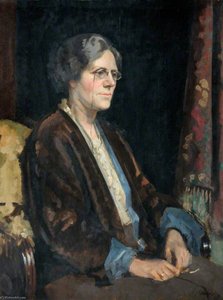
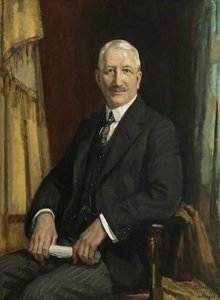
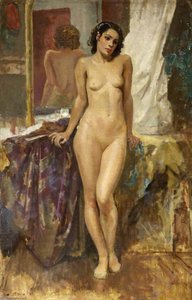
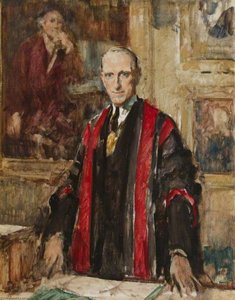
As his career progressed, Hodge’s versatility became his greatest strength. His repertoire expanded to include intimate portraits, such as the introspective Reverie, and graceful studies of movement like Preparation for the Ballet. These works showcase a different facet of his talent: a soft, romantic realism that celebrates the quiet, contemplative moments of life. His technical prowess earned him significant recognition within the British art establishment, marked by several prestigious appointments:
- 1915: Elected to the Royal Society of British Artists
- 1927: Elected member of the Royal Institute of Oil Painters
- 1929: Elected member of the Royal Society of Portrait Painters
- 1931: Elected member of the Royal Institute of Painters in Watercolours
Beyond his individual canvases, Hodge contributed to the public's aesthetic experience through decorative commissions, including notable murals for Bedford Hospital. His membership in the Chelsea Arts Club further cemented his place within the vibrant artistic community of London. When he passed away on February 6, 1949, and was laid to rest in Chelsea’s Brompton Cemetery, he left behind a body of work that remains a vital bridge between the classical traditions of the past and the modern, emotive sensibilities of the twentieth century. His paintings continue to invite viewers into a world where light, shadow, and memory intertwine.
Perguntas e Respostas
Posso estudar o uso de cores de Francis Edwin Hodge em todas as suas obras?
O DNA da Paleta de Francis Edwin Hodge apresenta o perfil cromático da obra do artista.
Como a carreira de Francis Edwin Hodge é dividida em períodos?
A Linha do tempo de Francis Edwin Hodge é uma linha do tempo interativa que apresenta as obras do artista em ordem cronológica, organizadas em capítulos por períodos de sua carreira.
Como posso encontrar todas as obras de Francis Edwin Hodge por técnica?
As obras de Francis Edwin Hodge podem ser exploradas por técnica na página de Por Técnica do artista.