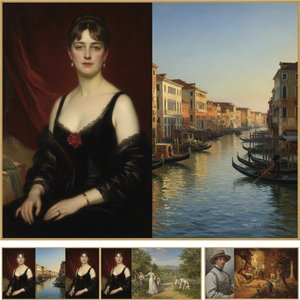
A Legacy of Line and Light: The Dual Artistry of John Burnet
The story of John Burnet is one of remarkable versatility, a narrative that weaves together the structural precision of architecture with the soulful intimacy of portraiture. Born in 1784 in Fisherrow, Edinburgh, Burnet was a man shaped by the disciplined aesthetics of his era. Raised in a household where classical principles were paramount—his father, George Burnet, served as the Surveyor-General of Excise—the young artist was immersed in an environment that valued both order and grandeur. This early exposure to neoclassical ideals provided the foundation for a career that would eventually bridge the gap between the decorative arts of the nineteenth century and the monumental architectural shifts of the Victorian age.
In 1806, driven by a thirst for broader horizons, Burnet relocated to London, a move that would ignite his development as a painter. It was here, amidst the vibrant artistic pulse of the British capital, that he established himself as a portraitist of significant merit. Alongside contemporaries like John Frederick Lewis, Burnet honed a meticulous technique characterized by an extraordinary attention to detail and a profound respect for his subjects. His work during this period often focused on the human condition, particularly through his evocative depictions of the Greenwich Pensioners. These portraits, such as those of Joseph Miller and John Wilkinson, are far more than mere likenesses; they are poignant windows into the lives of the lower classes during the Napoleonic era, rendered with a realism that captures both the dignity of the individual and the weight of their history.
Mastery of the Canvas and the Chiaroscuro Technique
Burnet’s prowess as a painter lay in his ability to manipulate light and shadow to evoke deep emotional resonance. In his oil on canvas works, he masterfully employed chiaroscuro, using dramatic contrasts to create a sense of volume, texture, and atmosphere. This technique allowed him to breathe life into the weathered faces of his subjects, making the wrinkles of age and the folds of worn fabric feel tangibly present to the viewer. His brushwork, while grounded in a disciplined realism, often possessed an impressionistic quality that lent a certain softness and movement to his landscapes and portraits alike.
The significance of his painted works extends beyond their aesthetic beauty; they serve as vital historical documents. Through his eyes, we witness the quiet struggles and the stoic resilience of 19th-century British life. His ability to find grandeur in the ordinary—to elevate a pensioner or a simple landscape into a subject of high art—marked him as a painter of deep empathy. This sensitivity to character and environment ensured that his artistic output remained deeply connected to the social fabric of his time, even as he embraced the more formal academic styles prevalent in London's art circles.
Architectural Grandeur and the Burnet Legacy
While his early fame was rooted in the delicate strokes of a paintbrush, Burnet’s later life saw him become a cornerstone of Scottish architectural history. The transition from the canvas to the construction site was not a departure from art, but rather an expansion of it. As part of the influential firm Burnet & Son, he contributed to a stylistic revolution in Glasgow. This era saw the emergence of what would be known as the "Burnet Baroque"—a bold, expressive architectural language characterized by monumental proportions and intricate ornamentation.
This architectural evolution was marked by several key characteristics:
- Structural Innovation: A fearless embrace of bold lines and massive forms that redefined the Glasgow skyline.
- Eclectic Influence: A sophisticated blending of Neoclassical, Renaissance, and Italianate styles, often infused with an admiration for American architectural grandeur.
- Ornamental Richness: The use of expressive sculptural elements to adorn public landmarks, such as the Glasgow Stock Exchange.
Ultimately, John Burnet’s life represents a rare synthesis of the fine and applied arts. Whether he was capturing the fleeting expression of a pensioner on canvas or designing the enduring stone facades of a growing metropolis, his work remained anchored in a profound respect for structure, detail, and the human experience. His legacy continues to resonate through the historic streets of Glasgow and within the quiet, evocative halls of museums that house his intimate portraits, standing as a testament to a life dedicated to the pursuit of beauty in all its forms.
Perguntas e Respostas
Posso estudar o uso de cores de John Burnet em todas as suas obras?
O DNA da Paleta de John Burnet apresenta o perfil cromático da obra do artista.
Por quais outros nomes ou pseudônimos John Burnet é conhecido?
John Burnet também é conhecido pelos nomes John James Burnet.
Posso explorar as obras de John Burnet por palavra-chave?
Para encontrar obras de John Burnet sobre um tema específico, utilize a página de Por palavras-chave do artista, que agrupa as obras por palavra-chave.