A Victorian Visionary: The Life and Legacy of John Duvall
The canvases of John Duvall (1815–1892) transport the viewer to a bygone era, a world steeped in romanticism and imbued with a profound sense of storytelling. A prominent figure within the nineteenth-century English art scene, Duvall was much more than a mere chronicler of scenes; he was a meticulous narrator who used oil and brush to craft intimate glimpses into rural life, biblical tales rendered with startling realism, and portraits that captured not just likeness but also character and emotion. Born in Margate, Kent, his early years provided the foundation for a career that would eventually see him become a cornerstone of the Suffolk School of painting. While his roots were in Kent, his move to Ipswich by 1852 marked a pivotal chapter in his life, where he established a studio in the Butter Market and became a central figure in the local artistic community, eventually serving as the first chairperson of the Ipswich Fine Art Club.
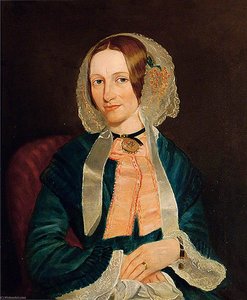
Duvall’s artistic journey was one of remarkable evolution and adaptability. Initially, he found success as a portrait painter, capturing the dignity and essence of his subjects with academic precision. However, as the mid-nineteenth century progressed, the rapid spread of photography began to diminish the demand for traditional portrait commissions. Rather than retreating from the changing tides of art history, Duvall pivoted with grace, redirecting his immense talent toward landscapes, sporting subjects, and rustic scenes. This transition allowed him to explore the burgeoning Romantic movement through a uniquely British lens. His work began to reflect a deep fascination with the natural world, particularly the serene and atmospheric beauty of the Suffolk countryside, where he mastered the ability to render light and color with breathtaking accuracy.
Mastery of Narrative and Nature
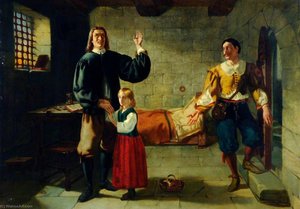
The true brilliance of Duvall’s oeuvre lies in his ability to blend the spiritual with the terrestrial. He possessed a profound engagement with religious themes, frequently revisiting biblical narratives to create works of deep emotional resonance. One of his most celebrated subjects involved recreating scenes from Pilgrim’s Progress, such as his poignant depiction of ‘John Bunyan in Bedford Gaol.’ In these compositions, Duvall utilized the technique of chiaroscuro—the dramatic interplay between light and shadow—to heighten the psychological complexity of his characters. These paintings were not merely illustrations; they were moral meditations designed to provoke spiritual contemplation in the viewer, reflecting the Victorian preoccupation with ethics and faith.
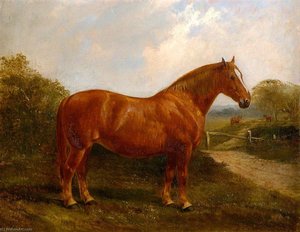
Parallel to his religious dramas was his celebrated mastery of animal portraiture and landscape. Duvall held a particular affinity for horses, a passion that led him to provide illustrations for the Suffolk Horse Society's Stud Book. His equine works, such as ‘Hungerford Mare’ and ‘Leiston,’ showcase an incredible attention to anatomical detail and texture, using impasto techniques to bring the sheen of a chestnut coat or the strength of a dark mane to life. When painting landscapes, he employed atmospheric perspective to create a convincing illusion of depth, allowing the viewer to wander through the misty, tranquil expansions of Stoke Park. His ability to capture the subtle nuances of light—the way it filters through trees or settles upon a stable floor—rendered his landscapes as living, breathing entities.
Historical Significance and Artistic Influence
Though much of his work was overlooked by the broader international art market during his lifetime, John Duvall’s contribution to British art remains significant. He stood at the intersection of several major movements: the meticulous realism of the early nineteenth century and the more expressive, emotionally charged approach of the later Victorian era. His influence can be seen in the way he bridged the gap between high-concept religious narrative and the accessible, grounded beauty of rural life. His legacy is preserved through his exhibitions at prestigious institutions such as:
- The Royal Academy
- The British Institution
- The Royal Society of British Artists
Today, Duvall is remembered as a painter who could find the extraordinary within the ordinary. Whether he was capturing the quiet dignity of a gentleman or the raw power of a working horse, his work remains a testament to the enduring power of narrative art. He transformed the landscapes of Suffolk and the stories of the Bible into a cohesive visual language that continues to captivate those seeking the soul of the Victorian age.
Perguntas e Respostas
Quais cores John Duvall utilizou com mais frequência?
O uso da cor em John Duvall, através das obras listadas em este site, pode ser estudado na página DNA da Paleta do artista.
A qual período histórico pertence a obra de John Duvall?
John Duvall atuou no período 19th Century. Este período situa a atividade do artista na história.
Posso visitar um museu virtual das obras de John Duvall?
É possível fazer uma visita virtual: a página Galeria 3D de John Duvall apresenta as obras do artista em uma galeria tridimensional.