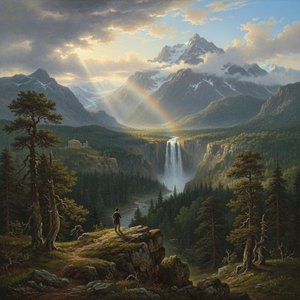
The Painter of Irish Landscapes: The Life and Legacy of Jonathan Fisher
In the golden age of the Enlightenment, as the rugged beauty of the Irish landscape began to capture the romantic imagination of Europe, one artist stood as a primary chronicler of the nation's topographical soul. Jonathan Fisher (c. 1740–1809) was more than a mere illustrator; he was a master of light and atmosphere, an engraver of precision, and a painter whose works served as a visual bridge between the wild reality of Ireland and the burgeoning aesthetic of the sublime. Born in Dublin, Fisher’s life unfolded against the backdrop of a changing Ireland, moving from the bustling streets of Dame Street to the quiet dignity of Bishop Street, all while his eyes remained fixed upon the sweeping vistas of the countryside.
While some historical accounts suggest a formal training in London, the truth of Fisher's development is perhaps even more compelling: he was likely a largely self-taught virtuoso. His early years were marked by a dual existence, working as a linen draper in The Liberties while simultaneously honing his craft with an intensity that earned him prestigious accolades from the Dublin Society. By 1763, his talent for landscape painting had already begun to garner significant premiums, and by 1768, he was recognized for producing the finest original landscapes in oil. This period of rapid ascent saw him become a regular fixture in the exhibitions of the Society of Artists, where his ability to translate the textures of nature onto canvas began to command widespread respect.
Mastery of Technique and the Art of the Engraving
Fisher’s artistic repertoire was remarkably diverse, spanning the delicate nuances of watercolor, the rich depth of oil painting, and the intricate technical demands of aquatint engraving. He possessed a rare sensitivity to the interplay of light and shadow, a quality that allowed him to capture the luminous, often mercurial, weather patterns characteristic of the Irish climate. His technique in watercolor involved the masterful layering of thin, translucent washes, creating a sense of depth and atmospheric perspective that made his landscapes feel alive with moisture and movement.
However, it was through his engravings that Fisher truly achieved widespread renown. He had an extraordinary ability to translate the ephemeral qualities of light into the permanent medium of print. His published series were monumental achievements in 18th-century printmaking:
- Views of Killarney: Published in 1770 and 1789, these works captured the breathtaking scenery of the lakes and mountains, cementing his reputation as a premier landscape artist.
- The Picturesque Tour of Killarney: A set of twenty exquisite engravings dedicated to his patron, the Earl of Portarlington, showcasing a sophisticated use of aquatint.
- Regional Surveys: His expansive documentation of Kilkenny, Cork, Waterford, and Belfast provided much of the era's most detailed visual record of Irish topography.
- Carlingford Lough: Through his sketchbooks and published views, he brought the dramatic coastal scenery of the north to a wider audience in London and beyond.
Historical Significance and Enduring Influence
The significance of Jonathan Fisher extends far beyond the aesthetic pleasure of his works; he was an essential documentarian of a landscape before the heavy hand of industrialization. His meticulous attention to flora, fauna, and topographical accuracy provides modern historians with an invaluable window into the 18th-century Irish environment. Through his patronage and friendship with figures like the Earl of Portarlington, Fisher also navigated the complex social structures of his time, securing a stable life that allowed him to focus on his monumental series of sixty views, a project of immense scale and ambition.
As he reached the twilight of his life, Fisher’s dedication to the craft remained unbroken. Upon his death in 1809, he left his entire collection of art materials to his pupil and assistant, Henry Graham, ensuring that the tools of his trade would continue to inspire future generations. Today, the works of Jonathan Fisher reside in prestigious institutions such as the National Gallery of Ireland and the Ulster Museum, where they continue to evoke the same sense of wonder and reverence that they did two centuries ago. He remains a foundational figure in Irish art, a man who looked upon the hills and lakes of his homeland and saw not just scenery, but a profound, enduring poetry.
Perguntas e Respostas
Posso navegar pelas obras de Jonathan Fisher por paleta de cores?
A página Por paleta de cores agrupa as obras de Jonathan Fisher por suas paletas de cores.
Posso navegar pelas obras de Jonathan Fisher por humor?
A Coleção por Humor de Jonathan Fisher organiza as obras do artista por humor.
Quais cores Jonathan Fisher utilizou com mais frequência?
O DNA da Paleta de Jonathan Fisher apresenta o perfil cromático da obra do artista.