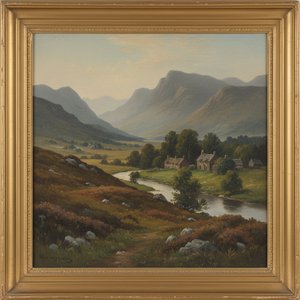
William Watson II (1847-1921): A Pioneer of Scottish Luminism
William Watson II was a British realist painter who achieved international acclaim for his masterful depictions of the Scottish Highlands and rural landscapes, particularly sheep paintings. Born in Edinburgh in 1847, he possessed an unwavering dedication to capturing the essence of the natural world with remarkable precision and sensitivity—a style that would come to define him as one of Scotland’s foremost Luminist artists. His artistic journey began modestly, influenced by the Impressionists' exploration of light and color, yet Watson swiftly developed a distinctive vision rooted in Romantic ideals and informed by meticulous observation.- Early Life & Education: Watson received his initial artistic training at the Slade School of Fine Art in London, where he honed his skills under renowned instructors like Frederic Leighton and Joseph Noel Paton. This formative period instilled in him a disciplined approach to technique and fostered an appreciation for classical composition.
- Scottish Highland Inspiration: Watson’s fascination with Scotland deepened during his travels throughout the Highlands—a region that would become the cornerstone of his artistic output. He was particularly drawn to the rugged beauty of Glen Goil and Glen Fyne, where he tirelessly documented the changing seasons and the daily lives of shepherds tending their flocks.
- Technique & Style: Watson’s signature style is characterized by Luminist principles—a deliberate rejection of Impressionistic brushstrokes in favor of soft, diffused light and atmospheric perspective. He achieved this effect through painstaking layering of thin glazes applied over a carefully prepared underpainting, resulting in canvases imbued with an unparalleled sense of tranquility and realism.
Notable Works & Artistic Achievements
Watson’s oeuvre comprises over 300 paintings—primarily landscapes featuring sheep, cattle, and Highland scenery—that are held in prestigious collections worldwide. Among his most celebrated pieces include “Morning near Oban,” “On The Goil, Glen Goil, Argyllshire,” and “Spring, Glen Fyne.” These works exemplify his ability to convey not merely visual representations but also emotional resonance—capturing the spirit of place and conveying a profound connection with the natural world. His meticulous attention to detail—from the subtle nuances of color to the precise rendering of textures—established him as a benchmark for realism in British painting during the late Victorian era.Influence & Legacy
Watson’s artistic vision profoundly impacted subsequent generations of Scottish painters and cemented his place within the broader Romantic movement. He championed a humanist aesthetic that prioritized observation, empathy, and an honest portrayal of everyday life—values that resonated deeply with contemporaries and continue to inspire artists today. His unwavering commitment to Luminist technique—specifically its ability to evoke mood and atmosphere—established him as a pioneer in capturing the sublime beauty of Scotland’s landscapes. Watson's enduring legacy resides not only in his stunning artworks but also in his contribution to shaping artistic discourse and fostering an appreciation for the power of visual art to communicate profound truths about human experience and our relationship with nature.Recognition & Honors
Watson was recognized as a leading figure within the Scottish Art World, receiving numerous accolades during his lifetime. He served as President of the Royal Scottish Academy from 1906-1908, demonstrating his commitment to artistic excellence and fostering dialogue among fellow artists. His work continues to be studied and admired by scholars and collectors alike—a testament to its enduring beauty and significance within the history of British art.Perguntas e Respostas
Por quais outros nomes William Watson é conhecido(a)?
William Watson também é conhecido pelos nomes William Watson Ii.
Como a carreira de William Watson é dividida em períodos?
Um relato cronológico da obra de William Watson está disponível na página Linha do tempo do artista, onde as obras são apresentadas em ordem de criação, capítulo por capítulo.
De onde é William Watson?
William Watson nasceu em United Kingdom.