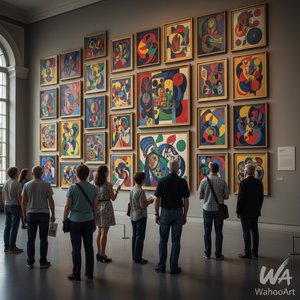
1925. Acrilic pe pânză întinsă, 60.0 x 60.0 cm. Arnold Schönberg Center.

§ 1Catalogue data


§ 2Abstract
Descriere obiect de colecție
Știința jocului și diplomația se îmbină în această creație inovatoare a lui Arnold Schönberg din 1925 – Chess Coalitionă: un simbol al războiului și al negocierilor inteligente.
 Vezi mai mult
Biografie artist
Explorează muzica revoluționară a lui Arnold Schoenberg – atonalitatea, tehnica celor douăsprezece tonuri și influența asupra compozitorilor din secolul XX. Descoperă moștenirea sa la Schönberg Center.
§ 3Commentary
Coalition Chess: A Symphony of Strategy and Diplomacy Embodied in Wood
Arnold Schönberg’s “Coalition Chess,” conceived in the turbulent years following World War I, transcends mere game play; it represents a profound exploration of artistic innovation and intellectual engagement. Created in 1925, this striking wooden chess set stands as a testament to Schönberg's unwavering commitment to challenging conventions and forging new paths within the realm of visual art.
- Overall Impression: The image depicts a meticulously crafted wooden chess set arranged on a stark black and white checkered board. Its composition centers around the chessboard, emphasizing the strategic core of the artwork. Studio lighting casts an even glow across the scene, highlighting the textures and subtle nuances of the wood’s grain – a deliberate choice reflecting Schönberg's fascination with capturing precise detail.
- Style: The piece leans heavily into realism, mirroring Schönberg’s stylistic preferences during this period. Unlike Impressionistic explorations of fleeting moments, “Coalition Chess” strives for an unwavering portrayal of form and materiality, prioritizing accuracy over subjective interpretation.
- Technique: Photographic documentation ensures a faithful representation of the chess set's construction. The technique favors controlled environments, guaranteeing consistency in illumination and minimizing distortion – crucial considerations for presenting artwork with exacting standards.
- Materials: Primarily composed of wood and plastic, “Coalition Chess” utilizes materials chosen to convey both solidity and innovation. The wooden pieces embody tradition and craftsmanship, while the plastic components introduce a contemporary element, symbolizing Schönberg’s willingness to embrace new artistic mediums.
Historical Context: War Anxiety and Artistic Rebellion
Born in Vienna in 1874, Arnold Schönberg emerged as a pivotal figure within the Second Viennese School alongside Alban Berg and Anton Webern. His early works mirrored Brahmsian-Wagnerian influences, yet he swiftly propelled himself toward atonality—a revolutionary departure from tonal harmony that fundamentally altered musical landscape.
The creation of “Coalition Chess” coincided with Schönberg’s decision to resign from the Prussian Academy of Arts due to Nazi persecution. This act underscored his unwavering defiance against ideological constraints and solidified his position as a champion of artistic freedom—a sentiment powerfully reflected in the artwork's conceptual framework.
Symbolism: The Chessboard as Arena for Dialogue
Beyond its aesthetic qualities, “Coalition Chess” operates on multiple symbolic levels. The chessboard itself represents an arena for confrontation and negotiation – mirroring Schönberg’s preoccupation with diplomatic relations during a period marked by political instability.
The chess pieces—representing Yellow, Black, Green, and Red—symbolize military forces alongside the complexities of international alliances. Their arrangement embodies Schönberg's engagement with wartime anxieties and his desire to provoke contemplation about power dynamics and strategic considerations.
Emotional Impact: A Reflection of Artistic Vision
“Coalition Chess”’s subdued palette—primarily black, white, and earthy tones—contributes to its contemplative mood. The artwork invites viewers to engage in a dialogue with Schönberg's artistic sensibilities—a celebration of precision, materiality, and intellectual rigor.
Ultimately, this chess set serves as an enduring emblem of Schönberg’s pioneering spirit—a testament to his ability to transform familiar forms into instruments of profound artistic expression. Its meticulous craftsmanship and conceptual depth continue to inspire admiration among collectors and interior designers alike.
Întrebări și răspunsuri
Din ce curent artistic face parte "Chess Coalitionă" de Arnold Schoenberg?
"Chess Coalitionă" de Arnold Schoenberg face parte din mișcarea Modern Expressionism. Acest curent oferă contextul stilistic al operei.
Cum face "Chess Coalitionă" de Arnold Schoenberg legătura între Modern Expressionism și țara de origine a artistului?
Lucrarea de Modern Expressionism „Chess Coalitionă” a fost creată de un artist născut în Austria.
În ce mișcare și în ce epocă este situată opera "Chess Coalitionă" de Arnold Schoenberg?
"Chess Coalitionă" de Arnold Schoenberg face parte din mișcarea Modern Expressionism, reprezentativă pentru epoca Era modernă a creatorului său.


 Comută pe versiunea Print


 Pentru opere de artă sau reproduceri care depășesc 105 cm (aproximativ 41 de inch) pe oricare dintre laturi, cadrul va fi livrat demontat, sub formă de kit. Această metodă asigură o livrare sigură și previne deteriorarea în timpul transportului.