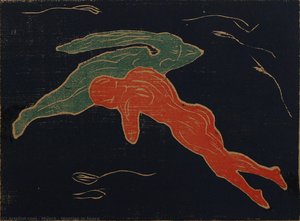
1908. Acrylic On Canvas.

§ 1Catalogue data


§ 2Abstract
Descriere obiect de colecție
This striking black and white drawing portrays Edvard Munch in a moment of profound introspection, utilizing bold charcoal strokes to convey melancholy and anxiety. Inspired by Rembrandt's technique, it embodies Expressionism's focus on emotion over realism.
 Vezi mai mult
Biografie artist
Descoperă universul sumbru și expresiv al lui Edvard Munch! Picturi emblematice precum "Țipătul" explorează anxietatea, moartea și emoțiile umane profunde. O forță a artei moderne!
§ 3Commentary
A Window into Munch’s Soul: Decoding ‘Self-Portrait with Cigarette’
Edvard Munch, a titan of modern art, bequeathed to us not merely images but visceral explorations of the human condition. Born in 1863 amidst the melancholic landscapes of Norway, Munch's artistic legacy rests firmly upon canvases imbued with an unsettling honesty—a willingness to confront anxieties and grapple with mortality head-on. His magnum opus, ‘The Scream,’ solidified his reputation as a prophet of psychological unease, yet ‘Self-Portrait with Cigarette’ (1895), painted during a period of profound personal turmoil, offers an equally compelling glimpse into the artist's inner world—a self-examination rendered in charcoal and graphite that continues to resonate powerfully today.Expressionist Roots: Beyond Realistic Representation
‘Self-Portrait with Cigarette’ exemplifies Expressionism, a movement born from the crucible of late 19th-century Europe. Rejecting Impressionistic pursuit of fleeting beauty, Expressionists sought to convey subjective experience—the raw emotion underlying every moment. Munch achieved this feat not through meticulous detail but through deliberate distortion and bold color choices (though absent here due to its monochrome execution). Thick, gestural lines dominate the composition, mirroring the artist’s agitated state of mind and rejecting the conventions of academic art. This stylistic decision wasn't merely aesthetic; it was a conscious rebellion against societal norms and an assertion of artistic freedom—a desire to communicate feeling above all else.Symbolism Woven into Charcoal Strokes
The artwork’s visual language is laden with symbolism, reflecting Munch’s preoccupation with existential themes. The cigarette itself serves as a potent emblem: representing both physical decay – mirroring the pervasive fear of illness and death – and a deliberate rejection of bourgeois morality. Munch's gaze directly confronts the viewer, fostering an unsettling intimacy that underscores the vulnerability inherent in confronting one’s own demons. The muted blue background amplifies this mood of detachment, creating an atmosphere reminiscent of Rembrandt’s masterful use of chiaroscuro—a technique designed to heighten dramatic effect and illuminate psychological states.A Dialogue with Artistic Giants: Rembrandt's Influence
Munch’s compositional choices echo the stylistic innovations championed by Rembrandt van Rijn, a Dutch Baroque painter who prioritized emotional impact over photographic accuracy. Like Rembrandt, Munch utilizes dramatic lighting – specifically, illumination from below – to sculpt his face and hand against the dark backdrop, drawing attention to these focal points and emphasizing their expressive qualities. This deliberate manipulation of light serves as a testament to Munch’s erudition and his engagement with the artistic heritage of his time—a recognition that true art transcends mere imitation and strives for profound emotional resonance.Legacy: An Image That Still Screams
‘Self-Portrait with Cigarette’ stands as more than just a beautifully executed drawing; it's an enduring symbol of psychological vulnerability and artistic courage. Its influence extends far beyond the Expressionist movement, inspiring artists across generations to explore the complexities of human emotion through unconventional techniques and daring stylistic choices. Today, reproductions of this artwork continue to captivate audiences worldwide—a testament to Munch’s ability to distill profound existential anxieties into a single, unforgettable image—a visual echo of ‘The Scream,’ reminding us that art can illuminate the darkest recesses of our inner selves.Întrebări și răspunsuri
Ce reprezintă "Self-portrait with cigarette" și ce atmosferă transmite?
„Self-portrait with cigarette” surprinde melancholy, anxiety, cigarette, symbolism, introspection, light contrast, norwegian art, având o atmosferă Dramatic.
Cine a creat "Self-portrait with cigarette" și în ce an?
Lucrarea „Self-portrait with cigarette” este creată de Edvard Munch și datează din 1908.
Unde pot vizualiza "Self-portrait with cigarette" de Edvard Munch sub formă de diaporama?
Diaporama pentru "Self-portrait with cigarette" poate fi vizualizată pe pagina Galerie foto a operei de artă.


 Comută pe versiunea Print


 Pentru opere de artă sau reproduceri care depășesc 105 cm (aproximativ 41 de inch) pe oricare dintre laturi, cadrul va fi livrat demontat, sub formă de kit. Această metodă asigură o livrare sigură și previne deteriorarea în timpul transportului.