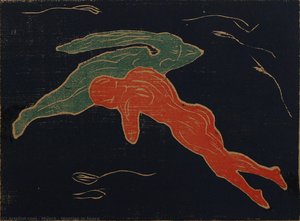
Acrylic On Canvas.

§ 1Catalogue data


§ 2Abstract
Descriere obiect de colecție
Experience Edvard Munch’s ‘Untitled (1334)’ – a haunting portrait reflecting anxiety and introspection. Explore the artist's legacy through a meticulously crafted, hand-painted reproduction.
 Vezi mai mult
Biografie artist
Descoperă universul sumbru și expresiv al lui Edvard Munch! Picturi emblematice precum "Țipătul" explorează anxietatea, moartea și emoțiile umane profunde. O forță a artei moderne!
§ 3Commentary
A Portrait of Unease: Unpacking Edvard Munch’s “Untitled (1334)”
Edvard Munch's "Untitled (1334)," a seemingly simple depiction of a man in formal attire, is far more than a straightforward portrait. It’s a distilled essence of the anxieties and psychological turmoil that defined the artist’s life and, crucially, became the hallmark of Expressionism. Painted around 1908, during a period of intense personal struggle for Munch – marked by recurring bouts of illness and profound grief following the loss of his beloved sister – this work embodies a quiet desperation, a sense of being perpetually on the precipice of something unsettling.
The subject himself is rendered with an almost unnerving stillness. Dressed in the dark formality of a suit and tie, he stands rigidly before a neutral wall, his hands clasped behind him – a posture that simultaneously suggests control and profound restraint. His face, shadowed and partially obscured, bears a severe expression; a subtle downturn of the mouth and a gaze fixed into the distance convey a deep-seated melancholy and perhaps even a hint of suppressed rage. The background is deliberately sparse, devoid of any identifying details, further isolating the figure and amplifying his internal state.
The Language of Color and Form: Munch’s Expressionist Techniques
Munch's masterful use of color and form are central to conveying this emotional weight. While the palette is restrained – primarily consisting of muted browns, grays, and blacks – he employs subtle shifts in tone and texture to create a palpable sense of unease. Notice how the shadows seem to press inward, enveloping the figure and contributing to the overall feeling of confinement. The brushstrokes are loose and agitated, particularly around the face, mirroring the turbulence within the subject’s psyche. This deliberate departure from traditional representational techniques is characteristic of Expressionism – a movement that sought to depict not just what was seen, but what was *felt*.
The composition itself reinforces this sense of psychological tension. The man's verticality contrasts sharply with the horizontal lines of the wall, creating a visual imbalance that mirrors the internal conflict he embodies. Furthermore, the inclusion of two indistinct figures in the background – partially obscured and offering no clear connection to the central subject – adds another layer of ambiguity and reinforces the feeling of isolation.
Symbolism and the Echoes of Munch’s Life
To fully appreciate “Untitled (1334),” it's essential to consider the context of Edvard Munch’s life. His early childhood was profoundly shaped by illness and loss, experiences that would continue to haunt him throughout his career. The recurring themes of death, sickness, anxiety, and love permeate his work, often expressed through distorted forms, jarring colors, and emotionally charged imagery. The umbrella in the background, a common motif in Munch’s oeuvre, can be interpreted as a symbol of protection – or perhaps, ironically, of concealment, shielding the man from an unseen threat.
Interestingly, this painting shares stylistic similarities with Munch's earlier work, particularly his series of "The Sick Child" paintings. The pervasive sense of dread and vulnerability is strikingly consistent across these works, demonstrating a deeply ingrained preoccupation with mortality and human suffering. It’s a testament to Munch’s ability to translate intensely personal experiences into universally resonant symbols.
A Window into the Soul: Reproductions and Artistic Legacy
"Untitled (1334)" remains one of Edvard Munch's most compelling and emotionally charged works, offering a profound glimpse into the artist’s troubled psyche. AllPaintingsStore is proud to offer meticulously crafted hand-painted reproductions that faithfully capture the nuances of this iconic painting. These reproductions not only preserve the artistic integrity of the original but also allow viewers to experience the work’s evocative power in a tangible way. Whether you are an art enthusiast, collector, or simply seeking a piece of art that speaks to the complexities of the human condition, a reproduction of “Untitled (1334)” is sure to captivate and resonate.
Explore more works by Edvard Munch on our website: Edvard Munch’s Artist Page
Întrebări și răspunsuri
Sub ce alte nume sau pseudonime este cunoscut Edvard Munch?
Alte nume înregistrate pentru Edvard Munch, creatorul operei „untitled (1334)”, includ Munch.
În ce măsură subiectul operei „untitled (1334)” se regăsește în temele obișnuite ale lui Edvard Munch?
"untitled (1334)" înfățișează man, suit, tie, wall, reflection, seriousness, contemplation, umbrella, în timp ce temele recurente ale lui Edvard Munch sunt anxiety, mortality, psychological distress, nordic melancholy, existential themes, symbolism, personal trauma reflection, expressionist distortion. Compararea celor două relevă modul în care această lucrare se raportează la subiectele obișnuite ale artistului.
Ce stare și ce emoție se regăsesc în "untitled (1334)"?
Starea de spirit surprinsă în "untitled (1334)" de Edvard Munch este Dramatic, iar tonul său emoțional este Melancholic.


 Comută pe versiunea Print


 Pentru opere de artă sau reproduceri care depășesc 105 cm (aproximativ 41 de inch) pe oricare dintre laturi, cadrul va fi livrat demontat, sub formă de kit. Această metodă asigură o livrare sigură și previne deteriorarea în timpul transportului.