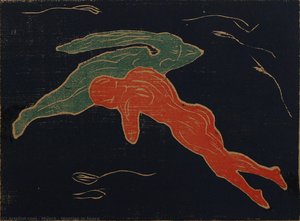
Oil On Canvas.

§ 1Date catalog

§ 2Abstract
Descriere obiect de colecție
Explore Edvard Munch’s "untitled (6704)", a serene coastal landscape in an Impressionistic style. Discover its melancholic beauty & symbolic depth – a key piece of Norwegian art history.
 Vezi mai mult
Biografie artist
Descoperă universul sumbru și expresiv al lui Edvard Munch! Picturi emblematice precum "Țipătul" explorează anxietatea, moartea și emoțiile umane profunde. O forță a artei moderne!
§ 3Comentariu
A Coastal Reverie: Exploring Munch’s Untamed Landscape
This evocative landscape by Edvard Munch transports us to a serene yet melancholic coastal scene, likely captured during the fleeting moments of dusk or dawn. The artwork presents a sweeping vista – an elevated viewpoint overlooking a tranquil sea dotted with distant islands. It's a composition built on contrasts: the strong horizontals of water and land are punctuated by the verticality of trees and foliage, creating a dynamic tension within the peaceful setting.Impressionistic Echoes & Expressionist Roots
The painting’s style resides comfortably between Impressionism and Post-Impressionism, leaning heavily towards the emotional intensity that would come to define Munch's signature *Expressionism*. Loose, expressive brushstrokes dominate, eschewing precise realism in favor of capturing a feeling – an atmosphere. Shapes are organic, mirroring the natural world, and texture is richly apparent through visible paint application. The flattened perspective and atmospheric perspective (where distant objects appear paler and less defined) contribute to a dreamlike quality, inviting contemplation rather than literal interpretation.A Palette of Mood & Atmosphere
Munch masterfully employs a cool color palette – blues, purples, and greens – to establish the painting’s mood. These hues evoke serenity but also carry an undercurrent of melancholy. The diffused lighting, typical of twilight, casts soft shadows and subtly highlights the contours of the landscape. This technique enhances the sense of tranquility while simultaneously hinting at a deeper emotional resonance. The wet-on-wet technique is evident in the blending of colors, creating seamless transitions that further soften the scene.Munch’s Life & The Language of Landscape
To understand this work fully, it's crucial to consider Edvard Munch’s biography. Born into a world marked by loss and familial illness (his mother and sister both succumbed to tuberculosis), Munch grappled with themes of mortality, anxiety, and psychological distress throughout his life. While not overtly depicting these struggles here, the landscape itself becomes a vessel for them. The vastness of nature can be interpreted as reflecting the immensity of human emotion, while the solitude of the scene evokes feelings of isolation and contemplation – emotions deeply familiar to Munch’s own experience. His early exposure to nihilist philosophy encouraged him to express inner turmoil through art, rejecting academic conventions.Symbolism & Emotional Resonance
Beyond its aesthetic qualities, this painting resonates with symbolic weight. The coastal setting often represents the boundary between the known and the unknown, life and death – themes central to Munch’s oeuvre. The tranquil scene can be seen as a yearning for peace amidst inner turmoil, or perhaps a poignant acceptance of solitude. It's a landscape that doesn’t simply depict a place; it *feels* like a state of mind.Collecting & Interior Design Considerations
A reproduction of this artwork would be a stunning addition to any collection, particularly for those drawn to emotionally resonant landscapes. Its cool palette and atmospheric quality make it exceptionally versatile in interior design. It would complement spaces aiming for a calming, contemplative atmosphere – bedrooms, libraries, or living rooms with neutral color schemes. The painting’s subtle drama also lends itself well to modern interiors seeking a touch of artistic depth and sophistication. Consider pairing it with natural materials like wood and stone to enhance the connection to its coastal subject matter.Întrebări și răspunsuri
Cum se încadrează „untitled (6704)” în temele și stilul lui Edvard Munch?
„untitled (6704)” împarte cu celelalte opere ale lui Edvard Munch stilul Post-Impressionism și temele recurente: expressionist anxiety, symbolic landscape", nostalgia & solitude, psychological depth, scandinavian moods, precursor to scream, exploring inner turmoil.
Care este dimensiunea și orientarea recomandate pentru printarea lucrării „untitled (6704)”?
Dimensiunea Large, orientarea Landscape: aceasta este configurația de imprimare recomandată pentru "untitled (6704)" de Edvard Munch.
Unde pot vedea o previzualizare a unei reproduceri a operei "untitled (6704)" de Edvard Munch?
Pagina de Previzualizare în spațiu pentru „untitled (6704)” vă permite să vizualizați opera de artă înainte de a comanda.


 Comută pe versiunea Print


 Pentru opere de artă sau reproduceri care depășesc 105 cm (aproximativ 41 de inch) pe oricare dintre laturi, cadrul va fi livrat demontat, sub formă de kit. Această metodă asigură o livrare sigură și previne deteriorarea în timpul transportului.