Garanție de rambursare în 100 de zile Livrare gratuită în toată lumea
449.587opere de artă 30.613artişti 4.660muzee 32limbi
Monedă
    Limba
      Atelier · Est. 2015 · Paris, Franța
      AllPaintingsStore
      allpaintingsstore.com
      Catalogue entry

      untitled (9656)

      Acrylic On Canvas.

      Fig. 1. Egon Schiele, untitled (9656). Shown as the reproduction you are specifying: , .

      § 1Catalogue data

      § 2Abstract

      Descriere obiect de colecție

      Explore Egon Schiele’s "untitled (9656)", a provocative ink drawing embodying Expressionism's raw emotion & dynamic lines. Discover this unique piece & Schiele’s legacy.

      Biografie artist

      Descoperă arta expresionistă intensă a lui Egon Schiele (1890-1918): portrete puternice, teme psihologice și linii unice. Descoperiți reproducerile acum!

      § 3Commentary

      A Study in Sensuality and Line: Exploring Egon Schiele’s Untitled Figure

      This captivating work by Egon Schiele is a prime example of his distinctive style – a potent blend of Art Nouveau's flowing lines with the raw emotionality that foreshadowed Expressionism. Executed with striking confidence, this untitled piece (9656) presents a female nude not as an idealized form, but as a powerfully present and psychologically charged figure.

      Subject & Composition

      The composition focuses intently on the torso and legs of the subject, emphasizing the curves of the body through dynamic posing. It’s a deliberate cropping that heightens the intimacy and immediacy of the image. The pose itself is provocative, suggesting both vulnerability and defiance – a recurring theme in Schiele's oeuvre. Rather than aiming for anatomical precision, Schiele prioritizes capturing the *feeling* of the form, resulting in an intentionally distorted yet compelling representation.

      Style & Technique

      Schiele’s masterful use of black ink against a pale yellow/cream background creates a dramatic contrast that accentuates the figure's contours. The lines are not merely outlines; they *are* the form, fluid and gestural, conveying movement and energy. Varying line weights and hatching techniques build depth and texture, adding visual interest despite the overall flatness of perspective. The technique suggests a rapid execution, almost as if Schiele were compelled to capture the image directly from his inner vision. It’s likely watercolor washes subtly enhance the shading and tonal variations within the ink drawing.

      Historical Context & Influences

      Born in 1890, Schiele lived a tragically short life but left an indelible mark on early 20th-century art. He was part of a generation grappling with societal upheaval and exploring new modes of expression. Influenced by Gustav Klimt – whom he initially met as a student – Schiele quickly developed his own unique voice, pushing boundaries further into psychological territory. His work often courted controversy due to its frank depiction of sexuality and the human body, challenging conventional artistic norms. He was associated with the Vienna Secession movement, which rejected academic traditions in favor of experimentation.

      Symbolism & Emotional Impact

      While not overtly symbolic, the artwork’s emotional resonance is undeniable. The subject's gaze (implied, though her face isn’t fully visible) and body language suggest a complex inner life – perhaps one of longing, vulnerability, or even rebellion. Schiele was deeply interested in exploring the psychological state of his subjects, and this piece embodies that fascination. The work evokes a sense of raw honesty and emotional intensity, inviting viewers to contemplate the complexities of human experience.

      Collecting & Interior Design

      A reproduction of this artwork would be a striking addition to any collection focused on Expressionism or early 20th-century art. Its bold lines and dramatic contrast make it a visually arresting piece that can serve as a focal point in a variety of interior design schemes. It pairs well with minimalist décor, providing a powerful counterpoint to clean lines and neutral palettes. Alternatively, it complements more eclectic spaces, adding depth and sophistication. The artwork’s intimate scale makes it suitable for smaller rooms or as part of a gallery wall arrangement.

      Further Exploration

      • Explore other works by Egon Schiele to understand the breadth of his artistic vision.
      • Investigate the Vienna Secession movement and its impact on Austrian art.
      • Consider artists like Broncia Koller-Pinell and Heinrich Böhler, contemporaries who shared similar stylistic concerns.
      • Visit museums such as the Leopold Museum in Vienna or the Egon Schiele Art Centrum in Český Krumlov to experience his work firsthand.

      Întrebări și răspunsuri

      "untitled (9656)" de Egon Schiele este o compoziție de tip portret, peisaj sau pătrată?

      "untitled (9656)" de Egon Schiele are un format Landscape. Formatul descrie proporțiile compoziției.

      În ce încăpere din casă s-ar potrivi o reproducere a operei "untitled (9656)"?

      O reproducere a „untitled (9656)” se potrivește de minune într-un Living Room.

      Din ce țară provine lucrarea de Expressionism „untitled (9656)”?

      "untitled (9656)" a fost creat de Egon Schiele, născut în Austria, în cadrul mișcării Expressionism. Originea artistului leagă această operă de Expressionism, așa cum este practicat de artiștii din Austria.
      § 4The artist

      Egon Schiele

      Egon Schiele

      1890 - 1918, Austria

      Quick facts about Egon Schiele

      • Artistic Movement Or Style: Expressionism
      • Artists Or Movements Influenced By This Artist: ['Secession']
      • Artists Who Influenced This Artist: ['Klimt']
      • Date Of Birth: 1890
      • Date Of Death: 1918
      • Full Name: Egon Schiele
      • Nationality: Austrian
      • Notable Artworks:
        • Self-Portrait
        • Couple
        • Peisaj
      • Place Of Birth: Tulln, Austria

      Biografie artist

      A Life Forged in Expression

      Egon Schiele’s life, a whirlwind of artistic passion and profound personal hardship, unfolded from his birth in Tulln an der Donau, Austria, in 1890. His early years were steeped in sorrow; the loss of his father, a railway station master, due to syphilis when Egon was just fourteen cast a long shadow, fueling within him a haunting preoccupation with mortality and the fragility of human existence. Raised initially by his mother and later under the watchful eye of his uncle Leopold Czihaczek, Schiele’s childhood lacked the stability common to many, yet it fostered an independent spirit—a crucial element in shaping his artistic vision. From a young age, he displayed an intense fascination with trains – a motif that would subtly reappear throughout his work – and a burgeoning talent for drawing, though this was often met with disapproval from his father who viewed it as a distraction from more practical pursuits. The untimely death of his sister Elvira further deepened the emotional landscape of his youth, imbuing his art with an undercurrent of melancholy and vulnerability. These formative experiences—loss, isolation, and a yearning for self-expression—became the bedrock upon which Schiele’s unique artistic voice was built, constantly grappling with themes of life, death, and the complexities of the human condition.

      The Crucible of Vienna: Artistic Development

      Schiele's formal artistic training began at the Kunstgewerbeschule (School of Arts and Crafts) in Vienna, but he quickly found himself stifled by its conservative approach—a rigid adherence to tradition that clashed with his burgeoning creative spirit. Seeking a more stimulating environment, he transferred to the Akademie der bildenden Künste (Academy of Fine Arts), only to discover further disillusionment with its academic constraints. This dissatisfaction led him to abandon formal training altogether, choosing instead to forge his own path – a bold decision reflecting his unwavering artistic conviction and determination to express himself on his own terms. A pivotal influence during these early years was Gustav Klimt, the celebrated Secessionist painter. Schiele deeply admired Klimt’s decorative style and his exploration of symbolism, even receiving mentorship from the established artist. However, Schiele soon diverged significantly from Klimt's aesthetic, developing a distinctly individual voice characterized by its stark honesty, psychological intensity, and unflinching portrayal of human vulnerability. He became a founding member of the *Neues Wiener Kunstgruppe* (New Viennese Art Group) in 1909, alongside other progressive artists who challenged the prevailing artistic norms of the time. This group provided a space for experimentation and innovation, allowing Schiele to refine his style and explore new avenues of expression. His early works—often unsettling portraits and self-portraits—began to emerge as powerful statements of emotional turmoil, featuring distorted figures, elongated limbs, and a palpable sense of unease. These paintings were not merely representations of physical form but explorations of the inner landscape—the anxieties, desires, and fears that haunted the human psyche. He sought to depict not what he *saw*, but what he *felt*.

      Raw Emotion and Unflinching Truth

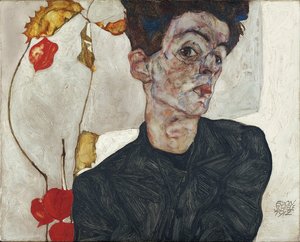
      Egon Schiele’s art is immediately recognizable for its raw honesty and psychological depth. He fearlessly confronted themes often considered taboo – sexuality, death, anxiety, isolation – with an unflinching gaze. His distinctive style features elongated figures, contorted poses, and expressive lines that convey a sense of unease and emotional intensity. The human form, particularly the nude, became his primary subject, not as an object of idealized beauty but as a vessel for exploring the complexities of human experience. Self-portraits constitute a significant portion of his oeuvre, offering intimate glimpses into his inner world—a world often marked by loneliness and self-doubt. He didn’t shy away from depicting himself in unflattering or vulnerable poses, revealing a profound level of self-awareness and introspection. Beyond self-portraiture, Schiele created numerous portraits of others, capturing their likenesses with an unsettling realism that seemed to penetrate beneath the surface. His landscapes, while less central to his work than his figurative paintings, demonstrate his mastery of form and color, often reflecting the same emotional intensity as his portraits. The use of line is particularly striking in Schiele’s work; it's not merely a tool for defining shape but an expressive force that conveys emotion and psychological tension. Recurring motifs like the *Physalis* plant – symbolizing death and transience with its delicate, papery husk – further underscore this preoccupation with mortality. The influence of Symbolism is also evident in his use of color and symbolism, adding layers of meaning to his compositions.

      A Legacy Cut Short: Achievements & Significance

      Despite facing censorship and legal challenges—including a brief imprisonment for allegedly corrupting minors with his art—Schiele gained recognition within Vienna’s avant-garde circles. His work challenged the conventions of the time, provoking both admiration and outrage. By the time of his untimely death during the Spanish flu pandemic in 1918 at the age of twenty-eight, he had established himself as a leading figure in Austrian Expressionism. Significant works such as *Self-Portrait with Physalis*, *Couple Embracing*, and *Field Landscape (Kreuzberg near Krumau)* stand as testaments to his artistic genius. His influence on subsequent generations of artists is undeniable, particularly those interested in exploring psychological themes and challenging conventional artistic norms. Schiele’s bold approach to form and subject matter continues to resonate with audiences today, making him one of the most important and influential figures in early 20th-century art. His paintings are now held in major museum collections worldwide, including the Leopold Museum in Vienna and the Egon Schiele Art Centrum in Český Krumlov, ensuring his artistic legacy endures. He left behind a body of work that is not merely aesthetically compelling but profoundly human—a testament to the power of art to confront the complexities of existence with honesty, courage, and unwavering vision.
      • Key Themes: Mortality, sexuality, isolation, psychological turmoil.
      • Influences: Gustav Klimt, Viennese Secession, personal trauma.
      • Style Characteristics: Elongated figures, contorted poses, expressive lines, raw emotion.

      § 5Comparanda

      § 6Questions

      Informații rapide

      • notable elements: provocative pose, dynamic stance, strong contrast
      • dimensions: Unknown
      • style: expressive, gestural, curvilinear
      • medium: ink drawing, possibly watercolor washes

      Test de cunoștințe despre artă

      Fiecare întrebare are un singur răspuns corect.

      Întrebare 1:
      Egon Schiele is most closely associated with which artistic movements?
      Întrebare 2:
      What is the primary medium used in 'untitled (9656)'?
      Întrebare 3:
      The composition of 'untitled (9656)' emphasizes which aspect of the figure?
      Întrebare 4:
      What kind of contrast is created in 'untitled (9656)'?
      Întrebare 5:
      The lines used in this artwork are best described as…

      § 7Cite this entry

      AllPaintingsStore.com, “Egon Schiele, untitled (9656)”, https://allpaintingsstore.com/ro/art/egon-schiele-untitled-9656-9GEUCW-en/ArtistReproduction/ (accessed 1 Octombrie 2026).

      § 8The reproduction

      Reproducere pictată manual în ulei

      Pictură în ulei pe pânză, pictată manual de artiștii noștri la dimensiunea și ramele dorite de dumneavoastră, pe comandă. ( Comută pe versiunea Print Comută pe Imagine Digitală)

      It is specified on the order sheet in the margin; the present state of that sheet reads as follows.

      untitled (9656)

      Tehnică de reproducere

      Dimensiune reproducere

      -

      Selecție de artiști de elită

      Mai multe detalii, rafinament și timp suplimentar de execuție

      -

      Ramă pentru reproducere artistică

      -

      -

      Pentru opere de artă sau reproduceri care depășesc 105 cm (aproximativ 41 de inch) pe oricare dintre laturi, cadrul va fi livrat demontat, sub formă de kit. Această metodă asigură o livrare sigură și previne deteriorarea în timpul transportului.

      Este necesară asamblarea profesională – acest produs nu este de tip DIY (de făcut singur).
      Kitul trebuie asamblat, iar pânza întinsă, de către un legător de cadre experimentat, utilizând adeziv pentru lemn (neinclus în colet), o cheie pentru întinderea pânzei și cleme pentru a menține barele la unghi drept în timp ce adezivul se usucă. Asamblarea incorectă sau tensiunea neuniformă a pânzei pot deteriora permanent opera de artă și nu sunt acoperite de garanția noastră.

      • Toate barele din lemn masiv sunt incluse, tăiate cu precizie la dimensiunea necesară.

      • Asamblat cu șuruburile incluse, plus adeziv pentru lemn pentru îmbinările de colț, care nu este furnizat și trebuie achiziționat de către tâmplarul dumneavoastră.

      • Sunt necesare unelte profesionale care nu sunt incluse: o șipte de întindere a pânzei (tensionator) și cleme pentru a menține barele la unghi drept în timp ce adezivul se usucă.

      Important:
      Îmbinările de colț necesită adeziv pentru lemn, barele trebuie fixate cu clești de strângere până când adezivul este complet uscat, iar întinderea pânzei pe cadrul asamblat necesită un clește pentru întins pânza. Niciunul dintre aceste elemente nu este inclus în kit. Vă rugăm să consultați un încadrator profesionist cu experiență înainte de a comanda această dimensiune.

      Etichetă de prezentare

      -

      -

      Lac de protecție

      Lac lucios (intensifică nuanțele și oferă protecție împotriva luminii și a umidității)

      -

      Personalizează opera mea de artă

      Exemple de elemente ce pot fi personalizate: Înlocuirea feței cu fotografia clientului; Adăugarea unui animal de companie (de exemplu, înlocuirea unei pisici cu un câine); Includerea unui mesaj ascuns în fundal; Modificarea peisajului sau a elementelor din fundal.

      -

      Livrare rapidă

      Livrare la nivel mondial () în 3-4 săptămâni, în loc de cele 5 săptămâni standard. (29 Octombrie). Fără compromisuri când vine vorba de calitate.

      -

      Livrare rapidă

      Livrare la nivel mondial () în 5 săptămâni. (5 Noiembrie).

      Inclus

      Preț total calculat

      lei 1200

      Included with every order

      • Livrare expres gratuită la nivel mondial
      • Pânză de in de înaltă calitate
      • Asigurare completă pentru transport
      • Garanție de rambursare a taxelor vamale
      • Garanția fidelității culorilor
      • Politica de retur în 100 de zile (doar pentru defecte de fabricație)
      • Garanție de rambursare 100%
      • Ofertă pentru comenzi multiple
      Order sheet