Garanție de rambursare în 100 de zile Livrare gratuită în toată lumea
449.587opere de artă 30.613artişti 4.660muzee 32limbi
Monedă
    Limba
      Atelier · Est. 2015 · Paris, Franța
      AllPaintingsStore
      allpaintingsstore.com
      Catalogue entry

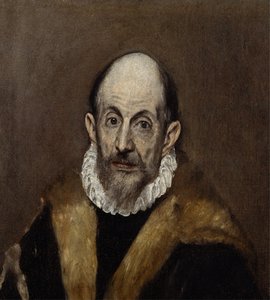
      Elderly Gentleman

      Acrylic On Canvas.

      Fig. 1. El Greco, Elderly Gentleman. Shown as the reproduction you are specifying: , .

      § 1Catalogue data

      § 2Abstract

      Descriere obiect de colecție

      Delve into El Greco's masterful portrait of an elderly man—a poignant exploration of spirituality and human dignity captured in muted tones and elongated forms, housed at Museo del Prado.

      Biografie artist

      În ulei pe pânză, pictură impresionistă inspirată de sculptura greacă Laocoön și Fiilor săi. El Greco surprinde dramatismul sfârșitului său în Toledo.

      § 3Commentary

      Introduction to the Artist and Painting

      El Greco (Doménikos Theotokopoulos) was a renowned Spanish artist who played a significant role in the Spanish Renaissance. His unique style, which blended elements of Byzantine, Venetian, and Spanish art, is exemplified in his painting The Elderly Gentleman. This oil on canvas work, created in the 1590s, showcases El Greco's mastery of color, light, and composition.

      The Painting's Details and Style

      The Elderly Gentleman is a portrait of an elderly man with white hair and a beard, presented simply against a grey background. The sitter looks directly at the spectator, engaging the viewer in a sense of intimacy. The painting's style is characteristic of Mannerism, an artistic movement that emphasized elegance, intellectual complexity, and artificiality. El Greco's use of elongated forms, exaggerated emotions, and unrealistic colors creates a visually captivating composition.

      Significance in Art History

      The Elderly Gentleman is considered one of El Greco's most important works, showcasing his unique style and contribution to the Spanish Renaissance. The painting is housed at the Museo del Prado in Madrid, where it remains a popular attraction for art enthusiasts. To learn more about El Greco and his works, visit https://AllPaintingsStore.com.

      Discover More Masterpieces at AllPaintingsStore.com

      At AllPaintingsStore.com, we offer a wide range of high-quality handmade oil painting reproductions, including works by El Greco and other renowned artists. Explore our collection to find the perfect piece for your home or office.
      To learn more about the artist and his style, visit El Greco's page on AllPaintingsStore.com or the Wikipedia page on El Greco.

      Întrebări și răspunsuri

      Cum este descrisă atmosfera din "Elderly Gentleman" de El Greco?

      "Elderly Gentleman" de El Greco este descris prin atmosfera sa Elegant. Această clasificare poate ajuta la integrarea lucrării într-un anumit decor.

      Din ce stil face parte "Elderly Gentleman"?

      "Elderly Gentleman" de El Greco face parte din mișcarea Mannerism. Acest curent oferă contextul stilistic al operei.

      Care sunt culorile dominante în "Elderly Gentleman" de El Greco?

      „Elderly Gentleman” este definit de o paletă Earthy, dominată de culoarea Phthalo Green (#2d1b1c).
      § 4The artist

      El Greco

      El Greco

      1541 - 1614, Grecia

      Quick facts about El Greco

      • Artistic Movement Or Style: Mannerism, Barroco
      • Artists Who Influenced This Artist:
        • Tiziano
        • Tintoretto
      • Date Of Birth: 1541
      • Full Name: Doménikos Theotokópoulos
      • Nationality: Greacă-Spaniolă
      • Notable Artworks:
        • El Espolio
        • St. Sebastian
        • Burial of the Count of Orgaz
        • View of Toledo
      • Place Of Birth: Crete, Grecia

      Biografie artist

      Doménikos Theotokópoulos, called El Greco

      Doménikos Theotokópoulos, known to the world as El Greco – “the Greek” – was a painter whose life and work defied easy categorization. Born in 1541 on the island of Crete, then under Venetian rule, his artistic journey led him through Venice and Rome before finding its ultimate expression in the spiritual heartland of Spain: Toledo. El Greco wasn’t merely a product of these places; he synthesized their influences into something wholly unique, a style that anticipated the emotional intensity of Expressionism and the fragmented forms of Cubism centuries later. His early training within the Byzantine tradition instilled in him a meticulous attention to detail and a profound understanding of religious iconography. This foundation, however, wouldn’t confine him. He signed his works in Greek, often appending “Krḗs” – Cretan – as a proud declaration of his origins, even as he ventured into new artistic territories. The seeds of his distinctive style were sown not just in technique but also in the fervent religious climate of his homeland and the rich tapestry of Venetian art.

      Early Life and Artistic Training

      Little is known about Doménikos’s formative years. Records indicate that he was born in Fodele (or Candia), Crete, to a family of merchants—a fact confirmed by documents from 1566 where he appeared as “Maestrul Menegos Theotokopoulos” and with the word Κρής (“Cretan”) appended to his name. This deliberate assertion of Cretan identity speaks volumes about his sense of heritage and his desire to establish himself within the artistic traditions of Byzantium. His father, Nikolaos Zacharias Theotokópoulos, was a wealthy trader who instilled in Doménikos a love for learning and an appreciation for humanist ideals—values that would profoundly shape his intellectual development. Despite the prevailing Venetian dominance on Crete at the time, El Greco’s upbringing fostered a connection to Orthodox Christianity and Byzantine art, which served as crucial influences on his artistic vision. He began his formal training in Crete under Antonios Pizzorusso, a Venetian painter who taught him perspective and anatomical drawing—skills essential for mastering Western Renaissance techniques.

      Venetian Influence: Embracing Innovation

      Around 1567, Doménikos embarked on a transformative journey to Venice, the epicenter of artistic innovation during the Renaissance. Immediately immersing himself in the vibrant atmosphere of the Venetian Republic, he studied the masterpieces of Titian, Tintoretto, and Veronese—artists who had revolutionized painting with their mastery of color, composition, and dramatic lighting. He absorbed their techniques, experimenting with looser brushwork and embracing the sensual qualities of oil paint. This Venetian influence is vividly apparent in his early works, such as *Saint Sebastian* (1600), where anatomical detail blends seamlessly with an almost theatrical use of light and shadow—a stylistic hallmark that would characterize much of his oeuvre. He skillfully incorporated Venetian compositional principles into his paintings, creating dynamic scenes filled with movement and emotion. Furthermore, he honed his skills in fresco painting, a technique favored by Venetian artists for decorating churches and palaces.

      Rome: Mannerism and Artistic Challenges

      In 1570, Doménikos moved to Rome—a city teeming with artistic ambition and competition—where he established a workshop and executed a series of commissions. During his stay in Italy, he encountered the stylistic currents of Mannerism, spearheaded by artists like Parmigianino and Bronzino. Mannerist painters rejected the idealized beauty of High Renaissance art, favoring elongated figures, distorted perspectives, and sophisticated compositions that prioritized intellectual contemplation over emotional expression. While Doménikos demonstrated considerable talent within this challenging aesthetic framework, he struggled to gain widespread recognition in Rome’s competitive artistic milieu—a fact exacerbated by his inability to secure patronage from influential papal circles. Despite these difficulties, he continued to refine his technique and explore new stylistic ideas, absorbing influences from various artists and traditions.

      Toledo: Spiritual Synthesis and Artistic Legacy

      By 1577, Doménikos settled in Toledo—a city steeped in religious fervor during the Counter-Reformation—where he received major commissions from churches and monasteries and produced his most celebrated paintings. The atmosphere of Toledo—characterized by austere piety and a fervent devotion to Catholicism—provided an ideal backdrop for El Greco’s artistic explorations. He created monumental altarpieces that conveyed profound spiritual emotion, employing dramatic lighting and expressive figures to communicate the mysteries of faith. His masterpiece, *The Burial of the Count of Orgaz* (1586-1588), exemplifies his stylistic synthesis—combining Byzantine influences with Venetian techniques and Mannerist distortions—resulting in a work of unparalleled grandeur and emotional intensity. El Greco’s distinctive style—characterized by elongated figures, intense emotion, and dramatic lighting—became a precursor to Expressionism and Cubism, influencing generations of artists who sought to convey psychological depth and visual dynamism. His legacy endures as one of the most important figures in Western art history—a visionary painter whose work continues to inspire awe and contemplation centuries after his death in 1614.

      § 5Comparanda

      § 6Questions

      Informații rapide

      • Title: The Elderly Gentleman
      • Notable elements or techniques: Elongated forms; exaggerated emotions
      • Artist: El Greco
      • Influences: Byzantine art"; "Venetian painting
      • Artistic style: Symbolic; Intense color palette

      Test de cunoștințe despre artă

      Fiecare întrebare are un singur răspuns corect.

      Întrebare 1:
      What artistic movement is El Greco’s ‘The Elderly Gentleman’ primarily associated with?
      Întrebare 2:
      Which element contributes to the painting's atmosphere of intimacy and engagement?
      Întrebare 3:
      Where is ‘The Elderly Gentleman’ currently housed?
      Întrebare 4:
      What technique characterizes El Greco's style, evident in elongated forms and exaggerated emotions?
      Întrebare 5:
      The painting’s background depicts what setting?

      § 7Cite this entry

      AllPaintingsStore.com, “El Greco, Elderly Gentleman”, https://allpaintingsstore.com/ro/art/el-greco-elderly-gentleman-85FR9G-en/ArtistReproduction/ (accessed 1 Octombrie 2026).

      § 8The reproduction

      Reproducere pictată manual în ulei

      Pictură în ulei pe pânză, pictată manual de artiștii noștri la dimensiunea și ramele dorite de dumneavoastră, pe comandă. ( Comută pe versiunea Print Comută pe Imagine Digitală)

      It is specified on the order sheet in the margin; the present state of that sheet reads as follows.

      Elderly Gentleman

      Tehnică de reproducere

      Dimensiune reproducere

      -

      Selecție de artiști de elită

      Mai multe detalii, rafinament și timp suplimentar de execuție

      -

      Ramă pentru reproducere artistică

      -

      -

      Pentru opere de artă sau reproduceri care depășesc 105 cm (aproximativ 41 de inch) pe oricare dintre laturi, cadrul va fi livrat demontat, sub formă de kit. Această metodă asigură o livrare sigură și previne deteriorarea în timpul transportului.

      Este necesară asamblarea profesională – acest produs nu este de tip DIY (de făcut singur).
      Kitul trebuie asamblat, iar pânza întinsă, de către un legător de cadre experimentat, utilizând adeziv pentru lemn (neinclus în colet), o cheie pentru întinderea pânzei și cleme pentru a menține barele la unghi drept în timp ce adezivul se usucă. Asamblarea incorectă sau tensiunea neuniformă a pânzei pot deteriora permanent opera de artă și nu sunt acoperite de garanția noastră.

      • Toate barele din lemn masiv sunt incluse, tăiate cu precizie la dimensiunea necesară.

      • Asamblat cu șuruburile incluse, plus adeziv pentru lemn pentru îmbinările de colț, care nu este furnizat și trebuie achiziționat de către tâmplarul dumneavoastră.

      • Sunt necesare unelte profesionale care nu sunt incluse: o șipte de întindere a pânzei (tensionator) și cleme pentru a menține barele la unghi drept în timp ce adezivul se usucă.

      Important:
      Îmbinările de colț necesită adeziv pentru lemn, barele trebuie fixate cu clești de strângere până când adezivul este complet uscat, iar întinderea pânzei pe cadrul asamblat necesită un clește pentru întins pânza. Niciunul dintre aceste elemente nu este inclus în kit. Vă rugăm să consultați un încadrator profesionist cu experiență înainte de a comanda această dimensiune.

      Etichetă de prezentare

      -

      -

      Lac de protecție

      Lac lucios (intensifică nuanțele și oferă protecție împotriva luminii și a umidității)

      -

      Personalizează opera mea de artă

      Exemple de elemente ce pot fi personalizate: Înlocuirea feței cu fotografia clientului; Adăugarea unui animal de companie (de exemplu, înlocuirea unei pisici cu un câine); Includerea unui mesaj ascuns în fundal; Modificarea peisajului sau a elementelor din fundal.

      -

      Livrare rapidă

      Livrare la nivel mondial () în 3-4 săptămâni, în loc de cele 5 săptămâni standard. (30 Octombrie). Fără compromisuri când vine vorba de calitate.

      -

      Livrare rapidă

      Livrare la nivel mondial () în 5 săptămâni. (6 Noiembrie).

      Inclus

      Preț total calculat

      lei 1200

      Included with every order

      • Livrare expres gratuită la nivel mondial
      • Pânză de in de înaltă calitate
      • Asigurare completă pentru transport
      • Garanție de rambursare a taxelor vamale
      • Garanția fidelității culorilor
      • Politica de retur în 100 de zile (doar pentru defecte de fabricație)
      • Garanție de rambursare 100%
      • Ofertă pentru comenzi multiple
      Order sheet