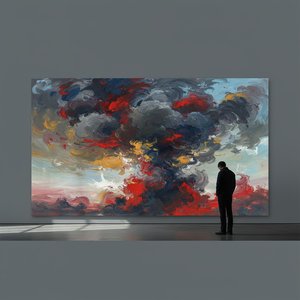
1992. Acrylic On Canvas. Inter-American Development Bank.

§ 1Catalogue data


Această lucrare este protejată de drepturile de autor
Lucrarea de artă afișată pe această pagină este protejată de legile privind drepturile de autor, ceea ce înseamnă că nu putem crea sau vinde în mod legal o reproducere identică. Această protecție este garantată prin acorduri internaționale, precum Convenția de la Berna și de legile naționale, inclusiv cele prevăzute de Legea dreptului de autor din S.U.A. – Titlul 17. Toate drepturile rezervate. Orice reproducere neautorizată este interzisă.
Ca alternativă respectuoasă și legală, oferim tablouri pictate manual, personalizate, inspirate de original. Artistii noștri experimentați și profesioniști studiază cu atenție stilul, starea de spirit și esența artistică a originalului pentru a crea o piesă nouă și unică, care evocă aceeași emoție – rămânând, în același timp, o creație originală în sine.
Această metodă respectă pe deplin reglementările privind drepturile de autor, deoarece nu implică copierea sau duplicarea operei protejate. În schimb, este o reinterpretare creativă – o pictură nouă, influențată de original, dar care nu este identică cu acesta.
 Citește mai mult
§ 2Abstract
Descriere obiect de colecție
Biografie artist
Fernando de Szyszlo (1925-2017) was a pivotal Peruvian abstract artist who fused European modernism with pre-Columbian themes & Incan motifs. Explore his paintings, sculptures, and legacy as a key figure in Latin American art.
§ 3Commentary
Fernando de Szyszlo: Bridging Ancient Echoes and Modern Expression
Fernando de Szyszlo (1925-2017) stands as a monumental figure in Peruvian art history, recognized for his pioneering role in establishing abstract expressionism within Latin America while simultaneously honoring the profound legacy of Andean culture. Born in Lima to a Peruvian mother of Spanish-Indian descent and a Polish father, Szyszlo’s formative years instilled in him an appreciation for both European intellectual traditions and indigenous heritage—a duality that would profoundly shape his artistic vision. This confluence of influences is palpable throughout his oeuvre, resulting in canvases that resonate with a unique blend of formal innovation and symbolic depth. Szyszlo's journey into art began at the National University of Engineering but was swiftly redirected by an irresistible passion for architecture before he decisively embraced the School of Plastic Arts of Pontifical Catholic University of Peru. Graduating in 1948, he embarked on a transformative voyage across Europe, immersing himself in the groundbreaking works of masters like Rembrandt and Titian—artists who championed dramatic chiaroscuro and psychological realism. These encounters ignited Szyszlo’s imagination and fueled his determination to forge a path distinct from established artistic conventions. His stylistic evolution culminated in the embrace of abstract expressionism during the mid-1950s, marking a pivotal moment in Peruvian art. Rejecting representational accuracy, Szyszlo sought to convey emotion and experience directly onto the canvas through spontaneous gestures and bold color palettes—a technique championed by artists like Jackson Pollock and Willem de Kooning. However, unlike his contemporaries who often prioritized purely formal experimentation, Szyszlo consistently incorporated elements of Andean iconography and symbolism into his paintings. Recurring motifs such as llamas, condors, and geometric patterns hark back to the rich artistic traditions of Peru’s pre-Columbian past, grounding his abstract explorations in a tangible connection to Peruvian cultural heritage. The painting "Duino-Nueve (Orrantia/92)" exemplifies Szyszlo's distinctive approach. The image depicts a solitary figure wielding a knife—a potent symbol representing both vulnerability and decisive action—against a dark backdrop punctuated by flashes of intense color. The artist’s meticulous attention to detail, particularly in capturing the texture and contours of the hand holding the blade, underscores his commitment to conveying palpable physicality alongside conceptual ideas. Furthermore, Szyszlo's masterful use of pigment creates an atmosphere of dramatic tension, mirroring the psychological complexities inherent in the subject matter. Szyszlo’s artistic legacy extends beyond stylistic innovation; he served as a crucial catalyst for fostering dialogue between Peruvian art and Andean culture—a contribution that continues to inspire artists and scholars alike. His unwavering dedication to exploring the expressive potential of abstraction combined with his reverence for indigenous traditions solidified his position as one of Peru's most influential visual artists, ensuring that his work remains relevant and captivating for generations to come.- Artist: Fernando de Szyszlo
- Born Year: 1925
- Death Year: 2017
- Birth City: Lima
- Birth Country: Peru
Historical Context
Szyszlo’s artistic endeavors unfolded during the formative years of Peruvian art history—a period marked by burgeoning interest in European modernism alongside an increasing awareness of Andean cultural identity. The influence of Surrealist artists like René Magritte and Salvador Dalí can be discerned in Szyszlo's exploration of dreamlike imagery and subconscious symbolism, reflecting a broader artistic preoccupation with psychological depth and imaginative vision.Style & Technique
Szyszlo’s signature style—abstract expressionism infused with Andean motifs—characterized by spontaneous brushstrokes, bold color combinations, and textural layering—represents a radical departure from traditional Peruvian painting practices. He skillfully manipulated pigment to create luminous surfaces that capture the essence of emotion and experience, mirroring the expressive dynamism found in the works of European masters like Willem de Kooning and Franz Kline.Symbolism
Recurring motifs such as llamas, condors, and geometric patterns—elements drawn from Andean iconography—serve as powerful symbols representing resilience, spiritual aspiration, and connection to ancestral traditions. Szyszlo’s deliberate incorporation of these visual cues underscores his commitment to honoring Peruvian cultural heritage while simultaneously elevating abstract expressionism beyond purely formal considerations.Emotional Impact
“Duino-Nueve (Orrantia/92)” evokes a profound sense of contemplation and unease—a reflection of Szyszlo’s masterful ability to convey psychological complexity through visual language. The painting's dramatic chiaroscuro contrasts heighten the tension between vulnerability and determination, prompting viewers to confront existential questions about human experience and artistic expression.Întrebări și răspunsuri
Ce nivel de contrast prezintă "Duino-Nueve (Orrantia/92)" de Fernando de Szyszlo?
Nivelul de contrast al operei "Duino-Nueve (Orrantia/92)" de Fernando de Szyszlo este Serene.
Pot vedea "Duino-Nueve (Orrantia/92)" de Fernando de Szyszlo sub diferite lumini?
Pagina Raze X a operei "Duino-Nueve (Orrantia/92)" de Fernando de Szyszlo este un vizualizator interactiv care vă permite să parcurgeți onze straturi optice ale imaginii lucrării, inclusiv o perspectivă de tip radiografie.
Ce punct comun are "Duino-Nueve (Orrantia/92)" cu restul creației lui Fernando de Szyszlo?
„Duino-Nueve (Orrantia/92)” împarte cu celelalte opere ale lui Fernando de Szyszlo stilul Abstract Expressionism și temele recurente: european modernism, andean heritage, symbolic imagery, exploring identity, central role.


 Comută pe versiunea Print


 Pentru opere de artă sau reproduceri care depășesc 105 cm (aproximativ 41 de inch) pe oricare dintre laturi, cadrul va fi livrat demontat, sub formă de kit. Această metodă asigură o livrare sigură și previne deteriorarea în timpul transportului.