Garanție de rambursare în 100 de zile Livrare gratuită în toată lumea
449.587opere de artă 30.613artişti 4.660muzee 32limbi
Catalogue entry

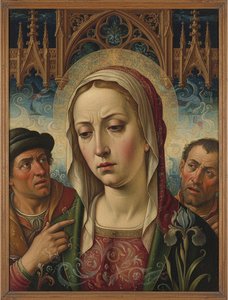
Lamentation

Oil On Panel, 36.0 x 30.0 cm. Muzeul Hermitaj.

Fig. 1. Hugo van der Goes, Lamentation. Shown as the reproduction you are specifying: , .

§ 1Catalogue data

Dimensiuni
36.0 x 30.0 cm

§ 2Abstract

Descriere obiect de colecție

Experience the poignant beauty of Hugo van der Goes' 'Lamentation,' a masterpiece capturing grief and sorrow with masterful realism and emotional depth. Explore its rich symbolism and historical significance.

Biografie artist

Hugo van der Goes (1440-1482) a fost un pictor flamand revoluționar, cunoscut pentru realismul dramatic, portretele emoționale și capodopera "Portinari". Influența sa asupra Renașterii italiene este incontestabilă.

§ 3Commentary

The Heart of Sorrow: Hugo van der Goes’ Lamentation

Hugo van der Goes' "Lamentation," a cornerstone of Early Netherlandish painting, isn’t merely a depiction of grief; it’s a profound exploration of human emotion rendered with an unprecedented level of psychological realism. Completed around 1460-70, this monumental panel—originally part of a larger altarpiece—captures the raw agony of Christ's death and the mourning of his followers with a startling immediacy that continues to resonate centuries later. The painting’s power lies not just in its technical brilliance but also in its ability to evoke a visceral response from the viewer, inviting contemplation on themes of loss, faith, and the human condition.

The scene unfolds within a dimly lit interior, dominated by the stark white linen shroud covering Christ's body. He is positioned centrally, his face serene yet undeniably vulnerable, resting upon a simple cushion—a deliberate choice that elevates him beyond mere suffering to a state of quiet acceptance. Surrounding him are figures draped in rich fabrics – deep blues, reds, and whites – each engaged in distinct gestures of mourning. Mary Magdalene, identifiable by her flowing red robes and sorrowful expression, gently covers his face with a cloth, while John the Evangelist kneels, placing a crown of thorns upon his head—a potent symbol of Christ’s sacrifice and humiliation. Other figures include Nicodemus, holding a vial, and Joseph of Arimathea, carefully carrying the body.

A Masterclass in Realism and Composition

Van der Goes was a revolutionary figure in the artistic landscape of his time, pushing beyond the stylized conventions of previous Flemish painting. He achieved this through an intensely realistic portrayal of human anatomy, meticulously rendered with a deep understanding of musculature and expression. Notice the subtle details: the wrinkles etched on the faces of the mourners, the delicate folds of their garments, the individual textures of the fabrics—all contribute to a sense of palpable presence. The composition itself is carefully orchestrated, employing a pyramidal structure that draws the eye towards Christ’s central figure while distributing the emotional weight across the surrounding figures. The use of chiaroscuro – dramatic contrasts between light and shadow – further intensifies the scene's emotional impact, highlighting key elements and creating a sense of depth and atmosphere.

Symbolism Woven into Sorrow

Beyond its immediate depiction of grief, “Lamentation” is rich in symbolic meaning. The white linen shroud represents purity and Christ’s innocence, while the crown of thorns signifies his suffering and sacrifice. The inclusion of figures like Nicodemus and Joseph of Arimathea—both prominent early Christians—underscores the universality of mourning and the shared experience of loss within the Christian community. Even seemingly minor details, such as the small squirrel perched on a beam in the background, have been interpreted as symbolic representations of mortality and the fleeting nature of earthly existence. The painting’s careful balance between religious iconography and human emotion elevates it beyond a simple devotional image, transforming it into a profound meditation on life, death, and faith.

A Legacy of Emotional Depth

“Lamentation” stands as a testament to Hugo van der Goes' artistic genius and his pioneering approach to painting. His ability to capture the raw intensity of human emotion—to convey grief, sorrow, and acceptance with such remarkable realism—established him as one of the most important artists of the Early Netherlandish period. The work’s influence can be seen in subsequent generations of painters, who continued to draw inspiration from its dramatic composition, psychological depth, and masterful use of color and light. Today, reproductions of “Lamentation” continue to captivate audiences worldwide, offering a poignant reminder of the enduring power of art to evoke empathy and inspire reflection.

Specifications

  • Title: Lamentation
  • Description: A religious scene depicting the mourning over Christ’s death, featuring figures covering his body with cloths, placing a crown of thorns on his head, and expressing sorrowful emotions.
  • Photo Description: The image depicts a religious scene that appears to be the Lamentation of Christ, as suggested by the title "Lamentation" and the presence of figures who seem to be mourning or preparing for burial. The painting is executed in an oil on panel style, which is typical for works from the Northern Renaissance period.
  • Size: 36 x 30 cm
  • Date: Unknown

Artist Information

  • Artist: Hugo van der Goes
  • Birth Year: 1440
  • Death Year: 1482
  • Birth City: Ghent
  • Birth Country: Belgium
  • Biography: A Pioneer of Flemish Realism: The Life and Art of Hugo van der Goes

Additional Research

For further exploration, consider these resources:

Întrebări și răspunsuri

Ce format și orientare de imprimare se recomandă pentru "Lamentation" de Hugo van der Goes?

Pentru o printare a lucrării "Lamentation" de Hugo van der Goes, recomandăm dimensiunea de Medium în orientare Portrait.

Culorile din "Lamentation" de Hugo van der Goes sunt vii sau discrete?

Culoarea operei "Lamentation" prezintă o Subtle Color a saturației și o Balanced a intensității.

Există lucrări similare cu "Lamentation"?

Pagina Lucrări similare pentru "Lamentation" de Hugo van der Goes prezintă opere de artă similare.

§ 4The artist

Hugo van der Goes

Hugo van der Goes

1440 - 1482, Belgia

Quick facts about Hugo van der Goes

  • Artistic Movement Or Style: Pictura flamandă timpurie
  • Artists Or Movements Influenced By This Artist:
    • Domenico Ghirlandaio
    • Renaștere
  • Artists Who Influenced This Artist:
    • Jan van Eyck
    • Dirk Bouts
  • Date Of Birth: c. 1440
  • Date Of Death: 1482
  • Full Name: Hugo van der Goes
  • Nationality: Flemish
  • Notable Artworks:
    • Portinari
    • Monforte
    • Adorare
  • Place Of Birth: Ghent, Belgia

Biografie artist

A Pioneer of Flemish Realism: The Life and Art of Hugo van der Goes

Born around 1440 in the vibrant artistic hub of Ghent, Belgium, Hugo van der Goes emerged as a pivotal figure in the Northern Renaissance. Though shrouded in some mystery—details of his early life remain scarce—his impact on the development of painting during the latter half of the 15th century is undeniable. Van der Goes wasn’t merely a painter; he was an innovator who profoundly altered the course of artistic expression, influencing masters both within Flanders and across the burgeoning Italian Renaissance. He entered the Ghent painters' guild in 1467, marking his formal establishment as a master craftsman, yet it was his unique vision—a blend of intense realism, psychological depth, and dramatic composition—that would set him apart. Before Van der Goes, Flemish painting, while technically brilliant, often adhered to established conventions; he dared to break from these traditions, imbuing his work with an unprecedented level of human emotion and tangible reality.

Innovation and Artistic Style

Van der Goes’s artistic signature lies in his ability to infuse religious scenes with a startling sense of immediacy and emotional weight. He moved beyond the stylized conventions of earlier Flemish painting, imbuing his figures with a weighty presence and individualized character. His use of color was deliberate and often somber, creating a sense of gravity and spiritual intensity. This wasn’t simply about replicating appearances; it was about conveying inner states—awe, sorrow, reverence—through subtle gestures, expressive faces, and the careful manipulation of light and shadow. His monumental style, characterized by large-scale compositions and imposing figures, further amplified this emotional impact. He didn't shy away from portraying imperfections; his figures often possess a raw, almost unsettling realism that distinguishes them from the more idealized representations common in earlier art. This commitment to depicting humanity in all its complexity was revolutionary for its time, influencing artists who sought to move beyond mere technical skill and explore the depths of human experience. The influence of Jan van Eyck’s meticulous detail is evident, but Van der Goes transcends imitation, forging a style uniquely his own. He wasn't afraid to show wrinkles, blemishes, and the weariness of age, reflecting a profound understanding of the human condition. His compositions were often dynamic and theatrical, drawing the viewer into the scene with dramatic lighting and carefully orchestrated figures.

Masterpieces and Lasting Influence

Perhaps Van der Goes’s most celebrated work is the Portinari Altarpiece, commissioned by Tommaso Portinari, an Italian banker residing in Bruges. Completed around 1475, this magnificent triptych—now housed in the Uffizi Gallery in Florence—is a testament to his mastery of composition, color, and psychological insight. The scene depicting the Adoration of the Shepherds is particularly striking, with its dramatic lighting, realistic portrayal of humble figures, and palpable sense of wonder. The altarpiece’s arrival in Italy had a profound effect on Florentine artists, including Domenico Ghirlandaio, who were captivated by its innovative realism and emotional power. Another significant work is The Adoration of the Magi (Monforte Altarpiece), currently residing in Berlin's Gemäldegalerie. This piece showcases his skill in creating dynamic scenes filled with intricate detail and symbolic meaning. Beyond these iconic works, Van der Goes contributed to numerous civic projects, including heraldic decorations for Charles the Bold’s ceremonial entries into Ghent, demonstrating his versatility as an artist. His influence extended beyond painting; he impacted the development of book illustration through his designs which were disseminated by artists like Alexander Bening.

A Life Transformed: From Workshop to Monastery

In a surprising turn of events, at the height of his artistic success in 1477, Van der Goes abruptly closed his bustling workshop and entered the Roode Klooster monastery near Auderghem. This decision remains something of an enigma, though it’s believed to have been driven by a deep spiritual yearning or perhaps a struggle with mental health. Despite taking religious vows as a lay brother, he continued to accept painting commissions, even undertaking the task of evaluating unfinished works by Dieric Bouts for the city of Leuven. However, his final years were marked by increasing bouts of depression and psychological distress. Accounts suggest that he suffered a severe breakdown in 1482, tragically taking his own life shortly thereafter. This poignant end to a brilliant career adds another layer of complexity to the legacy of Hugo van der Goes—a man whose art explored the depths of human emotion while grappling with inner turmoil. The circumstances surrounding his death have fueled speculation for centuries, adding to the mystique that surrounds this remarkable artist.

A Legacy Enduring Through Time

Hugo van der Goes’s influence extended far beyond his relatively short lifetime. His innovative techniques and profound psychological insights paved the way for future generations of artists, both in Flanders and Italy. His work can be found today in prestigious museums such as the Musées royaux des Beaux-Arts in Brussels, offering a glimpse into the genius of this pioneering Flemish master. He remains a compelling figure—a testament to the power of art to capture the complexities of the human condition and to transcend cultural boundaries. His legacy continues to inspire awe and admiration, solidifying his place as one of the most important artists of the Northern Renaissance.
  • His emphasis on realism influenced subsequent generations.
  • The Portinari Altarpiece remains a landmark achievement in art history.
  • His exploration of psychological depth set a new standard for portraiture and religious painting.

§ 5Comparanda

§ 6Questions

Informații rapide

  • Influences: Early Netherlandish
  • Artist: Hugo van der Goes
  • Medium: Oil on panel
  • Dimensions: 36 x 30 cm
  • Location: Gemäldegalerie, Berlin

Test de cunoștințe despre artă

Fiecare întrebare are un singur răspuns corect.

Întrebare 1:
What is the primary subject depicted in Hugo van der Goes’ ‘Lamentation of Christ’?
Întrebare 2:
Which artistic period does Hugo van der Goes’ ‘Lamentation of Christ’ primarily belong to?
Întrebare 3:
What is a notable characteristic of Hugo van der Goes' style as seen in this painting?
Întrebare 4:
What is the significance of the figure holding a cloth over Christ’s face in ‘Lamentation of Christ’?
Întrebare 5:
The painting is signed ‘Hugo Van Der Goes’ in which location?

§ 7Cite this entry

AllPaintingsStore.com, “Hugo van der Goes, Lamentation”, https://allpaintingsstore.com/ro/art/hugo-van-der-goes-lamentation-8Y3SCS-en/ArtistReproduction/ (accessed 4 Octombrie 2026).

§ 8The reproduction

Reproducere pictată manual în ulei

Pictură în ulei pe pânză, pictată manual de artiștii noștri la dimensiunea și ramele dorite de dumneavoastră, pe comandă. ( Comută pe versiunea Print Comută pe Imagine Digitală)

It is specified on the order sheet in the margin; the present state of that sheet reads as follows.

Lamentation

Tehnică de reproducere

Dimensiune reproducere

-

Selecție de artiști de elită

Mai multe detalii, rafinament și timp suplimentar de execuție

-

Ramă pentru reproducere artistică

-

-

Pentru opere de artă sau reproduceri care depășesc 105 cm (aproximativ 41 de inch) pe oricare dintre laturi, cadrul va fi livrat demontat, sub formă de kit. Această metodă asigură o livrare sigură și previne deteriorarea în timpul transportului.

Este necesară asamblarea profesională – acest produs nu este de tip DIY (de făcut singur).
Kitul trebuie asamblat, iar pânza întinsă, de către un legător de cadre experimentat, utilizând adeziv pentru lemn (neinclus în colet), o cheie pentru întinderea pânzei și cleme pentru a menține barele la unghi drept în timp ce adezivul se usucă. Asamblarea incorectă sau tensiunea neuniformă a pânzei pot deteriora permanent opera de artă și nu sunt acoperite de garanția noastră.

  • Toate barele din lemn masiv sunt incluse, tăiate cu precizie la dimensiunea necesară.

  • Asamblat cu șuruburile incluse, plus adeziv pentru lemn pentru îmbinările de colț, care nu este furnizat și trebuie achiziționat de către tâmplarul dumneavoastră.

  • Sunt necesare unelte profesionale care nu sunt incluse: o șipte de întindere a pânzei (tensionator) și cleme pentru a menține barele la unghi drept în timp ce adezivul se usucă.

Important:
Îmbinările de colț necesită adeziv pentru lemn, barele trebuie fixate cu clești de strângere până când adezivul este complet uscat, iar întinderea pânzei pe cadrul asamblat necesită un clește pentru întins pânza. Niciunul dintre aceste elemente nu este inclus în kit. Vă rugăm să consultați un încadrator profesionist cu experiență înainte de a comanda această dimensiune.

Etichetă de prezentare

-

-

Lac de protecție

Lac lucios (intensifică nuanțele și oferă protecție împotriva luminii și a umidității)

-

Personalizează opera mea de artă

Exemple de elemente ce pot fi personalizate: Înlocuirea feței cu fotografia clientului; Adăugarea unui animal de companie (de exemplu, înlocuirea unei pisici cu un câine); Includerea unui mesaj ascuns în fundal; Modificarea peisajului sau a elementelor din fundal.

-

Livrare rapidă

Livrare la nivel mondial () în 3-4 săptămâni, în loc de cele 5 săptămâni standard. (1 Noiembrie). Fără compromisuri când vine vorba de calitate.

-

Livrare rapidă

Livrare la nivel mondial () în 5 săptămâni. (8 Noiembrie).

Inclus

Preț total calculat

lei 1224

Included with every order

  • Livrare expres gratuită la nivel mondial
  • Pânză de in de înaltă calitate
  • Asigurare completă pentru transport
  • Garanție de rambursare a taxelor vamale
  • Garanția fidelității culorilor
  • Politica de retur în 100 de zile (doar pentru defecte de fabricație)
  • Garanție de rambursare 100%
  • Ofertă pentru comenzi multiple
Order sheet