

1908. .

§ 1Date catalog

§ 2Abstract
Biografie artist
A German illustrator known for his elegant book plates. Discover the timeless beauty of Paul Thumann's art today.
1908. .
A German illustrator known for his elegant book plates. Discover the timeless beauty of Paul Thumann's art today.

1834 - 1908, Germany
Born on 5 October 1834 in Groß Schacksdorf-Simmersdorf, Paul Thumann was raised in the household of a teacher. His early inclinations did not immediately point toward the canvas. He initially sought a path in the technical sciences, enrolling at the engineering school in Glogau to pursue a career in that field. This practical direction, however, proved to be a temporary detour in a life that would eventually be defined by the visual arts.
The pull toward art eventually superseded his scientific interests. Between 1854 and 1856, Thumann sought formal instruction at the Prussian Academy of Arts in Berlin. This period of study provided the foundational discipline required for his future work as a painter and illustrator. He moved from the structured world of engineering toward the more fluid demands of graphic art and portraiture, setting the stage for a career that would span many decades and various mediums.
After honing his skills in the studios of Julius Hübner in Dresden, Thumann moved toward the academic rigor of the Weimar Saxon-Grand Ducal Art School. Under the guidance of Ferdinand Pauwels, his technical proficiency deepened, leading to his appointment as a professor in 1866. His career, however, was not confined to the quietude of the classroom. During the Franco-Prussian War, he stepped away from his academic duties to serve as a draftsman at the Prussian Third Army's headquarters, applying his precision to the demands of military documentation.
His reputation within the German academic circuit grew steadily. In 1875, he reached a significant professional milestone when he was appointed Professor at the Academy of Arts in Berlin. He held this prestigious position for over a decade, until 1887, shaping the next generation of artists through his instruction. His tenure in Berlin solidified his standing as a central figure in the institutional art world of the era.
Thumann’s life was marked by a restless movement across the European continent. His interests frequently drew him away from the academic circles of Berlin and Weimar toward the varied landscapes of Hungary and Transylvania. These excursions were often paired with more structured art-related tours through Italy and France, where he sought to refine his visual understanding. He also spent a period of time studying in England, a move that expanded his perspective beyond the Prussian tradition.
The pull of the Mediterranean proved particularly strong in his later years. Between 1887 and 1891, he made Italy his home, living there for several years. This period of residence allowed for a deeper immersion in the light and classical forms of the region. His reputation eventually crossed the Atlantic, reaching an audience far beyond the European sphere. In 1893, he exhibited his work Psyche at Nature's Mirror at the World's Columbian Exposition in Chicago. The piece caught the attention of the management of the White Rock Mineral Water, who subsequently purchased the reproduction rights to use the image as part of their logo.
Thumann’s output was defined by a versatility that bridged the gap between fine art and commercial illustration. He was a prolific illustrator, crafting plates for the literary works of Goethe, Tennyson, Chamisso, and Heine. His ability to translate text into visual form made him a frequent collaborator for publishers seeking elegance in their editions. This skill extended to his depictions of social and domestic life, seen in his various iterations of Die Gartenlaube produced in 1877, 1878, 1880, and 1882.
His reach extended beyond the printed page and into the realm of decorative arts. He produced several porcelain plaques, including a notable depiction of The Three Fates. In the realm of oil painting, his hand was seen in works such as The young suitor, which he signed and dated in 1871. His compositions often possessed a certain grace that appealed to both private collectors and commercial interests.
One of his most unexpected successes occurred through the medium of branding. His work Psyche at Nature's Mirror gained significant attention at the World's Columbian Exposition in Chicago in 1893. The image was so striking that the management of White Rock Mineral Water purchased the reproduction rights, adopting the work as a central element of their logo.
The final decade of Thumann's career was marked by a transition into significant institutional responsibilities. In 1892, he assumed the leadership of the Master Studio of Professor Julius Schrader, a position that solidified his influence within the academic circles of Berlin. His personal life during these years reflected a connection to the upper echelons of European society; he was married to a woman of the English nobility. This social standing was further extended through his family, as one of his daughters married the brother of the poet Algernon Swinburne.
As his career progressed, the elegance of his illustrative style began to face criticism for becoming increasingly facile. Despite this shift in critical reception, his presence in the German art scene remained steady until his passing. He died in Berlin on 19 February 1908.

AllPaintingsStore.com, “Paul Thumann, In the Bath (1908)”, https://allpaintingsstore.com/ro/art/in-the-bath-by-paul-thumann/ArtistReproduction/ (accesat la 23 Octombrie 2026).
Pictură în ulei pe pânză, pictată manual de artiștii noștri la dimensiunea și ramele dorite de dumneavoastră, pe comandă. ( Comută pe versiunea Print Comută pe Imagine Digitală)
Este specificat în marginea foii de comandă; starea actuală a acelei foi este următoarea.
In the Bath
Dimensiune reproducere
Mai multe detalii, rafinament și timp suplimentar de execuție
-
Pentru opere de artă sau reproduceri care depășesc 105 cm (aproximativ 41 de inch) pe oricare dintre laturi, cadrul va fi livrat demontat, sub formă de kit. Această metodă asigură o livrare sigură și previne deteriorarea în timpul transportului.
Este necesară asamblarea profesională – acest produs nu este de tip DIY (de făcut singur).
Kitul trebuie asamblat, iar pânza întinsă, de către un legător de cadre experimentat, utilizând adeziv pentru lemn (neinclus în colet), o cheie pentru întinderea pânzei și cleme pentru a menține barele la unghi drept în timp ce adezivul se usucă. Asamblarea incorectă sau tensiunea neuniformă a pânzei pot deteriora permanent opera de artă și nu sunt acoperite de garanția noastră.
Toate barele din lemn masiv sunt incluse, tăiate cu precizie la dimensiunea necesară.
Asamblat cu șuruburile incluse, plus adeziv pentru lemn pentru îmbinările de colț, care nu este furnizat și trebuie achiziționat de către tâmplarul dumneavoastră.
Sunt necesare unelte profesionale care nu sunt incluse: o șipte de întindere a pânzei (tensionator) și cleme pentru a menține barele la unghi drept în timp ce adezivul se usucă.
Important:
Îmbinările de colț necesită adeziv pentru lemn, barele trebuie fixate cu clești de strângere până când adezivul este complet uscat, iar întinderea pânzei pe cadrul asamblat necesită un clește pentru întins pânza. Niciunul dintre aceste elemente nu este inclus în kit. Vă rugăm să consultați un încadrator profesionist cu experiență înainte de a comanda această dimensiune.
-
Lac lucios (intensifică nuanțele și oferă protecție împotriva luminii și a umidității)
Exemple de elemente ce pot fi personalizate: Înlocuirea feței cu fotografia clientului; Adăugarea unui animal de companie (de exemplu, înlocuirea unei pisici cu un câine); Includerea unui mesaj ascuns în fundal; Modificarea peisajului sau a elementelor din fundal.
Livrare la nivel mondial () în 3-4 săptămâni, în loc de cele 5 săptămâni standard. (20 Noiembrie). Fără compromisuri când vine vorba de calitate.
Livrare la nivel mondial () în 5 săptămâni. (27 Noiembrie).
Inclus în fiecare comandă

Elevate your bathroom with icons from Van Eyck to Warhol. Find curated museum-quality art on AllPaintingsStore.com. Explore the full collection online.
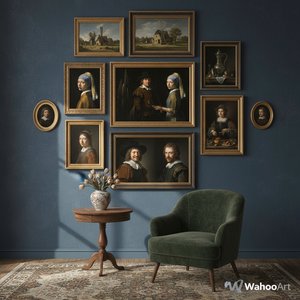
Descoperă top 10 capodopere Baroc Olandez! Rembrandt, Vermeer și alți maeștri. Explorează istoria artei, tehnicile unice și atmosfera luxoasă a picturilor baroce. Reproduceri de artă de calitate muzeală pe AllPaintingsStore.com.

Transform your bathroom with icons from Warhol to Renoir. Explore museum-quality masterpieces on AllPaintingsStore.com.

Explore a curated journey through iconic bathing scenes from myth to Impressionism. Discover the history of art's most sacred waters now.
 Vezi mai mult


 Pentru opere de artă sau reproduceri care depășesc 105 cm (aproximativ 41 de inch) pe oricare dintre laturi, cadrul va fi livrat demontat, sub formă de kit. Această metodă asigură o livrare sigură și previne deteriorarea în timpul transportului.


