Garanție de rambursare în 100 de zile Livrare gratuită în toată lumea
449.587opere de artă 30.613artişti 4.660muzee 32limbi
Monedă
    Limba
      Atelier · Est. 2015 · Paris, Franța
      AllPaintingsStore
      allpaintingsstore.com
      Catalogue entry

      Marching

      1915. Acrylic On Canvas.

      Fig. 1. Marc Chagall, Marching, 1915. Shown as the reproduction you are specifying: , .

      § 1Catalogue data

      § 2Abstract

      Descriere obiect de colecție

      The painting depicts a man standing on a rooftop amidst fantastical imagery – flying figures, animals, and a prominent clock – reflecting Chagall’s signature dreamlike style and capturing the spirit of Vitebsk's multicultural heritage.

      Biografie artist

      Descoperă universul unic al lui Marc Chagall (1887-1985), pictorul simbolist și suprarealist cu influențe puternice din folclorul evreiesc! Admira opere impresionante și înțelepciunea artistică a unui geniu!

      § 3Commentary

      A Symphony of Color and Memory: Exploring Marc Chagall's "I Am Alone"

      Marc Chagall’s “I Am Alone,” painted in 1915, isn’t merely a depiction of solitude; it’s an embodiment of existential angst rendered in the breathtaking language of Expressionism. Created during the turbulent years preceding World War I—a period marked by anxieties about national identity and impending conflict—the painting transcends its immediate historical context to speak to universal themes of isolation and longing. It's housed in the Musée d'Orsay, Paris, a testament to Chagall’s enduring influence on modern art.
      • Subject Matter: The canvas portrays a man standing alone on a rooftop amidst a swirling panorama of fantastical figures—a woman with outstretched arms, a child perched precariously on the edge of the roof, and several other stylized individuals drifting upwards into the heavens.
      • Style: Chagall’s style is unmistakably Expressionist. Rejecting representational accuracy in favor of emotional intensity, he employs bold colors—primarily yellows, blues, and reds—to convey mood and feeling rather than to faithfully reproduce reality. The figures themselves are distorted and stylized, imbued with a dreamlike quality that defies logical interpretation.

      Technique: Bold Brushstrokes and Layered Color

      Chagall’s technique is characterized by thick, impasto brushstrokes—meaning the paint is applied in layers so thickly that it stands up prominently from the surface of the canvas. This textural approach contributes significantly to the painting's dramatic impact, creating a palpable sense of movement and conveying the artist’s emotional state directly onto the artwork. The colors are blended strategically to create luminous washes and vibrant accents, enhancing the overall visual richness.
      • Color Palette: The dominant hues—golden yellows symbolizing warmth and optimism juxtaposed with deep blues representing melancholy and uncertainty—are deliberately chosen to evoke specific emotions. Chagall’s masterful use of color underscores the painting's psychological depth.
      • Composition: The rooftop setting serves as a focal point, anchoring the swirling figures and emphasizing the man’s isolation. The upward trajectory of the figures symbolizes aspiration but also hints at vulnerability—a yearning for connection amidst overwhelming circumstances.

      Symbolism: Folklore and Existential Concerns

      “I Am Alone” is replete with symbolic references drawn from Jewish folklore and Kabbalah—the mystical tradition of Judaism. The woman with outstretched arms represents compassion and maternal care, while the child symbolizes innocence and vulnerability. The swirling figures embody the chaotic forces of fate and the anxieties surrounding impending war. More broadly, the painting explores profound existential questions about human existence—questions concerning identity, purpose, and the inevitability of suffering.

      Ultimately, Chagall’s “I Am Alone” transcends its historical origins to resonate with viewers across generations. It's a hauntingly beautiful meditation on solitude, loss, and the enduring quest for meaning—a masterpiece that continues to inspire awe and provoke contemplation decades after its creation.

      Întrebări și răspunsuri

      Culorile din "Marching" de Marc Chagall sunt saturate sau tenue?

      Paleta lucrării "Marching" are o saturație de Clear Color Presence.

      Ce nivel de saturație și intensitate prezintă "Marching" de Marc Chagall?

      Culoarea operei "Marching" prezintă o Clear Color Presence a saturației și o Vivid a intensității.

      Ce armonie de culori prezintă "Marching" de Marc Chagall?

      Culorile din "Marching" de Marc Chagall prezintă o armonie Discordant Palette. Armonia descrie modul în care culorile interacționează între ele.
      § 4The artist

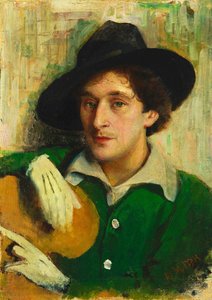
      Marc Chagall

      Marc Chagall

      1887 - 1985, Білорусь

      Quick facts about Marc Chagall

      • Artistic Movement Or Style: Cubism și simbolism
      • Artists Or Movements Influenced By Acest Artist: ['Surrealism']
      • Artists Who Influenced This Artist:
        • Bakst
        • Delaunay
      • Date Of Birth: 6 iulie 1887
      • Date Of Death: 28 martie 1985
      • Full Name: Marc Chagall
      • Nationality: Rusă (acum Belarus)
      • Notable Artworks:
        • I și Orașul
        • În Vinovație
      • Place Of Birth: Liozna, Belarus

      Biografie artist

      A Life Painted in Dreams: The World of Marc Chagall

      Marc Chagall, born Moishe Shagal in 1887 in the small Belarussian town of Liozna near Vitebsk, wasn’t merely a painter; he was a poet of color, a weaver of dreams, and a chronicler of memory. His life, spanning nearly a century, mirrored the tumultuous currents of the 20th century, yet his art remained steadfastly rooted in a deeply personal vision—one infused with the folklore of his Hasidic Jewish upbringing and an unwavering belief in the power of imagination. Vitebsk itself was more than just a birthplace; it became the emotional core of his artistic universe, a recurring motif populated by flying figures, whimsical animals, and the vibrant hues of remembered landscapes. The town’s unique blend of cultures—Russian Orthodox churches alongside bustling Jewish marketplaces—forged an aesthetic sensibility that would defy easy categorization throughout his long career. Though he sought formal training first with a local sign painter and later in St. Petersburg under Léon Bakst, and then in Paris at the Académie de la Grande Chaumière, Chagall never fully embraced any single artistic movement. He absorbed elements of Cubism, Symbolism, and Fauvism, but always filtered them through his own intensely personal lens, creating a style that was uniquely, unmistakably Chagall.

      Early Years and Artistic Beginnings

      Chagall’s formative years were marked by hardship and displacement. Born into a family of impoverished Jewish artisans, he experienced the trauma of pogroms—violent anti-Jewish riots—which instilled in him a profound awareness of persecution and loss. Despite these challenges, he pursued his artistic ambitions with unwavering determination, initially studying sign painting before enrolling at St. Petersburg’s Imperial Academy of Arts. However, he quickly rejected the academic conventions of the time, preferring to explore alternative approaches to representation. His early canvases—works like I and the Village (1911)—already demonstrated his distinctive style: fragmented landscapes imbued with symbolic meaning, figures rendered in a stylized manner that defied realistic proportions, and a palette dominated by bold, expressive colors. This stylistic choice wasn’t merely aesthetic; it reflected Chagall's desire to convey emotion rather than simply depicting the external world. He sought to capture the essence of experience—the weight of memory—and to express his inner life through visual imagery.

      The Symbolist Influence and Vitebsk

      Chagall’s artistic development was profoundly shaped by Symbolism, a movement that prioritized emotional expression over literal depiction. Artists like Gustave Moreau and Edvard Munch served as important influences, encouraging him to embrace dreamlike imagery and explore the subconscious mind. Vitebsk remained an enduring presence in Chagall's imagination—a town he revisited repeatedly throughout his life, both physically and artistically. The juxtaposition of Orthodox churches and Jewish marketplaces became a recurring motif in his paintings, symbolizing the tensions between tradition and modernity that characterized Russian Jewish culture. This visual language—characterized by flattened perspectives, stylized figures, and fantastical landscapes—became synonymous with Chagall’s artistic vision.

      The Revolution and Parisian Years

      The Russian Revolution of 1917 irrevocably altered Chagall's life trajectory. He returned to Vitebsk, where he established an art school that briefly flourished before succumbing to the pressures of Soviet repression. This period was marked by both creative energy and political disillusionment—a tension that would continue to inform his artistic output. Simultaneously, Chagall moved to Paris in 1923, immersing himself in the vibrant cultural landscape of the city and engaging with fellow Surrealists like André Breton and Pablo Picasso. He experimented with new techniques and explored themes related to mythology and folklore, solidifying his reputation as a visionary artist.

      Mature Style and Major Achievements

      Chagall’s mature style—characterized by lyrical abstraction and emotionally charged imagery—reached its zenith in the 1930s and 1940s. Paintings like Over Vitebsk (1920-1922) exemplify his masterful blending of Cubist influences with Symbolist sensibilities, creating canvases that are both intellectually stimulating and profoundly moving. The horrors of World War II prompted him to relocate to New York City, where he continued to produce monumental works—including The Four Seasons (1946-1948)—that captured the anxieties of the era while reaffirming his belief in beauty and transcendence. He received numerous prestigious commissions, including the ceiling of the Paris Opera (1964), a breathtaking spectacle of color and form that celebrated musical masterpieces. Chagall’s legacy extends beyond his paintings; he became an internationally recognized icon—a symbol of Jewish culture and artistic innovation—whose work continues to inspire artists and audiences alike. His enduring influence testifies to the power of art to transcend boundaries, to connect us to our shared humanity, and to illuminate the beauty and mystery of life.

      § 5Comparanda

      § 6Questions

      Informații rapide

      • Movement: Expressionism
      • Notable elements or techniques: Flying figures, vibrant colors
      • Subject or theme: Humanity and Spirituality
      • Year: 1915
      • Title: Marching

      § 7Cite this entry

      AllPaintingsStore.com, “Marc Chagall, Marching (1915)”, https://allpaintingsstore.com/ro/art/marc-chagall-marching-8XYGNE-en/ArtistReproduction/ (accessed 1 Octombrie 2026).

      § 8The reproduction

      Reproducere pictată manual în ulei

      Pictură în ulei pe pânză, pictată manual de artiștii noștri la dimensiunea și ramele dorite de dumneavoastră, pe comandă. ( Comută pe versiunea Print Comută pe Imagine Digitală)

      It is specified on the order sheet in the margin; the present state of that sheet reads as follows.

      Marching

      Tehnică de reproducere

      Dimensiune reproducere

      -

      Selecție de artiști de elită

      Mai multe detalii, rafinament și timp suplimentar de execuție

      -

      Ramă pentru reproducere artistică

      -

      -

      Pentru opere de artă sau reproduceri care depășesc 105 cm (aproximativ 41 de inch) pe oricare dintre laturi, cadrul va fi livrat demontat, sub formă de kit. Această metodă asigură o livrare sigură și previne deteriorarea în timpul transportului.

      Este necesară asamblarea profesională – acest produs nu este de tip DIY (de făcut singur).
      Kitul trebuie asamblat, iar pânza întinsă, de către un legător de cadre experimentat, utilizând adeziv pentru lemn (neinclus în colet), o cheie pentru întinderea pânzei și cleme pentru a menține barele la unghi drept în timp ce adezivul se usucă. Asamblarea incorectă sau tensiunea neuniformă a pânzei pot deteriora permanent opera de artă și nu sunt acoperite de garanția noastră.

      • Toate barele din lemn masiv sunt incluse, tăiate cu precizie la dimensiunea necesară.

      • Asamblat cu șuruburile incluse, plus adeziv pentru lemn pentru îmbinările de colț, care nu este furnizat și trebuie achiziționat de către tâmplarul dumneavoastră.

      • Sunt necesare unelte profesionale care nu sunt incluse: o șipte de întindere a pânzei (tensionator) și cleme pentru a menține barele la unghi drept în timp ce adezivul se usucă.

      Important:
      Îmbinările de colț necesită adeziv pentru lemn, barele trebuie fixate cu clești de strângere până când adezivul este complet uscat, iar întinderea pânzei pe cadrul asamblat necesită un clește pentru întins pânza. Niciunul dintre aceste elemente nu este inclus în kit. Vă rugăm să consultați un încadrator profesionist cu experiență înainte de a comanda această dimensiune.

      Etichetă de prezentare

      -

      -

      Lac de protecție

      Lac lucios (intensifică nuanțele și oferă protecție împotriva luminii și a umidității)

      -

      Personalizează opera mea de artă

      Exemple de elemente ce pot fi personalizate: Înlocuirea feței cu fotografia clientului; Adăugarea unui animal de companie (de exemplu, înlocuirea unei pisici cu un câine); Includerea unui mesaj ascuns în fundal; Modificarea peisajului sau a elementelor din fundal.

      -

      Livrare rapidă

      Livrare la nivel mondial () în 3-4 săptămâni, în loc de cele 5 săptămâni standard. (29 Octombrie). Fără compromisuri când vine vorba de calitate.

      -

      Livrare rapidă

      Livrare la nivel mondial () în 5 săptămâni. (5 Noiembrie).

      Inclus

      Preț total calculat

      lei 1200

      Included with every order

      • Livrare expres gratuită la nivel mondial
      • Pânză de in de înaltă calitate
      • Asigurare completă pentru transport
      • Garanție de rambursare a taxelor vamale
      • Garanția fidelității culorilor
      • Politica de retur în 100 de zile (doar pentru defecte de fabricație)
      • Garanție de rambursare 100%
      • Ofertă pentru comenzi multiple
      Order sheet