

Painting.

§ 1Catalogue data


Această lucrare este protejată de drepturile de autor
Lucrarea de artă afișată pe această pagină este protejată de legile privind drepturile de autor, ceea ce înseamnă că nu putem crea sau vinde în mod legal o reproducere identică. Această protecție este garantată prin acorduri internaționale, precum Convenția de la Berna și de legile naționale, inclusiv cele prevăzute de Legea dreptului de autor din S.U.A. – Titlul 17. Toate drepturile rezervate. Orice reproducere neautorizată este interzisă.
Ca alternativă respectuoasă și legală, oferim tablouri pictate manual, personalizate, inspirate de original. Artistii noștri experimentați și profesioniști studiază cu atenție stilul, starea de spirit și esența artistică a originalului pentru a crea o piesă nouă și unică, care evocă aceeași emoție – rămânând, în același timp, o creație originală în sine.
Această metodă respectă pe deplin reglementările privind drepturile de autor, deoarece nu implică copierea sau duplicarea operei protejate. În schimb, este o reinterpretare creativă – o pictură nouă, influențată de original, dar care nu este identică cu acesta.
 Citește mai mult
§ 2Abstract
Descriere obiect de colecție
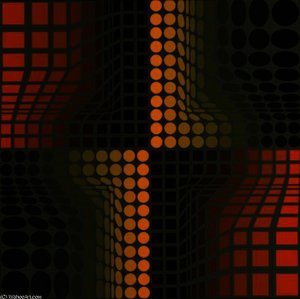
Victor Vasarely's 'Mahn' is a striking example of Op Art, utilizing geometric abstraction to create an optical illusion. Painted in 1963, this circular composition employs contrasting colors—primarily orange and red within smaller circles superimposed on a black canvas—to generate a dynamic visual experience rooted in Bauhaus principles. Explore Victor Vasarely’s mesmerizing ‘Mahn,’ an iconic Op
Biografie artist
Victor Vasarely, Károly Vaszary, Op Art, Kinetic Art, Abstractie geometrica, Iluzie optica, Arta maghiara, Arta moderna
§ 3Commentary
A Dance of Perception: The Vibrating Geometry of Victor Vasarely’s “Mahn”
To encounter Victor Vasarely's “Mahn” is to step into a realm where the canvas ceases to be a static surface and begins to breathe, pulse, and vibrate with an engineered energy. At first glance, the composition appears as a deceptively simple arrangement of nested circles, yet this simplicity is a mask for a profound exploration of visual mechanics. Brimming with vibrant orange and deep crimson hues, the artwork draws the viewer into a rhythmic spiral that seems to expand and contract with every blink of the eye. It is not merely a painting to be looked at; it is an experience to be felt, a kinetic encounter that challenges our very understanding of depth, stability, and movement.
The brilliance of “Mahn” lies in its mastery of Op Art—the Optical Art movement that revolutionized mid-20th-century aesthetics. Vasarely, often regarded as the grandfather of this movement, abandoned the traditional pursuit of illusionistic realism to embrace a technique rooted in precise geometric construction. Through what is known as “gyroscopic drawing,” where patterns are generated through mathematical precision, he creates a visual paradox. The concentric circles interact with the viewer's retina to produce an unsettling yet mesmerizing effect, making the flat plane appear to undulate. This deliberate manipulation of perspective transforms the artwork into a living organism, inviting the observer to participate in a silent dance of perception.
The Intersection of Bauhaus Logic and Postwar Optimism
The historical soul of “Mahn” is deeply intertwined with the Bauhaus ethos—a philosophy of functional design underpinned by rigorous mathematical principles. Vasarely’s journey from medical student to pioneer of abstraction was shaped by his time in Budapest's Műhely workshop, where he absorbed the discipline of geometric structure. This piece reflects the fervent period of postwar artistic experimentation, a time when the world was grappling with both the anxieties and the immense technological optimism of the scientific age. Unlike the dreamlike, subconscious explorations of Surrealism, “Mahn” asserts the power of rational thought and mathematical order to generate compelling, visceral experiences.
For the discerning collector or interior designer, this artwork offers a sophisticated focal point that bridges the gap between classical discipline and modern energy. The use of high-contrast colors—the warmth of orange against the intensity of red—creates a striking visual weight that can anchor a contemporary space. Because the piece relies on optical illusion rather than representational subject matter, it possesses a timeless quality that transcends fleeting trends. It serves as a testament to the beauty of precision, making it an ideal selection for those seeking to infuse their environments with intellectual depth and a sense of dynamic motion.
A Symphony of Color and Mathematical Harmony
Beyond its technical prowess, “Mahn” carries a profound emotional resonance. The concentricity of the circles suggests a sense of infinite progression, a cosmic harmony that speaks to the fundamental patterns found in nature and science alike. There is a hypnotic quality to the way the colors bleed into one another, creating a sensation of warmth and radiating light. This visual language does not just decorate a wall; it commands the atmosphere of a room, stimulating the intellect while providing a mesmerizing spectacle for the eyes.
Owning a high-quality reproduction of such a masterpiece allows one to bring this engineered energy into the home or gallery. Whether placed in a minimalist modern office or a vibrant, eclectic living space, “Mahn” acts as a window into the mechanics of sight itself. It remains an enduring icon of the 20th century, reminding us that through the careful application of geometry and color, art can transcend the boundaries of the physical world to touch the very essence of human consciousness.
Întrebări și răspunsuri
Unde pot vizualiza "Mahn" de Victor Vasarely sub formă de diaporama?
"Mahn" de Victor Vasarely poate fi vizualizată sub formă de diaporama pe pagina dedicată operei, Galerie foto.
Cum poate fi integrată "Mahn" de Victor Vasarely în decorul casei?
„Mahn” este recomandat pentru Accent, iar spațiul ideal de expunere este o Living Room.
"Mahn" de Victor Vasarely este o operă de artă luminoasă sau întunecată?
Luminozitatea percepută a operei "Mahn" de Victor Vasarely este deep_shadow. Aceasta poate fi adaptată la lumina spațiului în care va fi expusă.




 Comută pe versiunea Print


 Pentru opere de artă sau reproduceri care depășesc 105 cm (aproximativ 41 de inch) pe oricare dintre laturi, cadrul va fi livrat demontat, sub formă de kit. Această metodă asigură o livrare sigură și previne deteriorarea în timpul transportului.


