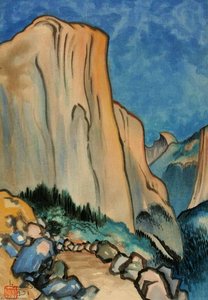
Chiura Obata - Zoroku Sato: A Life Bridging Worlds
Chiura Obata’s journey was one of remarkable resilience and artistic synthesis, a testament to the power of cultural exchange and the enduring spirit of creativity even in the face of adversity. Born Zoroku Sato in Okayama Prefecture, Japan (1885), his early life was steeped in tradition. At the age of seven, he was adopted by his older brother, Rokuichi, an artist himself, initiating a formal artistic education in the delicate art of sumi-e – Japanese ink painting. This foundational training instilled within him not just technical skill but also a deep reverence for nature and a philosophical approach to art that would permeate his entire career. Though initially steered towards a military path by his brother, Obata’s spirit yearned for artistic freedom, leading him at fourteen to leave home and pursue studies in Tokyo under masters like Tanryo Murata, Kogyo Terasaki, and Gaho Hashimoto. These years were crucial, exposing him not only to the nuances of Japanese aesthetics but also to burgeoning Western influences that would later shape his unique style. In 1903, a young Obata embarked on a new chapter, immigrating to the United States with aspirations of studying American art before continuing his journey in Europe – a path that ultimately led him to settle and flourish in San Francisco.Early Life and Artistic Foundations
Obata’s formative years were marked by both practical necessity and profound artistic inspiration. Immediately following his arrival in America, he secured employment as an illustrator for Japanese newspapers like *The New World* and *The Japanese American*, diligently documenting the devastating aftermath of the 1906 San Francisco earthquake through meticulous sketches. Simultaneously, he honed his design skills working with prominent department stores such as Gump’s and the Emporium – roles that demanded precision and attention to detail, qualities which would serve him well throughout his artistic career. However, it was a transformative sketching expedition of Yosemite and the Sierra Nevada in 1927 that truly ignited Obata's passion for landscape painting. The grandeur of California’s wilderness captivated him, prompting an unwavering dedication to capturing its majesty on canvas and woodblock prints. This experience solidified his belief in the importance of observing nature closely—a conviction that would become central to his artistic vision. He was trained in Western as well as modern Japanese art with a focus on Japanese sumi ink-and-brush painting, painting throughout his life in the eclectic style.From Illustration to Landscape: Finding a Californian Voice
Obata’s early illustrations for Japanese publications showcased his talent for capturing emotion and conveying narrative through visual imagery—skills honed during his formative years as an artist. His work with Gump's and The Emporium further developed his design sensibilities, emphasizing balance and harmony – principles that would inform his later artistic endeavors. Yet, it was Yosemite’s breathtaking vistas that irrevocably altered Obata’s trajectory. Inspired by the towering granite cliffs and serene lakes of Yosemite National Park, he embarked on a lifelong pursuit of portraying California's natural beauty with unparalleled accuracy and sensitivity. This commitment to observation—a cornerstone of his artistic philosophy—manifested itself in his celebrated “World Landscape Series,” consisting of thirty-five meticulously crafted colored woodblock prints that captured the essence of Yosemite’s splendor.The World Landscape Series and Artistic Recognition
Obata's magnum opus, *The World Landscape Series*, represents a pinnacle of Californian landscape painting and exemplifies his masterful command of sumi ink and woodblock printing techniques. Produced with painstaking care at Takamizawa Print Works, these prints are not merely depictions of Yosemite; they are meditations on the sublime—expressions of awe and reverence for the grandeur of nature. The series’s enduring appeal stems from Obata's ability to convey both visual precision and emotional depth—a feat achieved through his meticulous attention to detail and his profound understanding of Japanese artistic traditions. His work gained considerable acclaim during his lifetime, appearing in exhibitions across America and garnering recognition from prominent art institutions. Notably, he was honored as a professor at UC Berkeley for nearly twenty years, fostering the development of countless aspiring artists—a testament to his dedication to education and his belief in the transformative power of artistic expression.Legacy and Enduring Influence
Chiura Obata’s contribution to American art extends beyond his stunning landscapes; it encompasses his unwavering commitment to preserving cultural heritage and promoting intercultural dialogue. His establishment of an art school within Topaz Relocation Center during World War II stands as a poignant symbol of resilience—a demonstration of the human spirit's capacity for creativity even amidst profound adversity. Obata’s legacy continues to inspire artists and audiences alike, reminding us that art possesses the ability to transcend borders and foster understanding across cultures. His unwavering faith in nature’s beauty and his masterful technique solidified his place as one of the most influential landscape painters of the 20th century—a figure whose work remains relevant today as a celebration of artistic vision and human perseverance.Întrebări și răspunsuri
Unde pot vedea operele lui Chiura Obata în ordine cronologică?
Pagina Cronologia operelor de artă a artistului prezintă lucrările lui Chiura Obata ordonate cronologic, an de an.
De unde este Chiura Obata?
Chiura Obata s-a născut în Japonia.
Pot să explorez lucrările lui Chiura Obata în funcție de starea de spirit?
Pagina Galerie pe stări de spirit lui Chiura Obata organizează operele de artă ale artistului în funcție de starea de spirit.