A Titan of Antiquity: Claudio Ptolemy and the Shaping of Western Thought
Born around AD 100 in the ancient, lore-steeped environs of Canopus, Egypt, Claudio Ptolemy was far more than a mere mathematician; he was a monumental figure whose intellectual reach defined the scientific landscape of his era. Living during the twilight years of the Roman Empire, Ptolemy functioned as a bridge between the classical wisdom of antiquity and the burgeoning curiosity that would eventually ignite the Renaissance. His life’s work was not merely an academic pursuit but a profound attempt to decode the very language of the universe, creating a legacy that resonates through the centuries in both scientific treatises and the evocative beauty of historical cartography.
The brilliance of Ptolemy is most vividly captured in his role as the architect of celestial observation. Through his magnum opus, Almagest, he meticulously charted the movements of the planets using sophisticated geometric principles. By developing a geocentric model—a concept that placed Earth at the heart of the cosmos—he provided a framework for astronomical prediction that remained the undisputed authority for over 1,500 years. This was not a simple philosophical assertion but a complex mathematical achievement, utilizing intricate epicycles and deferents to account for the mysterious retrograde motion of planets. To gaze upon the celestial charts inspired by his work is to witness a moment in human history where mathematics and art danced in inseparable harmony, seeking to capture the divine order of the heavens.
Mapping the Known World: The Art of Geography
Beyond the reaches of the stars, Ptolemy revolutionized our understanding of the terrestrial realm through his monumental atlas, Geographia. In an age where maps often drifted into the territory of myth and legend, Ptolemy introduced a rigorous, mathematical approach to cartography. He consolidated vast amounts of knowledge from Greek, Egyptian, Roman, and Persian sources, utilizing mathematical projections to represent the contours of the Earth with unprecedented precision. His work transformed geography from a collection of narratives into a disciplined science of coordinates and projections.
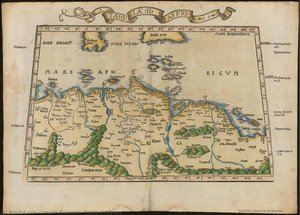
The enduring impact of his cartographic vision can be seen in the exquisite reproductions of his maps that continue to captivate collectors today. These works, such as the Map of Asia or the detailed Tabula II Affricae, serve as breathtaking windows into a time when the boundaries of the known world were still being etched by scholars and dreamers. Each line and coastline in these historical pieces reflects a meticulous attention to detail, where the ruggedness of distant lands meets the delicate artistry of hand-colored parchment. For the modern observer, these maps are more than mere navigational tools; they are profound explorations of human curiosity and the eternal desire to chart the unknown.
A Lasting Legacy in Art and Science
The historical significance of Claudio Ptolemy extends far beyond the dusty pages of ancient textbooks. His influence acted as a foundational pillar for the scientific revolution, providing the very principles that later astronomers would eventually challenge and refine. Yet, his impact is equally felt in the realm of visual aesthetics. The precision of his mathematical models and the structured beauty of his maps deeply influenced Renaissance artists who sought to depict the natural world with both accuracy and grace.
Today, the works attributed to his legacy continue to inspire a sense of wonder. Whether through the sweeping curves of mysterious oceans in a World Map or the intricate settlements detailed in his African charts, Ptolemy’s spirit lives on. He remains a symbol of the human intellect's ability to impose order upon chaos, turning the vast, terrifying expanse of the cosmos and the earth into a structured, beautiful, and ultimately understandable masterpiece.
Întrebări și răspunsuri
Există o prezentare generală a tuturor subiectelor pictate de Claudio Ptolomeo?
Atlas pe teme lui Claudio Ptolomeo este o pagină care clasifică operele de artă ale artistului în funcție de subiectele acestora.
Pot să explorez lucrările lui Claudio Ptolomeo în funcție de starea de spirit?
Lucrările lui Claudio Ptolomeo pot fi explorate în funcție de starea de spirit pe pagina Galerie pe stări de spirit a artistului, unde operele sunt organizate după stările lor de spirit.
Cum s-a evoluat creația lui Claudio Ptolomeo de-a lungul timpului?
Cariera lui Claudio Ptolomeo se desfășoară etapă cu etapă pe pagina Cronologie a artistului: o cronologie orizontală a operelor de artă, grupate în capitole reprezentative ale perioadelor de activitate.