A Pioneer of the Russian Baroque
The story of Ivan Nikitich Nikitin is one of profound transformation, mirroring the very evolution of Russia itself during the early eighteenth century. Born in Moscow to a family of an Orthodox priest, Nikitin’s early artistic foundations were laid within the sacred and industrious atmosphere of the Kremlin Armoury's engraving shop. Under the guidance of the Dutch artist Schwonbek, he began to absorb the technical rigors of Western European traditions, a seed that would eventually bloom into a revolutionary style. As the political tides shifted with the movement of the Armory to Saint Petersburg in 1711, so too did Nikitin’s horizons expand, leading him away from the traditional Russian parsuna style toward the grander, more fluid language of the European Baroque.
His journey took a decisive turn when Peter the Great, recognizing the young artist's potential, sent Nikitin and his brother Roman to Italy. Immersed in the artistic splendor of Florence and Venice between 1716 and 1720, Nikitin studied under masters such as Tommaso Redi. This period of intense exposure to Italian light and composition allowed him to move beyond the rigid, flat perspectives and dark backgrounds of his youth. Upon his return to Russia, he emerged not merely as a skilled craftsman but as a pioneer capable of translating the sophisticated aesthetics of the West into a uniquely Russian vernacular, eventually becoming a favorite court painter for the imperial family.
The Art of Character and Conflict
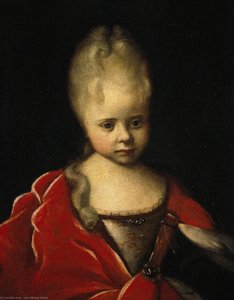
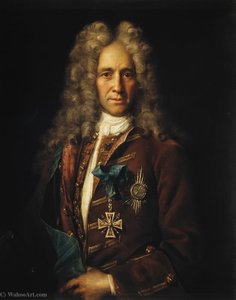
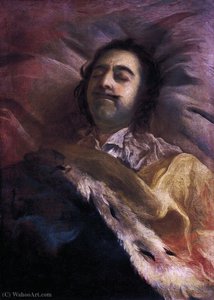
Nikitin’s oeuvre is characterized by a remarkable duality, spanning both the intimate psychological depth of portraiture and the sweeping drama of battle painting. In his portraits, he possessed a singular ability to capture the individual character and expression of his subjects, particularly the women of the imperial court. His works often feature an exquisite attention to detail, where the heavy textures of luxurious clothing and the delicate shimmer of accessories serve to ground the sitter in a tangible reality. Whether depicting Princess Anna Petrovna or the young Elizabeth of Russia, his brushwork transitioned from the stiff, symbolic forms of the seventeenth century to a more naturalistic, breathing presence that defined the new era.
Beyond the courtly elegance of his portraits, Nikitin holds a significant place in history as one of Russia's first notable battle painters. His depictions of monumental historical events, such as the Battle of Poltava and the Battle of Kulikovo, demonstrate his capacity to handle large-scale compositions and the chaotic energy of warfare. This versatility allowed him to document both the personal dignity of the ruling elite and the epic struggles that shaped the Russian state.
A Life of Turbulence and Legacy
Despite his proximity to imperial power, Nikitin’s life was marked by sudden and tragic upheaval. The very political fervor that fueled his artistic growth also led to his downfall. In 1732, following the distribution of pamphlets against the vice-Procurator of the Synod, Feofan Prokopovich, Nikitin and his brothers were arrested. The artist endured years of immense suffering, including torture and five years of imprisonment within the Peter and Paul Fortress, followed by a period of whipping and exile to Tobolsk. It was only through an amnesty signed by Anna of Russia that he was eventually permitted to return toward the center of Russian art.
The end of his journey was as poignant as its beginning; traveling from Siberia back toward Moscow, he passed away on the road in the early years of 1742. Though his life was cut short by the vagaries of political strife, his artistic legacy remained indelible. By bridging the gap between medieval Russian traditions and the burgeoning European Baroque, Ivan Nikitich Nikitin provided the visual vocabulary for a modernizing nation, leaving behind a body of work that remains a vital window into the soul of eighteenth-century Russia.
Întrebări și răspunsuri
Unde pot fi explorate operele lui Ivan Nikitich Nikitin, grupate pe teme și cuvinte cheie?
Pentru a găsi lucrări realizate de Ivan Nikitich Nikitin pe o temă specifică, accesați pagina După cuvinte cheie a artistului, unde operele sunt grupate pe cuvinte cheie.
Pot explora operele lui Ivan Nikitich Nikitin în funcție de tematică?
Operele lui Ivan Nikitich Nikitin pot fi explorate pe temă în pagina Atlas pe teme a artistului.
Pot să explorez lucrările lui Ivan Nikitich Nikitin pe categorii de mișcări artistice?
Operele lui Ivan Nikitich Nikitin pot fi explorate pe baza stilului artistic în pagina Toate mișcările de artă a artistului.