The Father of the Political Cartoon
In the vibrant and often turbulent landscape of late eighteenth-century Britain, few figures wielded as much satirical power as James Gillray. Often hailed as the "father of the political cartoon," Gillray possessed a singular ability to capture the anxieties, follies, and grand ambitions of his era through the medium of etching. Born in Chelsea, United Kingdom, he emerged from a background of meticulous craftsmanship, having first mastered the art of letter-engraving. This foundational skill in precise linework would later become the backbone of his legendary career, allowing him to translate complex political maneuvers into biting, visually arresting caricatures that resonated deeply with the public consciousness.
His artistic development was profoundly shaped by the works of William Hogarth, whose influence provided a blueprint for using art as a vehicle for social commentary. However, Gillray moved beyond mere observation, injecting his work with an unprecedented level of inventiveness and a keen sense of the ludicrous. His output, primarily published between 1792 and 1810, became a vital part of the British visual lexicon. Through his etchings—and occasionally utilizing aquatint and stipple techniques—he created a world where historical figures like Napoleon, George III, and various prime ministers were stripped of their dignity and recast as characters in a grand, often grotesque, theatrical drama.
Mastery of Satire and Technique
The brilliance of Gillray’s work lies in the seamless marriage of technical execution and narrative depth. While his subject matter was often topical and ephemeral, his mastery of the etching process ensured a lasting impact. His prints are characterized by intricate details and bold lines, capable of conveying both immense physical detail and profound emotional intensity. Whether he was employing a stark black and white palette to reflect the grim realities of war or using subtle tonal variations to capture the warmth of a domestic scene, his technical versatility allowed him to manipulate the viewer's mood with surgical precision.
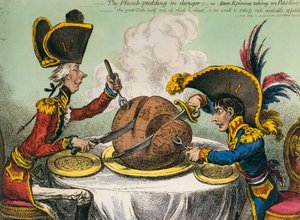
His approach to composition often utilized dramatic focal points to drive home his critiques. In works such as "The Zenith of French Glory," he used symbolic imagery—such as skeletal soldiers and grim metaphors—to voice a searing indictment of the French Revolution. Conversely, in pieces like "The Plum-Pudding in Danger," he demonstrated an ability to capture the quiet drama of conviviality and the material reality of Regency life. This duality—the ability to be both a ferocious political attacker and a nuanced observer of social ritual—is what elevated his work from mere caricature to high art.
Legacy and Historical Significance
The historical significance of James Gillray cannot be overstated. He did not merely record history; he helped shape the perception of it. His prints served as a mirror to the British psyche, reflecting the fears of revolution, the tensions of international conflict, and the shifting social hierarchies of the age. The enduring power of his imagery is evidenced by the fact that many of his most famous works are preserved in prestigious institutions like the National Portrait Gallery in London and Tate Britain.
Beyond his immediate era, Gillray’s influence persists in the very DNA of modern political cartooning. He established a standard for visual wit and social critique that continues to inspire satirists today. His life's work remains a testament to the power of the printed image to challenge authority, expose hypocrisy, and immortalize the complex spirit of an age defined by transformation.
Întrebări și răspunsuri
Cum pot urmări evoluția creațiilor lui James Gillray, an de an?
Există o cronologie a lucrărilor lui James Gillray: pagina Cronologia operelor de artă a artistului ordonează operele în funcție de data creației.
Pot studia utilizarea culorii de către James Gillray în toate lucrările sale?
Genoma Paletei lui James Gillray este o pagină care prezintă profilul cromatic al întregii creații a artistului.
Există o relatare cronologică a carierei lui James Gillray?
Cariera lui James Gillray se desfășoară etapă cu etapă pe pagina Cronologie a artistului: o cronologie orizontală a operelor de artă, grupate în capitole reprezentative ale perioadelor de activitate.