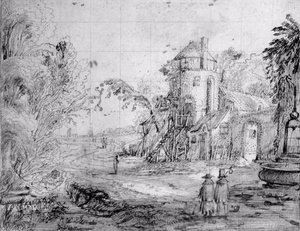
The Calligrapher of Light: The Life and Legacy of Jan van de Velde the Elder
In the vibrant tapestry of the Dutch Golden Age, where the brilliance of trade and intellectual discovery illuminated every corner of the Netherlands, few figures possess a legacy as multifaceted as Jan van de Velde the Elder. Born in Antwerp in 1568 and later finding his home in Haarlem, Van de Velde was far more than a mere painter; he was a master of the written word, an engraver, and a teacher whose influence rippled through the artistic communities of Rotterdam and Haarlem. While history often remembers the grand canvases of the era, Van de Velde’s true genius lay in the delicate precision of his hand—a skill that bridged the gap between the rhythmic beauty of calligraphy and the visual storytelling of the landscape.
His early life was shaped by a profound dedication to the art of writing. As a calligrapher and writing teacher, he possessed an intimate understanding of line and form, qualities that would later define his approach to visual arts. In 1592, his marriage to Mayken van Bracht brought him into influential circles, as his sister-in-law was connected to the prominent publisher Jan van Waesberghe. This connection allowed his artistry to reach a wider audience, particularly through his published works like the Spieghel der Schrijfkonste in 1605. Through these publications, Van de Velde did not merely teach a technique; he elevated calligraphy to a form of high art, treating every stroke of the pen with the same reverence one might accord a brushstroke on canvas.
A Mastery of Line and Landscape
As his career progressed, Van de Velde’s artistry expanded into the realm of engraving and landscape painting, where he began to infuse natural scenes with a subtle, human warmth. Influenced by the meticulous realism of Flemish traditions and the atmospheric depth found in Italian Renaissance masters, he developed a style that prioritized gezichtsbild—the art of scenic painting. His work was characterized by an extraordinary ability to capture the tranquil essence of the Dutch countryside, populating his landscapes with figures engaged in the quiet rhythms of everyday life. Unlike the dramatic and often turbulent compositions of the Baroque movement, Van de Velde’s approach championed a sense of profound serenity and clarity.
His technical development was marked by an obsession with detail and a mastery of tonal gradations. Whether he was engraving a complex scene or rendering the soft light hitting a rural path, his work maintained a consistent focus on atmospheric perspective. This ability to create depth through subtle shifts in color and light allowed him to transport the viewer into a world that felt both intimately familiar and breathtakingly vast. His collaborations, such as those with the artist Petrus Scriverius, further enriched his output, blending scientific observation with artistic intuition to create works that were as much about the truth of nature as they were about aesthetic beauty.
Historical Significance and Artistic Lineage
The historical importance of Jan van de Velde the Elder extends far beyond his individual achievements; he was a foundational figure in a lineage of Dutch greatness. His influence can be seen in the way he prepared the ground for the next generation of masters, most notably through his son, Jan van de Velde the Younger, who would become a celebrated painter and printmaker in his own right. The elder Van de Velde’s ability to merge the discipline of calligraphy with the expansiveness of landscape painting helped establish a new visual language for the Dutch Golden Age—one that found majesty in the mundane and divinity in the details of the natural world.
Today, when we look upon the works attributed to him, we see more than just historical artifacts; we encounter a window into a period of unparalleled artistic flourishing. His legacy remains etched in the very textures of his engravings and the quietude of his landscapes, reminding us that true mastery often resides in the balance between precision and soul. Through his life's work, Van de Velde ensured that the elegance of the line and the beauty of the earth would forever be intertwined in the annals of art history.
Întrebări și răspunsuri
Unde pot vizualiza operele lui Jan Van De Velde The Elder într-o galerie 3D?
O vizită virtuală este disponibilă: pagina Galerie 3D lui Jan Van De Velde The Elder prezintă lucrările artistului într-o galerie tridimensională.
Ce stări exprimă operele lui Jan Van De Velde The Elder?
Pagina Galerie pe stări de spirit lui Jan Van De Velde The Elder organizează operele de artă ale artistului în funcție de starea de spirit.
Unde și când s-a născut Jan Van De Velde The Elder?
Jan Van De Velde The Elder s-a născut în Haarlem, în anul 1568.