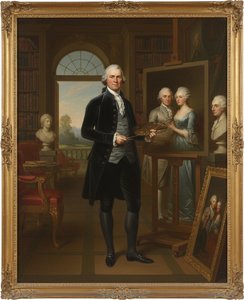
A Brief Brilliance: The Life of Nathaniel Smybert
In the quiet, burgeoning landscape of mid-18th-century Boston, a fleeting but significant light emerged in the form of Nathaniel Smybert. Born on January 20, 1734, to the esteemed Scottish-American painter John Smibert, Nathaniel was destined for the brush from his very first breaths. Growing up in the shadow of his father’s monumental influence, he did not merely observe art; he lived it. His early years were spent immersed in the technical rigors of the studio, absorbing the nuances of light, shadow, and the dignified poise required of colonial portraiture. As a pupil to his father, he inherited a legacy of precision and a deep connection to the burgeoning American artistic identity.
Though his time in the sun was tragically short, Smybert’s presence in the annals of American art is marked by an undeniable promise. He moved through the colonial art scene with the grace of a natural talent, honing a style that bridged the gap between European tradition and the raw, emerging spirit of the New World. His development was characterized by a rapid mastery of the portrait medium, a skill that allowed him to capture the very essence of the colonial elite. There was a certain gravity in his work, a sense of permanence that sought to immortalize the faces of a generation that was beginning to define itself apart from the Old World.
The Legacy of a Lost Master
The tragedy of Nathaniel Smybert lies in the profound "what if" that haunts his biography. Dying in November 1756 at the tender age of twenty-two, he departed the stage before he could truly claim his full maturity as an independent master. Yet, even within this brief window of activity, he achieved a level of recognition that few artists of his era could claim. He is often remembered alongside his father as a foundational figure in American portraiture, contributing to the very first wave of professional painting in the colonies.
His surviving works serve as poignant windows into the mid-18th century, offering more than just likenesses; they offer a glimpse into the social fabric of Boston. Some of his most notable contributions include:
- Portrait of Ezra Stiles: A work that captures the intellectual vigor of one of the era's most prominent figures.
- Portrait of Dorothy Wendell: A delicate and evocative piece held within the esteemed Collection of Dr. John L. Hale, showcasing his ability to render soft textures and human character.
- Architectural and Clerical Studies: His ability to capture the dignity of professionals like Peter Harrison through the lens of classical portraiture.
While his catalog may be small due to his untimely death, the historical significance of his work remains undiminished. He represents a vital link in the chain of American art history, proving that even a short-lived flame can leave an indelible mark on the canvas of time. To study Smybert is to witness the dawn of a colonial aesthetic, a moment when the brushstrokes of a young man in Boston began to shape the visual memory of a nation.
Întrebări și răspunsuri
În ce mișcări artistice a activat Nathaniel Smybert?
Stilurile în care a activat Nathaniel Smybert pot fi vizualizate pe pagina de Toate mișcările de artă a artistului, care grupează operele pe mișcări artistice.
Unde pot vizualiza operele lui Nathaniel Smybert într-o galerie 3D?
Pagina Galerie 3D a lui Nathaniel Smybert prezintă operele de artă ale artistului într-o galerie virtuală tridimensională.
Pot studia utilizarea culorii de către Nathaniel Smybert în toate lucrările sale?
Genoma Paletei lui Nathaniel Smybert este o pagină care prezintă profilul cromatic al întregii creații a artistului.
Cum pot găsi lucrările lui Nathaniel Smybert dintr-o anumită paletă de culori?
Pentru a găsi lucrări de Nathaniel Smybert dintr-o anumită paletă de culori, accesați pagina După paletă de culori a artistului.