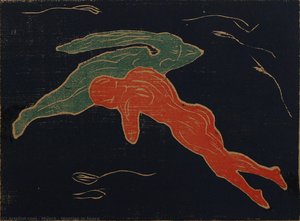
1897. Acrylic On Canvas. Tel Aviv Museum of Art.

§ 1Данные каталога


§ 2Абстракция
Описание предмета коллекционирования
 Читать далее
Биография художника
Эдвард Мунк: норвежский художник-экспрессионист, чьи картины "Крик" и другие произведения отражают тревогу, смерть и глубину человеческих эмоций.
§ 3Комментарий
A Descent into Darkness: Analyzing Edvard Munch’s “To the Forest”
The artwork, Edvard Munch's "To the Forest," stands as a haunting testament to the anxieties of the fin de siècle—a period marked by profound societal shifts and an increasing awareness of psychological complexities. Executed in 1897, this lithograph print embodies Munch’s signature Expressionist style, prioritizing emotional intensity over realistic representation. It's more than just a depiction of a woodland scene; it’s a visceral exploration of fear, isolation, and the yearning for connection amidst overwhelming darkness.- Subject Matter: The composition centers around two figures intertwined within a dense forest—a stark contrast between human intimacy and the oppressive grandeur of nature. Munch deliberately eschews detailed observation, opting instead to convey feeling through distorted forms and unsettling color palettes.
- Style & Technique: Munch’s Expressionism rejects Impressionistic ideals of capturing fleeting moments; rather, it seeks to express inner turmoil directly onto canvas. Lithography—a printing process utilizing stone or metal plates—was chosen for its ability to reproduce tonal variations with remarkable precision, mirroring the artist's preoccupation with conveying mood and atmosphere.
- Color Palette & Lighting: Dominating hues are deep greens and browns, reflecting the gloom of the forest but also hinting at decay. Subtle streaks of gold and blue serve as visual anchors, providing a fragile glimmer of hope against the pervasive darkness—a deliberate juxtaposition that underscores the emotional core of the piece. The diffused lighting reinforces the sense of mystery and unease, mirroring the psychological state of the figures depicted.
- Symbolism & Emotional Impact: The forest itself functions as a potent symbol of isolation and dread – an archetype frequently revisited in Munch’s oeuvre. More crucially, the embrace between the two individuals represents a desperate plea for solace and reassurance amidst existential anxieties. It speaks to universal themes of vulnerability and longing, resonating powerfully with viewers who recognize themselves within its melancholic beauty.
- Historical Context: Created during Munch's formative years, “To the Forest” reflects the broader intellectual currents of the time—particularly Nietzsche’s proclamation that "God is dead," which fueled a crisis of faith and spurred artists to grapple with questions of morality and meaning. Munch’s work anticipates the psychological explorations championed by Freud and Jung, cementing its place as an early landmark in modern art's preoccupation with the subconscious mind.
Вопросы и ответы
Как сочетаются контраст и гармония в работе «To the Forest»?
Цветовой анализ «To the Forest», Эдвард Мунк выявляет Serene контраст и Strong Color Unity гармонию.
В какой комнате, с учетом цветовой палитры, рекомендуется разместить «To the Forest»?
Цветовая палитра Earthy в работе «To the Forest», Эдвард Мунк идеально гармонирует с рекомендованным пространством: Living Room.
Насколько известно произведение «To the Forest», Эдвард Мунк?
«To the Forest» относится к категории Iconic.


 Перейти к печатным копиям


 Для произведений искусства или репродукций, размер которых превышает 105 см (приблизительно 41 дюйм) по любой из сторон, рама будет доставлена в разобранном виде (в виде комплекта). Этот метод обеспечивает безопасную доставку и предотвращает повреждения при транспортировке.