


 Предпросмотр
 Поделиться
 Поделиться
 Детали произведения

 Скачать
 Похожие работы
 Рентгенография
 Слайд-шоу
File Cutters
 Contemporary Realism
 1917
1917 31.0 x 47.0 cm
 Читать далее
Масляная репродукция ручной работы
Картина маслом на холсте в выбранном вами размере и раме, написанная на заказ нашими художниками. ( Купить принт Купить изображение)




































Выберите один из наших стандартных размеров, соответствующих оригинальным пропорциям произведения искусства.

Вы можете указать собственные размеры, чтобы картина идеально вписалась в выбранную раму или пространство. Если выбранный вами размер не соответствует пропорциям оригинала, мы либо обрежем полотно, либо расширим его за счет дополнительных элементов, написанных вручную. Цифровой макет будет отправлен вам на утверждение перед началом производства.
Обратите внимание, что предварительный просмотр на экране не отражает фактическую обрезку или расширение. Только макет точно покажет окончательную композицию.
Хотя доступны индивидуальные размеры, мы рекомендуем выбирать вариант из предопределенного списка, чтобы сохранить исходные пропорции.
После оформления заказа команда AllPaintingsStore.com свяжется с клиентом по электронной почте для уточнения деталей и предоставит предварительный макет
Доставка по всему миру () за 3–4 недели вместо стандартных 5 недель. (23 Август). Без компромиссов в качестве.

Бесплатная экспресс-доставка по всему миру

Высококачественный льняной холст

Полное страхование доставки

Гарантия возмещения таможенных пошлин

Гарантия точного соответствия цветов

Политика возврата в течение 60 дней (только при наличии дефектов)

Гарантия возврата 100% средств

Предложение оптовых скидок
 Вариант со стеклом доступен только для размеров менее 110 см

File Cutters
Техника репродукции
Размер репродукции
-


Итоговая стоимость
$ 383
Описание произведения
Industrial Setting and Women's Roles
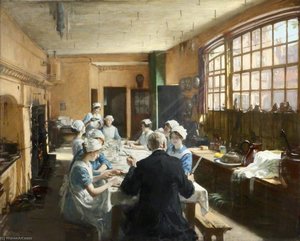
The scene depicts a group of women seated at tables with sewing machines, engaged in the production of clothing items such as dresses. The atmosphere suggests an industrial setting where teamwork and collaboration are essential. This painting highlights the significant role women played in the workforce during this period, often working in factories and contributing to the war effort. Key aspects of the painting include the attention to detail in the depiction of the sewing machines and the factory environment. The women appear focused and engaged in their tasks, demonstrating the importance of their work. For more information on industrial-themed paintings, visit Otto Friedrich Wilhelm Lietz: Industry in the Visual Arts at the Grohmann Museum.Artist and Style
Edward Frederick Skinner was a notable artist known for his contributions to the representation of industrial scenes. His style often featured detailed depictions of machinery and factory settings, as seen in "File Cutters" and other works like Coiling and Setting Springs and Making Bessemer Steel. These paintings provide a glimpse into the industrial era, showcasing the evolution of manufacturing processes.- Visit Painting by 'Edward Frederick Skinner': File Cutters to explore more about this artwork.
- Learn about the American frontier and its impact on industrial development.
The "File Cutters" by Edward Frederick Skinner is a significant artwork that highlights the importance of women's roles in the industrial era. Its detailed depiction of factory life and machinery makes it a fascinating piece for art enthusiasts and historians alike.
Похожие произведения




Биография художника
The Chronicler of the Industrial Soul
Edward Frederick Skinner, a name synonymous with the gritty, unvarnished reality of Britain’s industrial zenith, occupied a unique space in the early 20th-century art world. Born in London in 1865, Skinner emerged during an era defined by rapid technological expansion and a profound shift in the social fabric of the nation. While many of his contemporaries sought refuge in the ethereal beauty of idealized landscapes or the timeless grace of mythological subjects, Skinner turned his gaze toward the smoke-filled horizons of factories, mills, and workshops. His work serves as a visceral window into an age of iron and steam, capturing the transformative impact of machinery upon the human spirit and the physical landscape of England.
His artistic foundation was laid within the prestigious halls of the Slade School of Fine Art, where he underwent rigorous training under the watchful eyes of masters such as Frederic Leighton and Joseph Hooker. This academic lineage bestowed upon him a meticulous command of traditional techniques and an unwavering commitment to precision. It was this very discipline that allowed him to approach industrial subjects not with mere observation, but with a profound anatomical and structural accuracy. Skinner did not merely paint machines; he understood their weight, their texture, and the way they interacted with the light and the laborers who tended them.
A Realist Vision of Progress and Labor
The true essence of Skinner’s oeuvre lies in his refusal to romanticize the hardships of the working class. His breakthrough came through a seriesed of paintings that documented the pulsating heart of British industry. In works such as File Cutters, created in 1917, he captures the quiet intensity of women engaged in factory production. Through his brush, the rhythmic movement of sewing machines and the focused expressions of the laborers become symbols of a collective national effort. He utilized light not to soften the harshness of the factory floor, but to illuminate the dignity found within strenuous toil.
Skinner’s mastery of composition allowed him to weave complex narratives of productivity and order. In Forging Files, he employs a sophisticated use of warm colors and soft lighting to create a sense of familiarity within the industrial setting, yet he maintains an unflinching eye for the mechanical details that define the era. His ability to balance the monumental presence of heavy machinery with the delicate human elements of his subjects created a tension that mirrored the societal shifts of his time. Whether depicting the heat of a forge or the organized chaos of a machine shop, Skinner’s canvases act as historical documents, preserving the atmosphere of an era that was rapidly being reshaped by the very tools he so lovingly rendered.
War, Propaganda, and Lasting Legacy
As the shadows of World War I descended upon Europe, Skinner’s artistic mission took on a new, more urgent dimension. His talent was harnessed for the purpose of documentation and national morale, leading to commissions from the British Government. During this period, his work became an essential component of a concerted propaganda campaign, illustrating the vital role of munitions factories, naval shipyards, and the preparation of soldiers. In paintings like One of the Machine Shops, he captured the scale of wartime production, where large-scale weaponry and heavy transport were integrated into the daily landscape of labor.
The historical significance of Edward Frederick Skinner extends far beyond the aesthetic value of his oil paintings. He remains a pivotal figure for understanding the visual identity of the Industrial Age. His legacy is found in the way he bridged the gap between fine art and social documentation, elevating the factory floor to the status of a worthy subject for high art. Today, his works, many of which are preserved in institutions like the Science Museum in the United Kingdom, continue to offer profound insights into the evolution of manufacturing, the changing roles of women in the workforce, and the enduring, complex relationship between humanity and the machines we create.

edward frederick skinner
1865 - 1924
Основные сведения
- Artistic Movement Or Style: Realism
- Artists Or Movements Influenced By This Artist: ['Arts and Crafts Movement']
- Artists Who Influenced This Artist: ['William Morris']
- Date Of Birth: 1865
- Date Of Death: 1924
- Full Name: Edward Frederick Skinner
- Nationality: British
- Notable Artworks:
- Factory Scene I
- Coal Mine Landscape
- Place Of Birth: London, England
Похожие статьи

Эдвард Хоппер: 25 шедевров американского реализма для вашего интерьера
Погрузитесь в мир Эдварда Хоппера! 25 культовых картин американского реализма, полных света и тени. История искусства, техника живописи и вдохновение для вашего интерьера. Репродукции музейного качества на AllPaintingsStore.com.

Индустриальный Шик в Искусстве: 10 Шедевров для Стильного Интерьера
Погрузитесь в мир индустриального искусства! 10 шедевров от Моне до Пикассо, отражающих эпоху перемен и городскую жизнь. Репродукции картин высокого качества для стильного интерьера на AllPaintingsStore.com. Откройте всю коллекцию онлайн!

The Enduring Muse: Women as Subject & Symbol in Art History
Explore the rich history of women in art – from iconic muses to groundbreaking artists. Discover feminist movements, global perspectives & reclaim female narratives with AllPaintingsStore.

The Gritty Muse: Industrial Vibe as Defining Aesthetic in Modern Artwork
Explore the captivating world of industrial aesthetics in modern art. Discover key movements, influential artists & collecting insights at AllPaintingsStore.com – your source for museum-quality reproductions and expert art guidance.

Portrayals of Power & Perception: A Historical Survey of Women in Art
Explore the rich history of women in art – from iconic muses to groundbreaking artists. Discover feminist movements & reclaim female narratives with AllPaintingsStore. Expert insights for discerning collectors.


