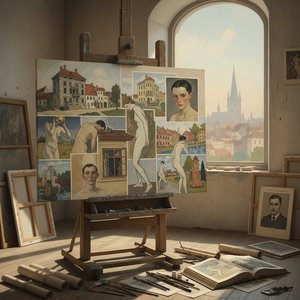
1910. Acrylic On Canvas, 313.0 x 449.0 cm. Музей Лепольда.

§ 1Данные каталога

- 313.0 x 449.0 cm


§ 2Абстракция
Описание предмета коллекционирования
 Читать далее
Биография художника
Эгон Шиле – экспрессионист, чьи работы полны тревоги и страсти. Его портреты, автопортреты и символические пейзажи исследуют границы человеческого существования. Откройте для себя мир Шилля!
§ 3Комментарий
A Portrait of Vulnerability: Exploring Egon Schiele’s ‘Nude Self-Portrait’
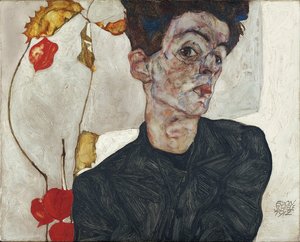
The painting “Nude Self-Portrait” by Austrian Expressionist Egon Schiele stands as a haunting testament to the artist's preoccupation with mortality and psychological exploration. Completed in 1910, this deceptively simple composition—measuring an imposing 313 x 449 cm—holds within it layers of profound symbolism and technical mastery that continue to captivate audiences today. Currently housed at the Leopold Museum in Vienna, Austria, Schiele’s self-portrait transcends mere representation; it delves into the artist's inner turmoil and confronts viewers with an unflinching gaze upon the human condition.The Expressionist Style: Distortion and Emotion
Schiele’s artistic vision firmly rooted in Expressionism prioritized conveying emotion over objective accuracy. Unlike Impressionists who sought to capture fleeting moments of light, Schiele deliberately distorted forms—particularly the nude figure—to express inner feelings of anxiety and isolation. The elongated torso, angular limbs, and compressed musculature contribute to a palpable sense of unease, mirroring the artist’s own psychological state during this period. This stylistic choice wasn't merely aesthetic; it was a conscious effort to communicate the anxieties inherent in confronting one's own vulnerability.Technique: Charcoal and Pastel – A Delicate Balance
Schiele employed charcoal and pastel on paper as his medium, achieving remarkable textural contrast. The stark black of the charcoal outlines defines the contours of the body with precision, while delicate pastel washes imbue the skin tones with subtle luminescence. This combination allows for a nuanced depiction of flesh—a material Schiele frequently explored in his work—revealing both its physicality and its fragility. The artist’s meticulous attention to detail underscores his desire not just to portray the figure but also to capture its psychological essence, highlighting the expressive potential of seemingly understated materials.Historical Context: Vienna at the Turn of the Century
Vienna in 1910 was a city undergoing significant social and intellectual transformation—the Austro-Hungarian Empire faced challenges from burgeoning nationalist sentiments, and artistic movements like Symbolism and Futurism wrestled with new ideas about representation. Schiele’s work reflects this atmosphere of uncertainty and disillusionment, aligning itself with the broader Expressionist movement's rejection of bourgeois ideals and embrace of subjective experience. The artist’s exploration of themes such as sexuality and death speaks to anxieties prevalent in Viennese society at the time—a period marked by repression and a fascination with taboo subjects.Symbolism: The Penis – A Bold Assertion
Perhaps the most striking element of “Nude Self-Portrait” is the prominent depiction of Schiele’s penis drawn on his torso. This deliberate inclusion transcends mere anatomical representation; it functions as a potent symbol of vulnerability, desire, and confronting one's own mortality. In Expressionist art, symbols often serve to convey deeper meanings beyond the literal surface. The drawing represents not only physical sexuality but also an acknowledgement of inescapable human limitations—a confrontation with the inevitability of death that permeates Schiele’s oeuvre. It is a bold gesture that challenges conventional notions of beauty and invites contemplation on the complexities of human existence.Emotional Impact: Confrontation and Reflection
“Nude Self-Portrait” compels viewers to confront uncomfortable truths about themselves and the human condition. The artist's gaze—direct, unflinching, and imbued with palpable emotion—forces us to contemplate our own mortality and vulnerability. Schiele’s work isn’t designed for passive admiration; it demands active engagement and invites introspection. It remains a powerfully evocative image that continues to resonate with audiences today, serving as a reminder of the enduring power of art to provoke thought and inspire emotional response.Вопросы и ответы
Как сочетаются контраст и гармония в работе «Nude Self-Portrait»?
Цветовая композиция «Nude Self-Portrait», Шиле сочетает в себе Gentle контраст с Unified Palette гармонией.
Кто является автором и в каком стиле выполнено произведение «Nude Self-Portrait»?
«Nude Self-Portrait» был создан Шиле в стиле Expressionist Movement. Автор и направление определяют художественную традицию этого произведения.
Из каких стран приезжают посетители «Nude Self-Portrait», Шиле?
Страница Статистика просмотров для работы «Nude Self-Portrait», Шиле содержит публичную статистику посещений: ежемесячное количество просмотров данного произведения, сравнение с наиболее популярными работами автора, а также географию посетителей.


 Перейти к печатным копиям


 Для произведений искусства или репродукций, размер которых превышает 105 см (приблизительно 41 дюйм) по любой из сторон, рама будет доставлена в разобранном виде (в виде комплекта). Этот метод обеспечивает безопасную доставку и предотвращает повреждения при транспортировке.