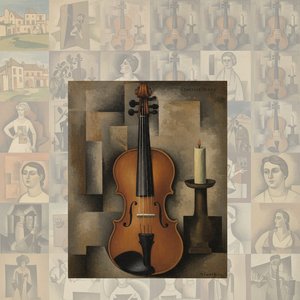
Acrylic On Canvas.

§ 1Catalogue data


Данное произведение защищено авторским правом
Произведение искусства, представленное на этой странице, защищено законом об авторском праве, что исключает возможность законного создания или продажи его точной репродукции. Данная защита обеспечивается международными соглашениями, такими как Бернская конвенция и национальным законодательством, включая положения, изложенные в Закон США об авторском праве — Раздел 17.
В качестве достойной и законной альтернативы мы предлагаем авторские картины ручной работы, вдохновленные оригиналом. Наши опытные профессиональные художники тщательно изучают стиль, настроение и художественную суть оригинала, чтобы создать новое, уникальное произведение, которое вызывает те же чувства, оставаясь при этом самостоятельным оригинальным творением.
Этот метод полностью соответствует нормам авторского права, так как он не предполагает копирования или дублирования защищенного произведения. Напротив, это творческая реинтерпретация — создание новой картины, которая вдохновлена оригиналом, но не является его точной копией.
 Подробнее
§ 2Abstract
Описание предмета
Georges Braque’s "Bistre Bird" is a pivotal Cubist study of avian form & flight. Explore fragmented shapes, earthy tones, and the dawn of modern art's revolutionary perspective. Hand-painted reproduction.
Биография художника
Жорж Брэк – пионер кубизма и мастер фавианства! Его новаторские картины, такие как «Дома в Л’Эстаке», поражают смелостью форм и цветом. Откройте мир искусства 20 века!
§ 3Commentary
Georges Braque’s “Bistre Bird”: A Study in Form and Flight
Georges Braque's "Bistre Bird," a captivating study in avian form, offers a glimpse into the artist’s pivotal role in the development of Cubism. Painted around 1908-1912 – a period of intense experimentation and collaboration with Pablo Picasso – this work transcends mere representation, becoming a profound exploration of perception and spatial relationships. The painting depicts a bird in mid-flight, its wings outstretched as if caught in an eternal moment of propulsion. Its plumage is rendered in shades of brown—a “bistre” hue that lends the piece a quiet dignity and earthy resonance – contrasting beautifully against the vibrant blue expanse of the sky. Noticeably, Braque doesn’t aim for photographic realism; instead, he dissects the bird's form into fragmented geometric shapes, mirroring the core tenets of Cubism. This approach wasn’t born in isolation; Braque’s early training as a house painter instilled within him an acute awareness of structure and perspective – skills that would prove invaluable as he dismantled traditional artistic conventions.
The Dawn of Cubism: Deconstructing Reality
“Bistre Bird” is inextricably linked to the revolutionary movement of Cubism, a style that emerged in Paris around 1907. Braque and Picasso, driven by a shared desire to challenge established notions of perspective and representation, began to break down objects into their constituent parts and reassemble them on the canvas from multiple viewpoints simultaneously. This wasn’t simply an aesthetic choice; it was a philosophical one, reflecting a growing interest in scientific theories of optics and the way our eyes perceive depth. The painting exemplifies this approach – the bird's wings are not presented as a single, continuous surface but rather as a series of overlapping planes, each rendered with careful attention to light and shadow. The background sky is similarly fragmented, suggesting an infinite space beyond the confines of the canvas. This deliberate distortion of reality aimed to capture the essence of an object – its underlying structure – rather than merely imitating its appearance.
Influences and Techniques: Cézanne’s Legacy
Braque's artistic journey leading up to "Bistre Bird" was profoundly shaped by the work of Paul Cézanne, a Post-Impressionist painter whose emphasis on geometric forms and multiple perspectives served as a crucial precursor to Cubism. Cézanne’s meticulous studies of landscapes and still lifes, particularly his exploration of how light interacts with solid objects, deeply influenced Braque's approach to composition and form. The artist spent considerable time studying Cézanne’s retrospective exhibition in 1907, recognizing the profound impact it would have on the avant-garde movement. Technically, Braque employed a technique known as “Analytical Cubism,” characterized by monochromatic color palettes – predominantly browns, grays, and ochres – and a focus on dissecting objects into their basic geometric components. The brushstrokes are often subtle and precise, contributing to the painting’s overall sense of controlled fragmentation.
Symbolic Resonance: Flight, Freedom, and Observation
Beyond its formal innovations, “Bistre Bird” carries a potent symbolic weight. The act of flight itself represents freedom, aspiration, and transcendence – themes that resonated deeply with the artists of the early 20th century. The bird’s poised stance suggests both vulnerability and strength, inviting contemplation on the delicate balance between observation and interpretation. Braque's choice of “bistre,” a muted brown tone, adds to this sense of quiet introspection. It evokes the earth, grounding the soaring image while simultaneously hinting at the vastness of the sky. Ultimately, "Bistre Bird" is not simply a depiction of a bird in flight; it’s an invitation to engage with the complexities of perception and the enduring power of art to transform our understanding of the world.
Вопросы и ответы
Что изображено на картине «Bistre bird», Жорж Брак и какое настроение она передает?
На полотне «Bistre bird» запечатлены bird flight, blue sky, brown bird, composition, movement, aviary, braque, а передаваемая им атмосфера — Earthy.
Как контраст и гармония сочетаются в работе «Bistre bird»?
Цветовая композиция «Bistre bird», Жорж Брак сочетает в себе Statement контраст с Discordant Palette гармонией.
Является ли произведение «Bistre bird» общественным достоянием?
Произведение «Bistre bird», Жорж Брак находится в все еще защищено авторским правом. Этот статус определяет правила воспроизведения изображения данного произведения.



 Переключиться на печать


 Для произведений искусства или репродукций, размер которых превышает 105 см (приблизительно 41 дюйм) по любой из сторон, рама будет доставлена в разобранном виде (в виде комплекта). Этот метод обеспечивает безопасную доставку и предотвращает повреждения при транспортировке.