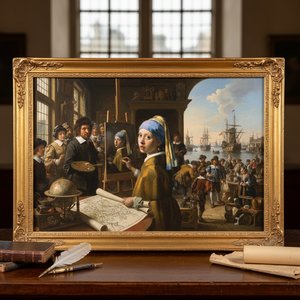
Young Drinker
Acrylic On Canvas. Residenzgalerie.
§ 1Catalogue data
§ 2Abstract
Описание предмета
Experience 'Young Drinker' by Gerard van Honthorst! This captivating Baroque painting showcases a contemplative youth enjoying wine, rich with light and symbolism. Explore its details & artistic context.
Биография художника
Герارد ван Хонторст – выдающийся голландский художник эпохи барокко, известный своими драматичными картинами с использованием светотени (кьяроскуро) и яркими портретами. Его работы отражают влияние Караваджо и стали важной частью искусства Нидерландов.
§ 3Commentary
A Moment of Quiet Contemplation: Gerard van Honthorst’s “Young Drinker”
Gerard van Honthorst's "Young Drinker," painted circa 1625, is more than a simple depiction of youth indulging in wine; it’s a carefully constructed tableau brimming with symbolism and bathed in the dramatic chiaroscuro that defined the artist’s signature style. This captivating portrait, now housed within the Centraal Museum in Utrecht, offers a glimpse into the complexities of 17th-century Dutch society – its burgeoning mercantile class, its fascination with pleasure, and its underlying tensions between piety and indulgence. Honthorst, a key figure in the Utrecht Caravaggisti School, expertly channels the influence of Caravaggio, particularly his masterful use of light and shadow to create an atmosphere of intense drama and psychological depth.
The painting immediately draws the eye to the young man seated at a table, seemingly lost in thought as he sips from a glass. His posture is relaxed yet alert, suggesting a moment of quiet contemplation amidst the bustle of daily life. The details are meticulously rendered: the delicate curve of his neck, the subtle flush on his cheeks, and the intricate folds of his blue garment all speak to Honthorst’s exceptional technical skill. However, it's not merely a study in realism; the artist employs a sophisticated system of visual cues to convey deeper meaning.
The Language of Light and Shadow: Honthorst’s Chiaroscuro
Honthorst’s mastery lies in his manipulation of light and shadow – a technique known as *tenebrism*. He doesn't simply illuminate the scene; he sculpts it with carefully placed pools of light that dramatically contrast with areas of deep darkness. This creates a powerful sense of depth, drawing the viewer into the intimate space of the room. The candle flame, positioned strategically to highlight the young man’s face and upper body, acts as a focal point, guiding our gaze and intensifying the emotional impact of the scene. The surrounding shadows are not merely absences of light; they contribute significantly to the painting's overall mood – suggesting mystery, introspection, and perhaps even a hint of melancholy.
Notice how the light subtly reveals details while obscuring others. The open book on the table, adorned with illustrations depicting classical scenes, hints at intellectual pursuits, yet these are overshadowed by the immediate pleasure of the drink. This juxtaposition speaks to the central theme of the painting: the tension between reason and desire, knowledge and indulgence.
Symbolism and Social Commentary
Beyond the technical brilliance, “Young Drinker” is rich in symbolic detail. The young man’s attire – a blue hat adorned with a feather – subtly references status and perhaps even a hint of aristocratic aspiration. The book itself offers further clues: its illustrations depict scenes from mythology, suggesting an engagement with classical ideals but also hinting at the potential for these ideals to be corrupted by earthly pleasures. Crucially, the open book is juxtaposed against the young man’s enjoyment of wine – a potent symbol of both celebration and excess.
The inclusion of the small bird in his hand adds an element of surprise and perhaps even a touch of whimsy. Birds are often associated with freedom, hope, and spirituality, yet their presence here seems somewhat incongruous, suggesting a fleeting moment of innocence amidst a world increasingly dominated by worldly concerns.
A Window into 17th-Century Dutch Life
“Young Drinker” provides a valuable window into the social and cultural landscape of 17th-century Holland. It reflects the growing prosperity of the merchant class, their embrace of luxury and pleasure, and their ongoing struggle to reconcile these desires with traditional values. Honthorst’s painting captures not just a portrait but an entire era – a time of artistic innovation, economic expansion, and profound social change. Reproductions of this compelling work offer a chance to bring this evocative scene into your own home, inviting contemplation and sparking conversation about the enduring themes of human experience.
Вопросы и ответы
Какова насыщенность цветов в работе «Young Drinker», Герхард ван Хонторст?
Цвета в работе «Young Drinker», Герхард ван Хонторст обладают Subtle Color насыщенностью. Насыщенность определяет, насколько яркими или приглушенными являются цвета.
Является ли произведение «Young Drinker», Герхард ван Хонторст общественным достоянием?
Что касается авторских прав, произведение «Young Drinker» находится в является общественным достоянием — срок действия авторского права истек.
Какой основной оттенок у «Young Drinker», Герхард ван Хонторст?
Преобладающий оттенок произведения «Young Drinker», Герхард ван Хонторст — Amber to Saffron. Этот оттенок является основополагающим тоном палитры.
§ 4The artist
Герхард ван Хонторст
1590 - 1656, Нидерланды
Краткая справка
- Artistic Movement Or Style: Барокко, Караваджизм
- Artists Or Movements Influenced By This Artist: ['Утрехтский Караваджизм']
- Artists Who Influenced This Artist: ['Микеланджело да Караваджо']
- Date Of Birth: 1592 г.
- Date Of Death: 1656 г.
- Full Name: Герхард ван Хонторст
- Nationality: Нидерландский
- Notable Artworks:
- Христос перед высоким жрецом
- Взятие Христа
- Place Of Birth: Утрехт, Нидерланды
Биография художника
A Master of Light and Shadow: The Life and Art of Gerard van Honthorst
Gerard van Honthorst, a name synonymous with dramatic intensity and masterful light manipulation, emerged from Utrecht in 1592 as a pivotal figure poised to enrich the Dutch Golden Age. Initially guided by his father, a skilled decorative painter, young Gerard’s innate talent blossomed under the tutelage of Abraham Bloemaert, establishing a solid foundation in draftsmanship and composition – a crucial stepping stone towards his future brilliance. However, it was a transformative journey to Rome that irrevocably altered the course of his artistic development, forever shaping his signature style and earning him the evocative nickname “Gherardo delle Notti,” or Gerard of the Nights. The encounter with Caravaggio’s revolutionary approach to light and shadow – the bold use of tenebrism – became the cornerstone of Honthorst's oeuvre, imbuing his canvases with a palpable sense of drama, psychological depth, and an undeniable theatricality. He didn’t merely imitate Caravaggio; he skillfully translated the Italian master’s innovations into a distinctly Dutch sensibility, focusing on intimate scenes bathed in the warm glow of candlelight, lamps, and flickering hearth fires – creating an atmosphere simultaneously realistic and profoundly captivating. This mastery over light wasn't simply technical prowess; it was a deliberate means of revealing character, of drawing the viewer directly into the emotional core of each depicted scene, inviting them to witness secrets and unspoken narratives.Roman Acclaim and the Foundations of His Style
Honthorst’s time in Rome between 1616 and approximately 1620 was a period of remarkable success and significant patronage. He quickly established himself within the city's vibrant artistic circles, gaining favor amongst its elite, including Vincenzo Giustiniani, for whom he created the monumental “Christ Before the High Priest,” now residing in London’s National Gallery. This painting stands as a prime example of Honthorst’s technical mastery and his ability to convey profound psychological complexity within his figures – a testament to his deep understanding of human emotion. Beyond simply replicating Caravaggio's techniques, Honthorst subtly adapted them to suit the Dutch aesthetic, prioritizing clarity and a more restrained emotional palette compared to the Italian master’s often overwhelming intensity. He also benefited from exposure to other influential artists of the era, including Bartolomeo Manfredi and the Carracci family, absorbing their diverse approaches to composition, color theory, and subject matter. The Palazzo Giustiniani, where he resided, served as a hub for artistic exchange, fostering an environment conducive to experimentation and innovation. This Roman period wasn’t just about technical refinement; it was a crucible in which Honthorst forged his unique artistic identity – a synthesis of Italian drama and Dutch realism.Return to the Netherlands and Royal Commissions
Upon returning to Utrecht around 1620, Honthorst swiftly established himself as a leading portrait painter within the burgeoning Dutch Republic. His ability to capture not just physical likeness but also the character, social standing, and inner life of his subjects made him exceptionally sought after by wealthy merchants, noble families, and even members of the royal court. He became president of the St. Luke’s Guild in Utrecht in 1623 – a prestigious appointment that underscored his growing influence within the artistic community. This period witnessed a prolific output of commissions, allowing Honthorst to further refine his style and develop a distinctive visual language characterized by dramatic lighting, dynamic compositions, and an acute awareness of human psychology. He produced numerous portraits of prominent figures, including members of the Stadtholder’s family and wealthy merchants, each imbued with a sense of realism and psychological depth. His work during this time demonstrates a remarkable versatility, ranging from formal court portraits to more intimate genre scenes depicting everyday life.The Utrecht Caravaggisti and Artistic Collaboration
Honthorst was a key figure in the *Utrecht Caravaggisti* movement – a group of Dutch painters who were deeply influenced by the dramatic realism and tenebrism pioneered by Caravaggio. Alongside artists like Hendrick ter Brugghen and Dirck van Baburen, Honthorst helped to establish a distinctly Dutch interpretation of Italian Baroque style, adapting its intensity and emotional power to suit the sensibilities of the Dutch Republic. This movement represented a significant shift in Dutch painting, moving away from the more restrained Mannerist styles prevalent in earlier decades. The *Utrecht Caravaggisti* were not simply imitators; they developed their own unique approaches to light, color, and composition, creating works that were both deeply rooted in Italian tradition and distinctly Dutch in character. Furthermore, Honthorst’s willingness to collaborate with other artists – notably Peter Paul Rubens during a visit to Utrecht – speaks volumes about his open-mindedness and artistic generosity. These collaborations weren't merely pragmatic arrangements; they represented intellectual exchanges that enriched the artistic landscape and broadened the horizons of both artists involved.Legacy and Enduring Influence
Gerard van Honthorst’s influence resonated far beyond his lifetime. He remains a pivotal figure in Dutch art history, celebrated for his dramatic use of light and shadow, his insightful portraits, and his ability to capture the complexities of human emotion. His paintings continue to captivate audiences today, offering a glimpse into the vibrant artistic world of the Dutch Golden Age. The *Diana and Apollo* painting, now housed at Hampton Court Palace, stands as a testament to his skill and artistry, while his numerous drawings provide valuable insights into his creative process. Honthorst’s legacy extends beyond individual works; he helped to shape the development of Dutch Baroque painting, inspiring generations of artists who followed in his footsteps. His ability to seamlessly blend Italian influences with Dutch sensibilities ensured his lasting impact on the artistic landscape, reminding us that true artistry lies not just in technical skill but also in the capacity to evoke emotion and illuminate the human condition.§ 5Comparanda
Похожие произведения
§ 6Questions
§ 7Further reading
Cite this entry
AllPaintingsStore.com, “Герхард ван Хонторст, Young Drinker”, https://allpaintingsstore.com/ru/art/gerard-van-honthorst-young-drinker-8XZH4S-en/ (accessed 1 Октябрь 2026).
§ 8The reproduction
Масляная репродукция ручной работы
Картина маслом на холсте в выбранном вами размере и раме, написанная на заказ нашими художниками. ( Переключиться на печать
Перейти к цифровым изображениям)
It is specified on the order sheet in the margin; the present state of that sheet reads as follows.
Young Drinker
Материал репродукции
Размер репродукции
-
Ведущий мастер элитного уровня
Более высокая детализация, изысканность и дополнительное время на создание работы
-
Рама для репродукции
-
-
Для произведений искусства или репродукций, размер которых превышает 105 см (приблизительно 41 дюйм) по любой из сторон, рама будет доставлена в разобранном виде (в виде комплекта). Этот метод обеспечивает безопасную доставку и предотвращает повреждения при транспортировке.
Требуется профессиональная сборка — это не продукт для самостоятельной сборки (DIY).
Комплект должен быть собран, а холст натянут опытным мастером по багетным рамам с использованием клеевого ПВА (не входит в комплект), струбцин для натяжки холста и зажимов, чтобы удерживать подрамник ровным до полного высыхания клея. Неправильная сборка или неравномерное натяжение холста могут привести к необратимому повреждению произведения искусства и не являются гарантийным случаем.
В комплект входят все бруски из массива дерева, точно вырезанные по размеру.
Собирается с помощью предоставляемых винтов, а также столярного клея для угловых соединений, который не входит в комплект и должен быть приобретен вашим мастером.
Требуются профессиональные инструменты, не входящие в комплект: щипцы для натяжки холста (натяжитель) и зажимы, чтобы удерживать рейки ровно во время высыхания клея.
Важно:
Для соединения углов требуется клей для дерева, перекладины необходимо зафиксировать струбцинами до полного высыхания клея, а для натяжки холста на собранную раму требуются щипцы для натяжки холста. Ни один из этих инструментов не входит в комплект. Пожалуйста, убедитесь в наличии опытного мастера по багетным работам перед заказом рамы такого размера.
Экспликация
-
-
Защитный лак
Глянцевый лак (насыщает цвета, защищает от воздействия света и влаги)
-
Настроить мою картину
Примеры возможных изменений: замена лица на фото клиента; добавление домашнего питомца (например, замена кошки на собаку); добавление скрытого сообщения на фоне; изменение пейзажа или элементов фона.
-
Срочно
Доставка по всему миру () за 3–4 недели вместо стандартных 5 недель. (29 Октябрь). Без компромиссов в качестве.
-
Экспресс-доставка
Доставка по всему миру () в течение 5 недель. (5 Ноябрь).
Включено
Итоговая стоимость
$ 258
Included with every order
- Бесплатная экспресс-доставка по всему миру
- Высококачественный льняной холст
- Полное страхование при транспортировке
- Гарантия возврата таможенных пошлин
- Гарантия точного цветового соответствия
- 100-дневный период возврата (только при обнаружении дефектов)
- Гарантия возврата 100% средств
- Скидка при заказе нескольких работ


Для произведений искусства или репродукций, размер которых превышает 105 см (приблизительно 41 дюйм) по любой из сторон, рама будет доставлена в разобранном виде (в виде комплекта). Этот метод обеспечивает безопасную доставку и предотвращает повреждения при транспортировке.