Гарантия возврата средств · 100 дней Бесплатная доставка по всему миру
449 587произведения искусства 30 613художники 4 660музеи 32языки
Валюта
    Язык
      Ателье · Осн. в 2015 г. · Париж, Франция
      AllPaintingsStore
      allpaintingsstore.com
      Catalogue entry

      Colored alphabet

      Acrylic On Canvas.

      Fig. 1. Джеймс Джонс, Colored alphabet. Shown as the reproduction you are specifying: , .

      § 1Catalogue data

      § 2Abstract

      Описание предмета

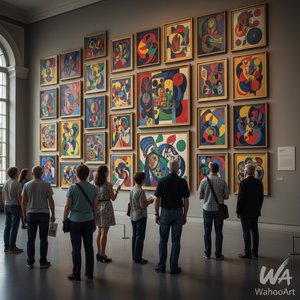
      A vibrant explosion of color featuring Jasper Johns’ iconic alphabet painting, showcasing his unique approach to abstraction and symbolism from the 1950s. Discover this captivating artwork and bring a touch of Johns' genius into your space.

      Биография художника

      Джеймс Джонс (1930) – пионер поп- и абстрактного экспрессионизма! Знаменитые работы: флаг, карты, мишени – переосмысление современного искусства. Откройте для себя мир символов!

      § 3Commentary

      Jasper Johns’ ‘Colored Alphabet’: A Play of Symbols and Perception

      Jasper Johns' "Colored Alphabet," created around 1959, stands as a deceptively simple yet profoundly complex work within the artist’s evolving body of exploration. This painting isn’t merely an arrangement of letters; it’s a meticulously crafted meditation on perception, representation, and the very nature of meaning itself – themes central to Johns' groundbreaking approach to art in the mid-20th century. The piece immediately draws the eye with its vibrant palette, a deliberate departure from the monochrome often associated with Abstract Expressionism, aligning it subtly with the burgeoning Pop Art movement that would soon challenge traditional artistic hierarchies.

      • Subject Matter: The core subject is undeniably the alphabet – 26 letters, both uppercase and lowercase, presented in isolation.
      • Color as a Key Element: Each letter is rendered in a distinct color, creating a visually arresting composition that elevates the mundane to the extraordinary. This chromatic layering isn’t arbitrary; it's a calculated strategy to disrupt conventional reading and viewing habits.
      • Abstract Arrangement: The letters are arranged without any discernible order or pattern, further emphasizing their symbolic weight rather than their functional purpose.

      The Roots of Iconography in Johns’ Work

      Understanding the context surrounding “Colored Alphabet” is crucial to appreciating its significance. Johns emerged during a period of intense artistic experimentation following World War II. The Abstract Expressionists, with their emphasis on raw emotion and gestural abstraction, had dominated the art scene, but Johns sought to move beyond purely subjective expression. He began to incorporate recognizable imagery – maps, flags, numbers, and, crucially, letters – into his work, transforming them into symbols that carried layers of cultural and personal meaning. This fascination with iconography reflects a broader postwar anxiety about identity, national narratives, and the increasingly mediated nature of reality.

      As documented in The Art Institute of Chicago’s collection, Johns utilized stencils as a key component of his process, adding another layer of complexity to the work. This technique is evident in "Colored Alphabet," where the precise execution of each letter suggests a deliberate engagement with the tools and methods of mass production – a subtle commentary on the role of images in contemporary society.

      Technique and Materiality

      The painting’s surface reveals Johns' meticulous attention to detail. The letters are rendered with a smooth, almost enamel-like finish, achieved through careful layering of paint. This technique creates a tactile quality that invites close examination, encouraging the viewer to consider not just what they see but also how it was made. The use of bright, saturated colors further enhances this sense of materiality, emphasizing the physicality of the artwork and challenging the traditional notion of painting as purely an illusionistic medium.

      Symbolic Resonance and Emotional Impact

      "Colored Alphabet" transcends a simple depiction of letters; it becomes a potent symbol of communication, knowledge, and perhaps even the limitations of language itself. The isolated letters disrupt our ability to read and comprehend, forcing us to confront the inherent ambiguity of representation. Johns’ work invites contemplation on how we interpret images and symbols, and how these interpretations shape our understanding of the world. It's a piece that resonates with a quiet intensity, prompting viewers to question their own perceptions and assumptions – a hallmark of Johns’ enduring artistic legacy.

      Вопросы и ответы

      Можно ли увидеть «Colored alphabet», Джеймс Джонс при другом освещении?

      Страница Рентгеновский снимок произведения «Colored alphabet», Джеймс Джонс представляет собой интерактивный просмотрщик, позволяющий перемещаться между одиннадцатью оптическими слоями изображения, включая рентгеновский вид.

      Какой художник и какой стиль стоят за «Colored alphabet»?

      За произведением «Colored alphabet» стоят Джеймс Джонс и направление Pop Art.

      О чем повествует «Colored alphabet» и какая атмосфера в ней царит?

      На полотне «Colored alphabet» запечатлены alphabet, jasper johns, color blocks, abstract art, iconography, pop art, visual symbols, а передаваемая им атмосфера — Calm.

      § 4The artist

      Джеймс Джонс

      Джеймс Джонс

      1930 - , Соединенные Штаты Америки

      Quick facts about Джеймс Джонс

      • Artistic Movement Or Style: Поп-арт, Абстрактный экспрессионизм
      • Artists Or Movements Influenced By This Artist:
        • Ворхол
        • Лихтенштейн
      • Artists Who Influenced This Artist:
        • Дюшан
        • Ротко
      • Date Of Birth: 15 мая 1930 г.
      • Full Name: Jasper Johns
      • Nationality: Американский
      • Notable Artworks:
        • Flag
        • Target
        • Map
      • Place Of Birth: А Augusta, США

      Биография художника

      A Life Painted in Symbols: The World of Jasper Johns

      Jasper Johns emerged as a pivotal figure in the landscape of American art, bridging the emotive intensity of Abstract Expressionism with the burgeoning Pop Art movement that would soon redefine artistic boundaries. Born in Augusta, Georgia, in 1930, his early life was marked by a sense of displacement following his parents’ divorce, an experience that perhaps subtly informed his later explorations of identity and belonging within the context of American iconography. His formative years unfolded across various schools before he briefly attended the University of South Carolina, but it wasn't until his move to New York City in 1949 that Johns truly began to forge his artistic path. A period of service during the Korean War further shaped his perspective, exposing him to a world far removed from the burgeoning art scene he was eager to embrace upon his return.

      Breaking with Abstraction: The Dawn of a New Visual Language

      The post-war American art world was dominated by Abstract Expressionism—a style characterized by spontaneous gesture and deeply personal emotional expression. While initially influenced by this movement, Johns felt compelled to move beyond its purely non-representational approach. He sought a new visual language, one that incorporated recognizable imagery not as illustrations but as vehicles for deeper contemplation. This wasn’t simply about *depicting* the world; it was about questioning how we perceive and interpret symbols within it. Key influences guided his departure: Marcel Duchamp's radical readymades challenged conventional notions of art-making, forcing a reevaluation of what constituted “art,” while the emphasis on materiality in Abstract Expressionism informed Johns’ early techniques—particularly his use of encaustic, a mixture of pigment and hot wax that allowed for layered textures and subtle shifts in color. However, it was the everyday objects and potent symbols of American culture—flags, targets, maps, numbers—that truly became central to his artistic vocabulary. He wasn't interested in escaping representation; he wanted to dissect it, layer it with meaning, and ultimately reveal its inherent ambiguities.

      Iconic Images: Flags, Targets, and the Language of Symbols

      Johns’ breakthrough works arrived in the mid-1950s, instantly establishing him as a force to be reckoned with. His paintings of flags, most notably *Flag* (1954–55), were not patriotic declarations but rather investigations into the very nature of representation. Rendered in a semi-abstract style, using encaustic—pigment mixed with hot wax—and collage techniques, these flags weren’t simply images; they were textured surfaces laden with symbolic weight. The image itself was deliberately ambiguous – a depiction of the American flag, yet simultaneously a study in its materiality and construction. The target series, beginning in 1958, further explored this fascination with recognizable forms, questioning perception and meaning through the seemingly straightforward image of a bullseye. *Map* (1961), with its fragmented and layered depictions of the United States, delved into themes of geography, identity, and the complexities of national representation. Works like *False Start* (1959) demonstrated his experimentation with language and visual codes, creating complex compositions that challenged viewers to decipher their underlying meanings. Even *White Flag* (1955), a seemingly simple monochrome canvas, prompted profound questions about absence, surrender, and the very act of seeing.

      The Influence of Rauschenberg and Neo-Dada

      Johns’ artistic evolution was profoundly shaped by his close collaboration with Robert Rauschenberg. Their shared interest in blurring the boundaries between art and life led to a dynamic exchange of ideas and techniques. Rauschenberg's "combine paintings," incorporating found objects and collage elements, influenced Johns’ approach to layering imagery and challenging traditional notions of artistic authorship. This period also saw a strong influence from Neo-Dada, with its playful appropriation of everyday objects and its rejection of established art conventions. Johns embraced this spirit of experimentation, using techniques like assemblage and ready-made elements in his work, further complicating the relationship between image and reality.

      Recognition and Enduring Impact

      Jasper Johns has received numerous accolades throughout his illustrious career. He was awarded the Golden Lion at the Venice Biennale in 1988, a testament to his enduring influence on the art world. In 1990, he was presented with the National Medal of Arts, recognizing his significant contributions to American culture. He also received the Presidential Medal of Freedom in 2011, the highest civilian honor bestowed by the United States government. His works are held in major museum collections throughout the world—the Museum of Modern Art, the Whitney Museum of American Art, the Metropolitan Museum of Art in New York, and Tate Modern in London, to name just a few. Johns’ impact extends beyond his paintings; he has been a significant contributor to printmaking and sculpture, demonstrating his versatility and unwavering commitment to artistic innovation. His enduring legacy lies not only in the iconic images he created but also in the profound questions he raised about the nature of representation, symbolism, and the very essence of what it means to be an artist in a rapidly changing world. He remains an active artist, constantly evolving his approach and solidifying his position as one of the most important figures in 20th and 21st-century art.

      § 5Comparanda

      § 6Questions

      Краткая справка

      • Medium: Acrylic on canvas
      • Title: Colored Alphabet
      • Movement: Pop Art, Iconography
      • Subject or theme: Alphabet, Symbols
      • Notable elements: Colored letters, stencils

      § 7Cite this entry

      AllPaintingsStore.com, “Джеймс Джонс, Colored alphabet”, https://allpaintingsstore.com/ru/art/jasper-johns-colored-alphabet-AE3MV4-en/ArtistReproduction/ (accessed 2 Октябрь 2026).

      § 8The reproduction

      Масляная репродукция ручной работы

      Картина маслом на холсте в выбранном вами размере и раме, написанная на заказ нашими художниками. ( Переключиться на печать Перейти к цифровым изображениям)

      It is specified on the order sheet in the margin; the present state of that sheet reads as follows.

      Colored alphabet

      Материал репродукции

      Размер репродукции

      -

      Ведущий мастер элитного уровня

      Более высокая детализация, изысканность и дополнительное время на создание работы

      -

      Рама для репродукции

      -

      -

      Для произведений искусства или репродукций, размер которых превышает 105 см (приблизительно 41 дюйм) по любой из сторон, рама будет доставлена в разобранном виде (в виде комплекта). Этот метод обеспечивает безопасную доставку и предотвращает повреждения при транспортировке.

      Требуется профессиональная сборка — это не продукт для самостоятельной сборки (DIY).
      Комплект должен быть собран, а холст натянут опытным мастером по багетным рамам с использованием клеевого ПВА (не входит в комплект), струбцин для натяжки холста и зажимов, чтобы удерживать подрамник ровным до полного высыхания клея. Неправильная сборка или неравномерное натяжение холста могут привести к необратимому повреждению произведения искусства и не являются гарантийным случаем.

      • В комплект входят все бруски из массива дерева, точно вырезанные по размеру.

      • Собирается с помощью предоставляемых винтов, а также столярного клея для угловых соединений, который не входит в комплект и должен быть приобретен вашим мастером.

      • Требуются профессиональные инструменты, не входящие в комплект: щипцы для натяжки холста (натяжитель) и зажимы, чтобы удерживать рейки ровно во время высыхания клея.

      Важно:
      Для соединения углов требуется клей для дерева, перекладины необходимо зафиксировать струбцинами до полного высыхания клея, а для натяжки холста на собранную раму требуются щипцы для натяжки холста. Ни один из этих инструментов не входит в комплект. Пожалуйста, убедитесь в наличии опытного мастера по багетным работам перед заказом рамы такого размера.

      Экспликация

      -

      -

      Защитный лак

      Глянцевый лак (насыщает цвета, защищает от воздействия света и влаги)

      -

      Настроить мою картину

      Примеры возможных изменений: замена лица на фото клиента; добавление домашнего питомца (например, замена кошки на собаку); добавление скрытого сообщения на фоне; изменение пейзажа или элементов фона.

      -

      Срочно

      Доставка по всему миру () за 3–4 недели вместо стандартных 5 недель. (30 Октябрь). Без компромиссов в качестве.

      -

      Экспресс-доставка

      Доставка по всему миру () в течение 5 недель. (6 Ноябрь).

      Включено

      Итоговая стоимость

      $ 258

      Included with every order

      • Бесплатная экспресс-доставка по всему миру
      • Высококачественный льняной холст
      • Полное страхование при транспортировке
      • Гарантия возврата таможенных пошлин
      • Гарантия точного цветового соответствия
      • 100-дневный период возврата (только при обнаружении дефектов)
      • Гарантия возврата 100% средств
      • Скидка при заказе нескольких работ
      Order sheet