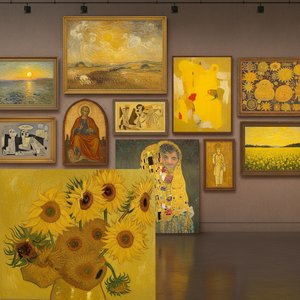
1936. Acrylic On Canvas, 46.0 x 38.0 cm.

§ 1Данные каталога

- 46.0 x 38.0 cm


Данное произведение защищено авторским правом
Произведение искусства, представленное на этой странице, защищено законом об авторском праве, что исключает возможность законного создания или продажи его точной репродукции. Данная защита обеспечивается международными соглашениями, такими как Бернская конвенция и национальным законодательством, включая положения, изложенные в Закон США об авторском праве — Раздел 17.
В качестве достойной и законной альтернативы мы предлагаем авторские картины ручной работы, вдохновленные оригиналом. Наши опытные профессиональные художники тщательно изучают стиль, настроение и художественную суть оригинала, чтобы создать новое, уникальное произведение, которое вызывает те же чувства, оставаясь при этом самостоятельным оригинальным творением.
Этот метод полностью соответствует нормам авторского права, так как он не предполагает копирования или дублирования защищенного произведения. Напротив, это творческая реинтерпретация — создание новой картины, которая вдохновлена оригиналом, но не является его точной копией.
 Узнать больше
§ 2Абстракция
Описание предмета коллекционирования
Биография художника
Сооснователь кубизма и автор «Герники». Откройте для себя революционные работы Пабло Пикассо уже сегодня.
§ 3Комментарий
A Fragmented Portrait: Unpacking Picasso’s ‘Untitled (77)’ from 1936
Pablo Picasso's “Untitled (77),” a striking head study rendered in a potent blend of blue and yellow, is more than just a portrait; it’s a concentrated distillation of the anxieties and surreal explorations that defined his pivotal years within the Surrealist movement. Created in 1936, during a period marked by both artistic ferment and profound historical upheaval – specifically, the Spanish Civil War – this work offers a glimpse into Picasso's evolving psyche and his willingness to dismantle traditional notions of representation.
The immediate impact is one of unsettling juxtaposition. The face, rendered with characteristic angularity and a pronounced frown, possesses an almost aggressive quality. It’s not simply angry; it feels burdened by a deep-seated sorrow, perhaps reflecting the turmoil gripping Spain at that time. Yet, this anguish is counterbalanced by the vibrant hues – the cool blues evoking melancholy and introspection, while the yellows inject a jarring energy, suggesting both hope and a simmering unrest. The meticulous detail in rendering each component—the meticulously drawn tie adorning the neck, the subtly sculpted body—creates an immediate tension between precision and distortion.
Deconstructing Form: Picasso’s Cubist Approach
Picasso's mastery of Cubism is undeniably present here, though it operates with a distinctively personal inflection. The head isn’t presented as a unified whole; instead, it’s fragmented into geometric planes and angles, echoing the fractured reality experienced during wartime. This deliberate dissection challenges our conventional perception of the subject, forcing us to actively engage in reconstructing the image within our own minds. Notice how the neck, seemingly separate from the face, is treated with a different level of detail, almost as if it’s an independent element contributing to the overall composition. The body, rendered in a simplified, almost skeletal form, further emphasizes this sense of deconstruction and reinforces the painting's underlying themes of instability and loss.
- Technique: Picasso employs a dry brush technique, layering thin washes of paint to build up texture and create a palpable sense of surface. The use of color is particularly significant – not merely decorative but deeply expressive, communicating mood and emotion with remarkable economy.
- Composition: The arrangement of the fragmented elements creates a dynamic visual rhythm, drawing the eye across the canvas and inviting contemplation. There’s no clear focal point; instead, the viewer's attention is distributed amongst the various components, mirroring the fractured state of mind suggested by the subject.
Symbolism and Historical Resonance
While Picasso rarely offered explicit explanations for his work, “Untitled (77)” resonates powerfully with the historical context of 1936. The Spanish Civil War cast a long shadow over Europe, fueling anxieties about fascism, violence, and the disintegration of societal norms. The painting can be interpreted as an embodiment of this collective trauma – a visual representation of a nation grappling with profound loss and uncertainty. The tie itself, a seemingly mundane detail, could symbolize the constraints and restrictions imposed by political oppression.
Furthermore, the work aligns with Picasso’s broader exploration of themes related to death, memory, and the subconscious during this period. He was deeply affected by the loss of his beloved daughter, Marie-Thérèse, in 1925, an event that undoubtedly informed his artistic output. “Untitled (77)” can be seen as a continuation of this ongoing dialogue with grief and mortality – a poignant meditation on the fragility of human existence.
A Timeless Portrait: Reproduction Possibilities
AllPaintingsStore offers meticulously crafted hand-painted reproductions of “Untitled (77),” allowing art lovers to experience Picasso’s genius in stunning detail. Our skilled artisans faithfully recreate the painting's nuanced color palette, textured brushstrokes, and complex composition, ensuring an authentic representation that captures the essence of this iconic work. Available in a range of sizes, from intimate study prints to large-scale statement pieces, our reproductions are ideal for collectors, interior designers seeking to infuse their spaces with artistic flair, or anyone captivated by Picasso’s enduring legacy. Each reproduction is created on archival-quality canvas and coated with UV protection, guaranteeing its longevity and preserving the artwork's vibrant beauty for generations to come.
Вопросы и ответы
Какое чувство вызывает «Untitled (77)»?
Эмоциональный тон, зафиксированный для «Untitled (77)», Пабло Пикассо, — Melancholic. Он передает суть чувств, которые выражает это произведение.
Когда и в какой технике было создано произведение «Untitled (77)»?
Техника исполнения работы «Untitled (77)», Пабло Пикассо — Acrylic On Canvas, дата создания — 1936.
Является ли «Untitled (77)», Пабло Пикассо одним из самых востребованных произведений в стиле Surrealism?
«Untitled (77)», Пабло Пикассо характеризуется как Iconic и относится к направлению Surrealism.



 Перейти к печатным копиям


 Для произведений искусства или репродукций, размер которых превышает 105 см (приблизительно 41 дюйм) по любой из сторон, рама будет доставлена в разобранном виде (в виде комплекта). Этот метод обеспечивает безопасную доставку и предотвращает повреждения при транспортировке.