

1877. Oil On Canvas, 14.0 x 19.0 cm.

§ 1Catalogue data

- 14.0 x 19.0 cm


§ 2Abstract
Описание предмета
Discover Paul Cézanne's 'Bathers' (1877), a pivotal Post-Impressionist masterpiece capturing figures in nature’s serene beauty. Explore the transition from Impressionism to Cubism through this iconic work, now available as a stunning hand-painted reproduction.
 Развернуть текст
Биография художника
Поль Сезанн: основоположник постимпрессионизма, предвосхитивший кубизм! Откройте для себя его новаторские пейзажи, натюрморты и портреты, изменившие ход искусства.
§ 3Commentary
A Moment of Tranquility: Paul Cézanne’s ‘Bathers’
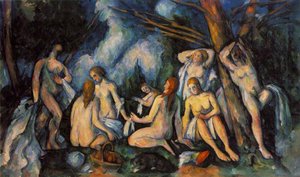
Paul Cézanne's “Bathers,” painted in 1877, isn’t merely a depiction of nude figures enjoying the dappled shade of a forest; it’s a profound exploration of form, space, and the very essence of perception. This pivotal work, housed within a relatively modest 14 x 19 cm canvas, represents a crucial bridge between the fleeting impressions of Impressionism and the nascent geometric investigations that would define Cubism. Cézanne, a man whose life was shaped by his father’s banking ambitions yet ultimately devoted to the pursuit of artistic truth, sought to capture not just what he *saw*, but how he *felt* looking at the world – a deeply personal and revolutionary approach.
The scene unfolds within a dense, almost claustrophobic woodland setting. Three figures dominate the composition: a man standing on his hands in a gesture of both strength and vulnerability; a woman seated beneath a sheltering tree, radiating an aura of serene contemplation; and a fourth figure glimpsed further back, adding depth to the spatial arrangement. Notice how Cézanne doesn’t present these forms as idealized representations of beauty, but rather as tangible blocks of color and volume, meticulously constructed from simple geometric shapes – cylinders, cones, and planes. This deliberate simplification, a hallmark of his style, anticipates the fragmented perspectives that would later characterize Cubism.
Impressionist Roots, Post-Impressionist Innovation
While undeniably rooted in the Impressionistic tradition—evident in the dappled light filtering through the trees and the loose brushwork— “Bathers” transcends its predecessors. Cézanne wasn’t interested in capturing a momentary impression of light; he was striving to reveal the underlying structure of reality itself. He employed a technique known as ‘alla prima,’ working directly onto the canvas with minimal underpainting, allowing the colors to blend and interact organically. The use of complementary color pairings – particularly the juxtaposition of blues and oranges – creates a vibrant energy within the scene, while simultaneously grounding the figures in their natural environment.
The painting’s historical context is equally significant. Created during a period of rapid social and artistic change, “Bathers” reflects the growing interest in the outdoors and the celebration of leisure amongst the burgeoning middle class. However, Cézanne's treatment of the nude form departs from traditional depictions of classical mythology or allegorical scenes. Instead, he presents them as ordinary individuals engaged in a simple, everyday activity – bathing in nature. This shift signaled a move away from purely decorative representations and towards a more intellectual and expressive approach to art.
Symbolism and Emotional Resonance
Beyond its formal innovations, “Bathers” is imbued with a subtle sense of melancholy and introspection. The solitary figure on his hands embodies a struggle for balance and control, while the woman beneath the tree exudes an almost otherworldly tranquility. The placement of these figures within the dense forest suggests a feeling of isolation and detachment from the outside world – a common theme in Cézanne’s work. It's important to note that Cézanne frequently revisited this subject matter throughout his career, continually refining and experimenting with different compositions and perspectives. Each iteration offers a unique interpretation of the same fundamental idea.
Cézanne’s “Bathers” is more than just a beautiful painting; it’s a testament to his revolutionary vision – a bold assertion that art could be both descriptive and conceptual, capturing not only what we see but also how we perceive and experience the world around us. A reproduction of this remarkable work offers a window into the mind of one of history's most influential artists, inviting viewers to contemplate the timeless themes of nature, beauty, and the human condition.
Вопросы и ответы
Из чего создано произведение «Bathers»?
Для создания «Bathers» Поль Сезанн использовал(а) технику Oil On Canvas. Эта техника определяет материальную природу оригинального произведения.
Можно ли использовать дополненную реальность, чтобы увидеть «Bathers», Поль Сезанн в своей комнате?
Вы можете примерить работу «Bathers», Поль Сезанн на свою стену с помощью страницы Предпросмотр в AR, используя технологию дополненной реальности на совместимом устройстве.
Насколько гармоничны цвета в работе «Bathers», Поль Сезанн?
Цвета в работе «Bathers», Поль Сезанн демонстрируют Strong Color Unity гармонию. Гармония описывает взаимосвязь цветов между собой.




 Переключиться на печать


 Для произведений искусства или репродукций, размер которых превышает 105 см (приблизительно 41 дюйм) по любой из сторон, рама будет доставлена в разобранном виде (в виде комплекта). Этот метод обеспечивает безопасную доставку и предотвращает повреждения при транспортировке.


