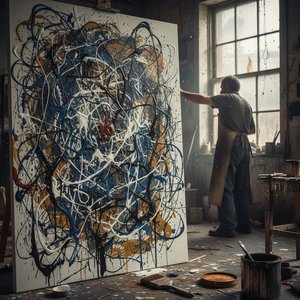
Acrylic On Canvas.

§ 1Catalogue data

§ 2Abstract
Описание предмета
Explore Jackson Pollock’s ‘Greetings’! A dynamic drip painting showcasing abstract figures & warm tones in an Expressionist style. Discover this unique mixed-media artwork's energy and layered texture.
 Развернуть текст
Биография художника
Джексон Поллок (1912-1956) – американский художник, пионер абстрактного экспрессионизма и техники "dripping". Его знаменитые полотна, такие как "Оранжевая голова" и "Blue Poles", отражают энергию, спонтанность и новаторский подход к живописи.
§ 3Commentary
Greetings: An Exploration of Pollock’s Expressionist Vision
Paul Jackson Pollock's “Greetings” stands as a testament to the radical spirit of Abstract Expressionism, encapsulating the movement’s core tenets within a deceptively simple composition. This artwork, created sometime in the mid-1940s—the zenith of Pollock’s groundbreaking drip technique—immediately captivates with its dynamic interplay of color and form, inviting viewers into a realm where visual sensation transcends representational accuracy.
- Subject Matter: The painting depicts stylized human figures engaged in movement, albeit abstracted to the point of near anonymity. These forms swirl and intertwine across the canvas, conveying an impression of restless energy and perhaps hinting at psychological turbulence—themes prevalent throughout Pollock’s oeuvre.
- Style & Technique: Pollock's signature method – drip painting – dominates this piece. He meticulously applied paint onto a horizontal surface laid on the floor, allowing gravity to guide drips and splatters from sticks or cans directly onto the canvas. This process yielded an uneven, textured surface achieved through layering paint and incorporating collage elements—a deliberate departure from traditional painting conventions.
- Color Palette & Composition: The artwork’s color scheme is dominated by warm hues – browns, reds, and yellows – punctuated by darker accents that contribute to the overall mood. The composition is deliberately unbalanced, emphasizing horizontal movement while simultaneously disrupting visual stability. Lines are loose and gestural, creating a sense of spontaneity and mirroring the artist's emotional state.
- Historical Context: “Greetings” emerged during a period of profound artistic experimentation following World War II. Pollock’s work aligns with the broader Expressionist impulse to convey emotion directly—a reaction against formalism and a celebration of subjective experience. It reflects the influence of Surrealism, particularly its exploration of unconsciousness and dreamlike imagery.
- Symbolic Significance: The distorted figures and swirling lines within “Greetings” are laden with symbolic resonance. They represent not merely physical movement but also transformation—a visual metaphor for confronting inner turmoil and embracing change. Pollock’s intention was to bypass rational thought, tapping into primal instincts and conveying feelings beyond verbal articulation.
The painting's signature in the lower left corner – “Greetings Lee and Johnson” – serves as a subtle reminder of its provenance and underscores the collaborative spirit inherent in artistic creation. This artwork embodies Pollock’s unwavering commitment to pushing boundaries, establishing him as one of the most influential figures in 20th-century art.
Вопросы и ответы
К какому художественному направлению относится «GREETINGS», Джексон Поллок?
Художественное направление, к которому относится «GREETINGS», Джексон Поллок, — это Abstract Expressionism. Такая классификация позволяет соотнести данную работу с другими произведениями и мастерами того же периода.
Какая цветовая палитра использована в «GREETINGS», Джексон Поллок?
В работе «GREETINGS», Джексон Поллок используется Dark цветовая палитра. Эта палитра определяет общий цветовой характер произведения.
Как можно использовать «GREETINGS», Джексон Поллок в домашнем декоре?
Для «GREETINGS», Джексон Поллок указаны две рекомендации по использованию (Accent) и размещению в пространстве (Living Room).


 Переключиться на печать


 Для произведений искусства или репродукций, размер которых превышает 105 см (приблизительно 41 дюйм) по любой из сторон, рама будет доставлена в разобранном виде (в виде комплекта). Этот метод обеспечивает безопасную доставку и предотвращает повреждения при транспортировке.