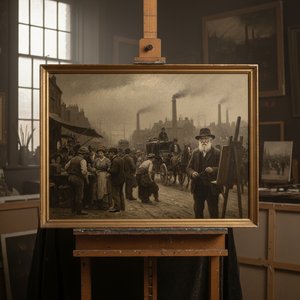
Joseph Walter West: A Visionary of Victorian England
Joseph Walter West, born in Sculcoates, Yorkshire, in 1860, was more than just a painter; he was a meticulous observer and interpreter of the Victorian world. His life, intertwined with Quaker principles and a deep appreciation for detail, shaped an artistic style that blended realism with a subtle, almost dreamlike quality – a hallmark of his enduring appeal. From humble beginnings as a cashier in Hull’s engineering works, West embarked on a journey fueled by a passion for art, ultimately establishing himself as a respected figure within the British art scene. His career spanned several decades, marked by consistent output and a growing reputation for capturing the essence of both landscape and human experience.Early Life and Artistic Training
West’s early years were steeped in the values of his Quaker upbringing – honesty, simplicity, and a deep connection to nature. This ethos profoundly influenced his artistic choices, favoring quiet observation over dramatic spectacle. He began his formal training at Bootham School in York, where he honed his drawing skills under Edwin Moore, a local artist known for his meticulous realism. Recognizing the need for further development, West moved to London in 1883 and enrolled at St John’s Wood School of Art, followed by studies at the Royal Academy Schools and the Académie Julian in Paris. These diverse influences combined to shape his distinctive style – a careful balance between British tradition and French Impressionism, resulting in works that are both technically proficient and emotionally resonant.A Palette of Light and Shadow: Artistic Style and Technique
West’s paintings are characterized by a remarkable sensitivity to light and atmosphere. He rarely employed bold brushstrokes or vibrant colors; instead, he favored muted tones – browns, greens, greys, and blues – creating a sense of depth and tranquility. His landscapes, particularly those depicting the Yorkshire countryside and the Italian Lakes, are imbued with a quiet melancholy, capturing the fleeting beauty of natural light. He was a master of *sfumato*, subtly blending colors to create soft transitions and atmospheric effects. This technique, combined with his meticulous attention to detail – evident in the rendering of textures, foliage, and even individual figures – gives his paintings a remarkable sense of realism while simultaneously evoking a dreamlike quality. His portraits, often depicting Quaker subjects, are equally compelling, capturing not just physical likeness but also an underlying sense of character and dignity.Notable Works and Exhibitions
West’s artistic output was substantial, with over 30 works exhibited at prestigious venues throughout Britain. Among his most celebrated paintings is “The Pillion,” a romantic oil painting depicting a horseback couple lost in a misty landscape – a testament to his ability to capture the mood and atmosphere of a scene. “Harry Simpson, Chairman of Hull Royal Infirmary” showcases his skill in portraiture, presenting a dignified depiction of a prominent figure from the local community. His later works, such as “Early Birds,” reflect a shift towards a more expressive style, utilizing textured impasto to convey the energy and vitality of rural life. His work was also featured in collections at institutions like the Tate, Birmingham, and the National Gallery of Scotland, solidifying his place within the broader canon of British art.Legacy and Historical Significance
Joseph Walter West’s legacy extends beyond his individual paintings. He represents a significant chapter in Victorian art – an era marked by both rapid industrialization and a renewed appreciation for nature and tradition. His work reflects this duality, capturing the beauty of the natural world while also subtly exploring themes of social responsibility and human connection. His meticulous technique and evocative style continue to resonate with viewers today, offering a glimpse into a bygone era and reminding us of the enduring power of art to capture the essence of human experience. He is remembered as a quiet but significant contributor to British painting, whose subtle yet profound vision continues to captivate audiences over a century after his death in 1933.Вопросы и ответы
Под какими еще именами известен Joseph Walter West?
Joseph Walter West также известен как J. Walter West, Walter West.
Где можно найти работы Joseph Walter West, сгруппированные по цветовой палитре?
На странице По цветовым палитрам работы Joseph Walter West сгруппированы по их цветовым палитрам.
Где я могу посмотреть работы Joseph Walter West, распределенные по настроению?
Работы Joseph Walter West можно просматривать по настроению на странице Комната настроения, где произведения распределены в соответствии с их эмоциональной окраской.