


The Intellectual Tapestry of Montserrat Pérez Gómez
The life and work of Montserrat Pérez Gómez represent a profound intersection between the rigorous precision of scientific inquiry and the evocative depths of architectural theory. Born in Toulouse, France, her intellectual journey has been shaped by a rare multidisciplinary approach that bridges the gap between the tangible structures of our built environment and the abstract complexities of chemical and historical analysis. As an enseignante-chercheuse at the Laboratoire Hétérochimie Fondamentale et Appliquée in Toulouse, she embodies a unique duality, navigating the meticulous world of heterochemistry while simultaneously exploring the poetic dimensions of architectural history.
Her academic foundation is as diverse as her creative vision. A graduate of the National Polytechnic Institute of Mexico, she pursued advanced scholarly heights by earning a Ph.D. in the History and Theory of Architecture from the University of Essex. This rigorous training allowed her to develop a lens through which she views the world—one that sees the structural integrity of a building and the chemical composition of its materials as part of a singular, interconnected narrative. Her career has been marked by significant roles within prestigious institutions, including her work with the CNRS and the Université de Toulouse, where she continues to mentor the next generation of researchers.
Architectural Scholarship and Literary Depth
Beyond the laboratory and the lecture hall, Pérez Gómez has established herself as a formidable voice in architectural scholarship. Her contributions to the field are characterized by a deep dive into the symbolic and erotic origins of architectural form, often blending historical critique with philosophical inquiry. She has held distinguished positions such as the Saidye Rosner Bronfman Professor in History and Theory of Architecture at the McGill University School of Architecture, where she directed the program with a focus on the intersection of memory, space, and theory.
Her literary output serves as a testament to her ability to weave complex historical threads into compelling narratives. Some of her most notable scholarly works include:
- Polyphilo or the Dark Forest Revisited: A profound exploration of architectural symbolism and the layered meanings within historical texts.
- El sueño de Polyfilo. El origen erótico de...: A work that delves into the more intimate and psychological connections between human desire and the creation of space.
Through these writings, she challenges the boundaries of traditional architectural history, inviting readers to consider how the structures we inhabit are reflections of our deepest cultural and subconscious impulses.
A Visionary Synthesis of Science and Art
While her formal training lies in science and architecture, the essence of Montserrat Pérez Gómez’s work is often perceived through a lens of artistic interpretation. Her multidisciplinary perspective allows for a unique way of seeing—where the molecular level of heterochemistry meets the grand scale of urban design. This synthesis creates a conceptual space where art and science are no longer separate disciplines but are instead two sides of the same investigative coin.
Her influence extends across borders, from her roots in France to her significant academic contributions in Canada and her connections to Mexico. By treating architecture as a living, breathing entity shaped by both physical laws and human imagination, she has left an indelible mark on contemporary thought. Her legacy continues to inspire those who seek to find the beauty in the microscopic and the profound meaning within the monumental.
Вопросы и ответы
Можно ли посетить виртуальный музей работ Montserrat Pérez Gómez?
Возможен виртуальный визит: на странице 3D-музей работы Montserrat Pérez Gómez представлены в трехмерной галерее.
Где можно найти работы Montserrat Pérez Gómez, сгруппированные по технике исполнения?
На странице Все техники работы Montserrat Pérez Gómez сгруппированы по технике исполнения.
Можно ли отсортировать работы Montserrat Pérez Gómez по цвету?
Страница Цветовой индекс художника Montserrat Pérez Gómez позволяет просматривать его работы, распределенные по цветам.


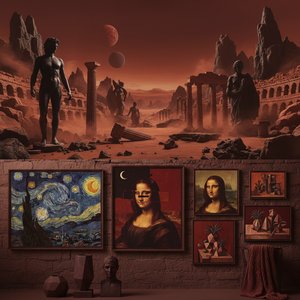
![Platform 6 [caminos De Hierro] — Montserrat Pérez Gómez](/media/artworks/images-thumb/6d/86/6d86cc6deece8c3b440f6b748211c198.jpg)


