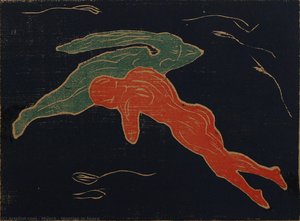
Oil On Canvas.

§ 1Catalogue data


§ 2Abstract
Popis zberateľského predmetu
A hauntingly beautiful Expressionist depiction of a young girl by Edvard Munch captures profound existential anxiety through vibrant colors and emotive brushstrokes, inviting you to explore this masterpiece of modern art.
 Zobraziť viac
Biografia umelca
Edvard Munch (1863-1944): Nórske umelecké dielo plné úzkosti, smútku a symboliky. Pozrite si ikonické obrazy ako Výkrik a Madona! #Munch #Výkrik #Madona
§ 3Commentary
A Window into Existential Solitude
In the quiet, evocative depths of Edvard Munch’s untitled (1561), we encounter a moment that feels both profoundly intimate and hauntingly distant. The painting presents a young girl positioned beside a fence, her gaze directed toward an unseen horizon, as if she is peering into the very fabric of existence itself. This deliberate framing—where the fence serves as both a physical barrier and a symbolic conduit—suggests a poignant separation from her immediate surroundings. While the scene includes other figures scattered throughout the composition and even the presence of two dogs, there remains an unmistakable sense of isolation. The girl stands as a focal point of quiet contemplation, her averted eyes hinting at a detachment from reality and a deep, internal preoccupation with the world beyond the tangible.
The atmosphere of the piece is a masterclass in emotional duality. At first glance, the scene might appear calm and serene, yet beneath the surface lies a subtle tension characteristic of Munch’s vision. The artist utilizes a vibrant yet muted color palette, dominated by reds and yellows, to stir the viewer's emotions. Through his signature Expressionist technique, Munch employs loose, visceral brushstrokes and an unsettling distortion of perspective to prioritize the conveyance of inner turmoil over meticulous realism. This approach allows the painting to transcend mere visual representation, transforming a simple sidewalk scene into a powerful tableau of psychological depth.
The Language of Symbolism and Emotion
To behold untitled (1561) is to engage with the burgeoning Expressionist movement that sought to depict the subjective human experience—fear, despair, and even ecstasy—with uncompromising honesty. The painting is laden with symbolic resonance; the girl’s gaze becomes a mirror for Munch's own struggles with existential dread and the fragility of life. Every element, from the way the light hits the fence to the placement of the figures in the distance, contributes to a narrative of longing and the pervasive feeling of being alone amidst a crowd.
For the discerning collector or interior designer, this work offers more than just aesthetic beauty; it provides a profound emotional anchor for any space. A high-quality reproduction of this piece brings into a room a sense of historical weight and intellectual depth. It is an invitation to pause and reflect, making it an ideal centerpiece for those who appreciate art that speaks to the complexities of the human soul. The painting does not merely decorate a wall; it invites a dialogue between the viewer and the profound anxieties and beauties of the modern condition.
Otázky a odpovede
Je "untitled (1561)" k dispozícii ako umelecká tlač?
„untitled (1561)“ je dostupná ako umelecká tlač na bavlnenom plátne alebo archivnom plátnovom papieri. Objednávky môžete zadávať na jej stránke Fine art tlač v rozmeroch podľa vašej voľby.
Pod akými inými menami alebo pseudonymami je známy/á Edvard Munch?
Medzi ďalšie známe mená umelca Edvard Munch, autora diela „untitled (1561)“, patria aj Munch.
Ako sa v díle „untitled (1561)“ spájajú médium a pohyb?
„untitled (1561)“ od Edvard Munch spája techniku Oil On Canvas s výtvarným smerom Expressionism. Technika a smer definujú spôsob vytvorenia a štýl diela.


 Prepnúť na tlač


 V prípade umeleckých diel alebo reprodukcií, ktorých ktorákoľvek strana je väčšia ako 105 cm (cca 41 palcov), sa rám dodáva v rozloženom stave ako sada. Táto metóda zabezpečuje bezpečnú доставu a chráni pred poškodením počas prepravy.