Záruka vrátenia peňazí · 100 dní Bezplatné celosvetové doručenie
449 587artworks 30 613umelci 4 660múzeá 32jazyky
Catalogue entry

Untitled

1973. Acrylic On Canvas.

Fig. 1. Marc Chagall, Untitled, 1973. Shown as the reproduction you are specifying: , .

§ 1Catalogue data

§ 2Abstract

Popis zberateľského predmetu

A whimsical pastel painting by Marc Chagall featuring a blue rabbit with red eyes, capturing the artist’s signature dreamlike style and vibrant colors from 1973 – discover this unique artwork and bring its magic into your home.

Biografia umelca

Pozrite si Marc Chagalla – slovenského židovského impresionistu a surrealistu! Jeho tvorba je oslavovaná svojimi fantastickými obrazmi, výraznými farbami a nezabuditeľným životopisom.

§ 3Commentary

A Dreamscape in Pastel: Marc Chagall’s ‘Untitled’ (1973)

Marc Chagall's “Untitled,” painted in 1973, is more than just a depiction of a blue rabbit; it’s an immersion into the artist’s profoundly personal and enduring world. This pastel masterpiece, signed and dated by the master himself, embodies the core tenets of Chagall’s oeuvre: a joyous collision of memory, folklore, and dreamlike fantasy. The painting immediately draws the eye to its central subject – a rabbit, rendered in delicate shades of blue and pink, its large red eyes holding an almost unsettlingly innocent gaze. It appears to be engaged in a quiet act, perhaps consuming a carrot or another root vegetable, adding a touch of rustic realism to the otherwise ethereal scene.

The Roots of a Vision: Chagall’s Liozna and Jewish Heritage

Born Moishe Shagal in 1887 in Liozna, Belarus – a town that would forever haunt his artistic imagination – Chagall's early life profoundly shaped his distinctive style. Liozna, a small, culturally rich community nestled near Vitebsk, was the birthplace of his unique vision. The painting’s very essence is rooted in this place: the vibrant colors, the whimsical forms, and the recurring motifs of flying figures and animals all stem from Chagall's memories of Liozna’s blend of Russian Orthodox churches and bustling Jewish marketplaces. His Hasidic Jewish upbringing instilled a deep reverence for storytelling and symbolism, elements that permeate his work throughout his career. The rabbit itself can be interpreted as a symbol of fertility, innocence, or even the elusive nature of memory – themes frequently explored in Chagall's art.

Technique and Palette: A Masterful Blend

Chagall’s technique in “Untitled” is characterized by loose brushstrokes and a vibrant use of pastel colors. He employs a layering method, building up the image with thin washes of pigment, creating a luminous quality that seems to emanate from within. The soft hues – blues, pinks, yellows, and greens – contribute to the painting’s dreamlike atmosphere, evoking a sense of nostalgia and tranquility. The artist's meticulous attention to detail, particularly in rendering the rabbit’s fur and eyes, is juxtaposed with the overall fluidity of the composition, demonstrating his masterful control over both precision and expressive freedom.

Symbolism and Emotional Resonance

Beyond its aesthetic beauty, “Untitled” resonates deeply with symbolic meaning. The rabbit, a recurring motif in Chagall’s work, represents not just an animal but also the subconscious mind – a place of hidden desires, forgotten memories, and fantastical possibilities. The act of eating suggests nourishment, both physical and spiritual. Painted in 1973, towards the end of his life, this piece reflects a culmination of decades spent exploring themes of love, loss, faith, and the enduring power of memory. It’s a poignant reminder of Chagall's ability to transform personal experience into universal symbols, inviting viewers to contemplate their own dreams and desires.

A Timeless Acquisition

This hand-painted reproduction captures the essence of Chagall’s genius, offering a window into his extraordinary world. Perfect for collectors seeking a piece of art history or interior designers looking to infuse a space with warmth, color, and profound emotional depth, this artwork is an investment in beauty and imagination. Its vibrant palette and evocative subject matter will undoubtedly become a cherished focal point within any setting.

Otázky a odpovede

Akú atmosféru vyžaruje dielo „Untitled“?

Celková nálada diela „Untitled“ od Marc Chagall je Ethereal. Táto nálada vystihuje všeobecnú atmosféru diela.

Patrí dielo „Untitled“ medzi najznámejšie diela smeru Fantastic Expressionism?

„Untitled“ od Marc Chagall je klasifikovaný ako Iconic a patrí do smeru Fantastic Expressionism.

Môžem si „Untitled“ od Marc Chagall pozrieť pod iným osvetlením?

X-ray pohľad na dielo „Untitled“ od Marc Chagall nájdete na jeho stránke RTG skenovanie: ide o interaktívne skúmanie obrazu prostredníctvom jedenástich optických vrstiev.
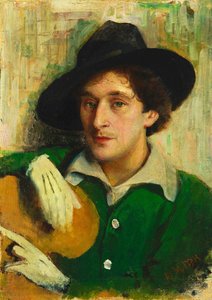
§ 4The artist

Marc Chagall

Marc Chagall

1887 - 1985, Bielorusko

Quick facts about Marc Chagall

  • Artistic Movement Or Style: Modernizmus, Kubizmus
  • Artists Or Movements Influenced By This Artist:
    • Surrealizmus
    • Cubizmus
  • Artists Who Influenced This Artist:
    • Leon Bakst
    • Pablo Picasso
    • Jean Metzinger
  • Date Of Birth: 7. júl 1887
  • Date Of Death: 28. marec 1985
  • Full Name: Marc Chagall
  • Nationality: Rusínsky-Francúzsky
  • Notable Artworks:
    • I a dedina
    • Žltý osol
    • Kôň s tiennikom
  • Place Of Birth: Ľozna, Bielorusko

Biografia umelca

A Life Painted in Dreams: The World of Marc Chagall

Marc Chagall, born Moishe Shagal in 1887 in the small Belarussian town of Liozna near Vitebsk, wasn’t merely a painter; he was a poet of color, a weaver of dreams, and a chronicler of memory. His life, spanning nearly a century, mirrored the tumultuous currents of the 20th century, yet his art remained steadfastly rooted in a deeply personal vision—one infused with the folklore of his Hasidic Jewish upbringing and an unwavering belief in the power of imagination. Vitebsk itself was more than just a birthplace; it became the emotional core of his artistic universe, a recurring motif populated by flying figures, whimsical animals, and the vibrant hues of remembered landscapes. The town’s unique blend of cultures—Russian Orthodox churches alongside bustling Jewish marketplaces—forged an aesthetic sensibility that would defy easy categorization throughout his long career. Though he sought formal training first with a local sign painter and later in St. Petersburg under Léon Bakst, and then in Paris at the Académie de la Grande Chaumière, Chagall never fully embraced any single artistic movement. He absorbed elements of Cubism, Symbolism, and Fauvism, but always filtered them through his own intensely personal lens, creating a style that was uniquely, unmistakably Chagall.

Early Years and Artistic Formation

Chagall’s formative years were marked by hardship and displacement. Born into a Jewish family in Vitebsk—a town steeped in Orthodox tradition—he experienced firsthand the challenges faced by Jews living under Tsarist rule. Despite limited formal education, he possessed an innate artistic talent that quickly blossomed. His initial training began with a local sign painter, honing his skills in draftsmanship and color theory. Subsequently, he pursued studies at St. Petersburg’s Zvantseva School of Drawing and Painting, where he encountered the influential teachings of Léon Bakst—a pioneer of theatrical design who championed avant-garde aesthetics. This exposure to Bakst's ideas profoundly shaped Chagall’s artistic sensibilities, introducing him to the principles of Cubism and fostering his fascination with geometric abstraction. Recognizing the importance of broadening his horizons, he traveled to Paris in 1908, immersing himself in the vibrant intellectual and artistic milieu of the École de Paris—a collective of artists who rejected academic conventions and embraced experimentation. During this period, he befriended fellow artists like Pablo Picasso and André Derain, absorbing their stylistic innovations and refining his own visual language.

The Symbolist Vision

Chagall’s early paintings—such as I and the Village (1911)—demonstrate a distinctive preoccupation with symbolism and memory. Unlike traditional landscapes that strive for objective representation, Chagall's depictions of Vitebsk are fragmented recollections imbued with emotional significance. Figures float amidst stylized forms, conveying feelings of longing and nostalgia—a characteristic trait that would define his artistic style throughout his career. The artist’s palette is bold and expressive, employing vibrant hues to communicate emotion rather than literal accuracy. This stylistic approach reflects Chagall's deep connection to Jewish folklore and mythology, as well as his profound engagement with the spiritual traditions of his upbringing. His use of color—particularly yellows, blues, and reds—is deliberately unconventional, creating a dreamlike atmosphere that transcends rational perception.

The Turbulent Years: Revolution and Exile

The Russian Revolution dramatically altered Chagall’s life trajectory. Returning to Vitebsk in 1917 amidst the upheaval of Bolshevik rule, he became involved in cultural initiatives aimed at revitalizing Belarusian art and culture. He established an Art School in Vitebsk—a bold experiment in artistic education that briefly flourished before succumbing to political pressures. During this period, Chagall wrestled with conflicting ideological impulses—embracing socialist ideals while simultaneously cherishing his Jewish heritage. The outbreak of World War I forced him into exile, disrupting his creative pursuits and propelling him back to Paris. Despite the hardships endured during wartime, Chagall continued to produce artwork that reflected the anxieties and uncertainties of the era. His painting White Crucifixion (1938)—a poignant meditation on suffering and persecution—stands as a testament to this period’s emotional intensity.

International Recognition and Artistic Legacy

Chagall achieved international acclaim during World War II, escaping occupied France with his wife in May 1941. He found refuge in New York City, where he resided for seven years, fostering collaborations with fellow artists and engaging in prolific creative activity. His work gained prominence during the Abstract Expressionist movement, cementing his reputation as one of the most influential figures in modern art. Following the war, Chagall returned to France, continuing to paint until his death in 1985 at Saint-Paul-de-Vence—a picturesque Provençal village that served as his artistic sanctuary for decades. His enduring legacy resides not only in his stunning paintings and stained glass windows but also in his unwavering commitment to artistic integrity and imaginative vision—a vision that continues to inspire artists and audiences alike. Chagall’s art transcends cultural boundaries, conveying universal themes of love, loss, faith, and remembrance—a testament to the transformative power of creativity and the enduring beauty of dreams.

§ 5Comparanda

§ 6Questions

Základné informácie

  • Subject or theme: Rabbit, folklore
  • Movement: Modernism
  • Notable elements: Blue rabbit, red eyes
  • Artist: Marc Chagall
  • Year: 1973

§ 7Cite this entry

AllPaintingsStore.com, “Marc Chagall, Untitled (1973)”, https://allpaintingsstore.com/sk/art/marc-chagall-untitled-8XYH65-en/ArtistReproduction/ (accessed 4 október 2026).

§ 8The reproduction

Ručne maľovaná olejová reprodukcia

Ručne maľovaný olej na plátne vo vašej zvolenej veľkosti a v ráme, vyrobený na mieru našimi umelcami. ( Prepnúť na tlač Prepnúť na digitálny obraz)

It is specified on the order sheet in the margin; the present state of that sheet reads as follows.

Untitled

Technika reprodukcie

Veľkosť reprodukcie

-

Výborne skúsený umelec

Viac detailov, jemnosti a dodatočného času na výrobu

-

Rámovanie reprodukcie

-

-

V prípade umeleckých diel alebo reprodukcií, ktorých ktorákoľvek strana je väčšia ako 105 cm (cca 41 palcov), sa rám dodáva v rozloženom stave ako sada. Táto metóda zabezpečuje bezpečnú доставu a chráni pred poškodením počas prepravy.

Vyžaduje sa odborná montáž – toto nie je produkt na vlastnú prípravu (DIY).
Sada musí byť zmontovaná a plátno napnuté skúseným profesionálnym rámovaníkom, s použitím drevárneho lepidla (nie je súčasťou sady), klieš na napínanie plátna a svoriek na udržanie prav角的 rámov počas schnutia lepidla. Nesprávna montáž alebo nerovnomerné napnutie plátna môže trvalo poškodiť umelecké dielo, čo nie je kryté našou zárukou.

  • Všetky lišty z masívneho dreva sú súčasťou balenia, presne narezané na mieru.

  • Montuje sa pomocou súčasťou balenia dodaných skrutiek, plus drevolepu na spoje v rohoch, ktorý nie je súčasťou balenia a musí si ho zabezpečiť váš montážnik.

  • Vyžadujú sa profesionálne nástroje, ktoré nie sú súčasťou sady: kliešte na napínanie plátna (napínací nástroj) a svorky na udržanie pravých uhlov rámov počas schnutia lepidla.

Dôležité:
Spoje v rohoch si vyžadujú lepidlo na drevo, tyče je potrebné upevniť pomocou svoriek, kým lepidlo úplne newyschne, a napnutie plátna na zostavený rám si vyžaduje klieže na napínanie plátna. Žiadna z týchto pomôcok nie je súčasťou sady. Pred objednaním tejto veľkosti si, prosím, zabezpečte skúseného odborníka na zakladanie rámov.

Popisné označenie

-

-

Ochranný lak

Lesklý lak (zvýrazňuje farby, chráni pred svetlom a vlhkosťou)

-

Prispôsobiť moje dielo

Príklady možností úprav: nahradenie tváre vlastnou fotografiou; pridanie domáceho zvieraťa (napr. nahradenie mačky psom); vloženie skrytého odkazu do pozadia; zmena krajiny alebo prvkov v pozadí.

-

Prioritné doručenie

Celosvetová doprava () za 3 až 4 týždne namiesto štandardných 5 týždňov. (1 november). Bez kompromisov v kvalite.

-

Rýchle doručenie

Celosvetová doprava do za 5 týždňov. (8 november).

V cene

Celková cena

€ 229

Included with every order

  • Bezplatná expresná doprava po celom svete
  • Vysokokvalitné lnianske plátno
  • Kompletné poistenie prepravy
  • Záruka vrátenia colného poplatku
  • Záruka presného farebného zhodnutia
  • 100-dená politika vrátenia tovaru (iba pri vadách)
  • 100% záruka vrátenia peňazí
  • Zľava pri väčšom množstve
Order sheet