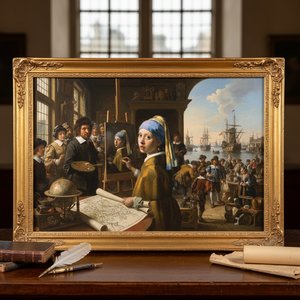
The Silent Maestro of Dutch Baroque and Rococo
In the grand, sweeping tapestry of seventeenth-century art, names like Rembrandt and Vermeer often command the spotlight, casting long shadows over the more subtle masters of the era. Yet, tucked within the intricate grain of exquisite woodwork and the shimmering surfaces of rare veneers, lies the legacy of Alexandre Jean Oppenordt. Born in the Gelderland province of the Netherlands around 1639, Oppenordt was not a painter of canvases, but a master of substance and texture. He was an artist of the tactile, a man whose medium was the very essence of luxury. While his life remains somewhat shrouded in the quietude of history, his influence resonated through the royal courts of Europe, bridging the gap between the heavy grandeur of the Dutch Baroque and the delicate, flowing grace of the French Rococo.
Oppenordt’s journey from the Netherlands to the heart of French artistry is a testament to the era's fluid cultural boundaries. His early years were defined by a rigorous apprenticeship under Johann Herman Schäffer in Zutphen, a renowned furniture maker whose workshop served as a crucible for Baroque excellence. It was here that Oppenordt mastered the principles of symmetry, opulent ornamentation, and the demanding art of marquetry. This foundational training instilled in him a profound respect for classical proportion, even as he later learned to embrace the more whimsical, organic forms that would define the coming century. His move to Paris allowed him to translate these Dutch technical precisions into the language of French elegance, eventually establishing him as a premier ébéniste (cabinetmaker) under the prestigious patronage of Louis XIV.
Mastery of Wood and Light
To encounter an Oppenordt creation is to witness a dialogue between light and material. As a master of marquetry, he possessed an uncanny ability to manipulate exotic veneers—ebony, ivory, and rare woods—to create illusions of depth and movement. His work was characterized by a meticulous attention to detail that transformed functional furniture into sculptural masterpieces. Unlike the static compositions of traditional cabinetry, Oppenordt’s designs began to breathe with a new vitality. He utilized the natural luster of polished wood to capture the flickering candlelight of Versailles, creating surfaces that seemed to shift and dance as one moved around them.
His technical repertoire was vast, blending the structural integrity required by the Baroque style with an emerging sensitivity toward the decorative flourishes of the Rococo. This evolution is perhaps best seen in his ability to integrate gilt-bronze mounts with intricate wood inlays, a technique that added a layer of regal brilliance to his pieces. His work was not merely about decoration; it was about the creation of an atmosphere. Through his hands, a small desk or a grand cabinet became more than furniture—they became vessels of prestige, embodying the power and sophistication of the age.
A Lasting Legacy in Decorative Arts
The historical significance of Alexandre Jean Oppenordt extends far beyond the physical objects he produced. He served as a vital link in a lineage of decorative excellence, most notably through his son, Gilles-Marie Oppenordt, who would go on to become one of the most celebrated architects and designers of the eighteenth century. The technical mastery and aesthetic innovation passed from father to son helped solidify the transition from the rigid structures of the late seventeenth century to the fluid, emotive beauty of the Rococo period.
Today, the fragments of his genius survive in the world's most esteemed collections, such as the Metropolitan Museum of Art and the Getty Museum. When we look upon a piece like his celebrated small desk, we are not just looking at oak, pine, and walnut; we are witnessing the enduring spirit of an artist who mastered the art of the unseen. His contribution reminds us that true artistry is found not only in the strokes of a brush but in the careful selection of a veneer and the precise placement of a golden ornament, forever etching his name into the very fabric of decorative history.
Otázky a odpovede
Koľko umelých diel od Alexandre Jean Oppenordt si môžete v katalógu prehliadnuť?
Na stránke Všetky diela umelcov si môžete prelistovať 1 dielo diel od umelca Alexandre Jean Oppenordt.
V akom meste a v ktorej krajine sa narodil/a Alexandre Jean Oppenordt?
Alexandre Jean Oppenordt sa narodil v meste Gelderland v krajine Netherlands.
Kde nájdem diela umelca Alexandre Jean Oppenordt usporiadané podľa farieb?
Spektrálny výber umelca Alexandre Jean Oppenordt je stránka, ktorá organizuje jeho diela podľa farieb.