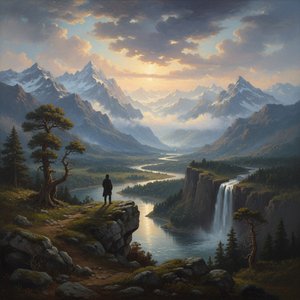
George Hayes: Bridging Landscapes and Figures of Wales
George Hayes (1824-1895) emerges from the vibrant artistic landscape of 19th-century Britain, specifically finding a significant foothold in Manchester and the captivating Welsh countryside. More than simply a painter, he was a versatile observer—a keen recorder of both dramatic seascapes and intimate scenes populated by figures, capturing the essence of his surroundings with a distinctive blend of realism and evocative atmosphere. His work, now housed in collections like that of the Lytham St Annes Art Collection, offers a glimpse into a period of artistic transition and reflects the growing interest in documenting the natural world alongside human experience. Hayes’s early life remains somewhat shrouded in detail, though his birth in Huddersfield suggests an upbringing rooted in Northern England. He later established himself as an artist primarily active in Manchester and Wales, locations that profoundly shaped his aesthetic sensibilities. The industrial heart of Manchester provided a backdrop of burgeoning urban life, while the rugged beauty and ancient traditions of Wales ignited a passion for depicting its dramatic coastlines, rolling hills, and quaint villages. His membership in the Royal Cambrian Academy further underscores his commitment to Welsh art and culture, suggesting an engagement with the artistic currents circulating within that region. Hayes’s artistic development can be traced through a progression of subject matter and technique. Initially, he seems to have focused on capturing the dynamism of the sea – evidenced by works like “River with Swans,” where bold brushstrokes convey both the power and serenity of the water. The composition is carefully balanced, utilizing contrasting colors—the pinks and blues of the sky against the warmer tones of the foliage—to draw the viewer’s eye through the scene. This early work demonstrates a mastery of capturing light and atmosphere, hallmarks that would continue to define his oeuvre. Later in his career, Hayes increasingly incorporated figures into his landscapes, suggesting an interest in exploring the relationship between humanity and nature. These scenes often depict rural life – farmers tending their fields, villagers engaged in everyday activities—offering intimate portraits of Welsh society. Hayes’s style is characterized by a directness and immediacy that reflects the Romantic sensibility prevalent during his time. He eschewed overly elaborate detail or academic precision, favoring instead a looser, more expressive approach to painting. His brushwork is often visible, contributing to the sense of spontaneity and capturing the fleeting qualities of light and weather. Influences can be traced back to the landscape painters of the early 19th century, such as John Constable and J.M.W. Turner, who similarly sought to capture the essence of nature through vibrant color and dynamic composition. However, Hayes’s work possesses a distinctly Welsh character, informed by the unique topography and cultural traditions of his adopted home. Despite his artistic success, Hayes's life was not without its challenges. Newspaper reports from the late 19th century reveal a man embroiled in minor legal disputes – claims over unpaid commissions and accusations of debt. These anecdotes offer a glimpse into the realities of an artist’s life during that era, highlighting the precariousness of pursuing a career dedicated to art. His involvement with amateur dramatic societies further demonstrates his commitment to his community and his desire to contribute beyond purely artistic pursuits. Ultimately, George Hayes remains a significant figure in 19th-century British art, particularly for his contributions to Welsh landscape painting. His ability to capture the beauty and drama of both the natural world and human experience—through evocative seascapes and intimate portraits—solidifies his place as an artist who skillfully bridged the gap between observation and expression. His work continues to resonate with viewers today, offering a window into a bygone era and a testament to the enduring power of art to capture the spirit of a place and its people.Related Works & Influences
- Sir George Hay (1572–1634), 1st Earl of Kinnoull, High Chancellor of Scotland: While separated by centuries, the Baroque portraiture of Sir George Hay by Adam de Colone demonstrates a similar emphasis on dramatic lighting and rich detail – qualities that can be observed in some of Hayes’s later works. The formal attire and dignified pose reflect a tradition of aristocratic portraiture that Hayes likely absorbed during his time in Manchester.
- John Jackson’s ‘George Hay Dawkins-pennant,’ a neoclassical portrait…: This piece exemplifies the neoclassical style prevalent at the time, showcasing a focus on capturing status and dignity through careful composition and dark tones. Hayes's later portraits demonstrate a similar attention to detail and formal presentation.
- Bishop George Hay (1729–1811): The biographical details of Bishop George Hay provide context for the artistic landscape of the period, highlighting the importance of religious patronage and the role of artists in documenting historical figures.
Further research into the Royal Cambrian Academy’s archives and collections would undoubtedly reveal additional influences on Hayes's work, shedding further light on his artistic journey.
Otázky a odpovede
Ako nájdem všetky diela umelca George Hayes v konkrétnej technike?
Stránka Všetky technikyလေး rozdeluje diela umelca George Hayes podľa použitej techniky.
Kde môžem nájsť štatistiky o dieloch umelca George Hayes?
Stránka Štatistiky umelca George Hayes zobrazuje štatistiky vypočítané z jeho umeleckých diel uvedených na táto webstránka.
Môžem si zoradiť diela umelca George Hayes podľa farby?
Stránka Spektrálny výberလေး organizuje diela umelca George Hayes podľa farieb.