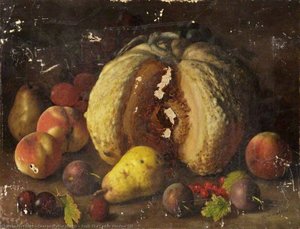
The Quiet Observer of Lancashire
Born in Preston, Lancashire, George Walter Harris entered a world where the visual language of his father, William Harris, was already a guiding light. This early immersion in the family craft meant that the act of seeing was, for him, a way of being. He did not merely look at the world; he studied the way light clung to the skin of a peach or how a shadow pooled beneath a heavy grape. His path led him from the familiar surroundings of his home to the disciplined halls of the Slade School of Fine Art in London. There, under the watchful eyes of instructors like Frederic Leighton and Joseph Noel Paton, he refined a technical precision that would define his entire life's work.
His sensibilities were shaped by the ideals of the Pre-Raphaelites, who sought a certain spiritual clarity through the depiction of beauty. Harris took these lessons and turned them inward, toward the stillness of the domestic sphere. He found a profound depth in the simplest of subjects, seeking to capture the fleeting essence of life through the meticulous rendering of fruit, flowers, and the quiet corners of a room.
The Art of the Still Life
Harris’s hand was one of patience and layered light. He worked with a method of applying thin glazes upon a toned ground, a technique that allowed him to build a luminous depth within his oils. His compositions were never loud or boastful. Instead, they relied on a subtle harmony of tones—ochres, siennas, and umbers—to create an atmosphere of calm. He focused on the textures of linen, the weight of a ceramic bowl, and the delicate fragility of a petal.
His subjects were often arranged with a careful sense of balance, creating a visual rhythm that invited contemplation. His repertoire included:
- Fruit arrangements featuring apples, pears, peaches, and grapes.
- Vases filled with seasonal blooms like dahlias and chrysanthemums.
- Domestic interiors and objects like lemons and squash.
In works such as Fruit The Laden Window Sill, he demonstrated an ability to bathe an arrangement in soft, natural light, making the objects feel present and tangible. Even when his subjects were as simple as a pineapple or a bowl of grapes, his draughtsmanship remained precise and unwavering.
A Legacy of Understated Elegance
Though he remained largely obscure during his own lifetime, the true weight of his contribution became clear as time passed. He did not chase the flamboyant grandeur of his contemporaries, choosing instead to master the nuances of light and shadow. This commitment to the quiet details of the natural world allowed his work to endure, finding its way into significant collections such as the National Portrait Gallery in Washington, D.C., and the Guildhall Art Gallery in London.
His paintings, such as Still Life with Apples and Grapes on a Ledge, reveal a man who found the infinite within the finite. He transformed the ephemeral beauty of a ripening fruit into something permanent. Today, his work is recognized as a cornerstone of British Baroque style, remembered for a certain stillness that continues to resonate with those who seek beauty in the subtle and the serene.
Otázky a odpovede
Ako je kariéra umelca George Walter Harris rozdelená do jednotlivých období?
Kariéra umelca George Walter Harris sa na jeho stránke Chronológia odvíja obdobie po období v podobe horizontálnej časovej osi diel, ktoré sú rozdelené do kapitol podľa jednotlivých období jeho tvorby.
Kde si môžem pozrieť všetky diela umelca George Walter Harris?
Všetky diela umelca George Walter Harris na táto webstránka si môžete pozrieť na jeho stránke Všetky diela umelcov.
Kde nájdem diela umelca George Walter Harris zoradené podľa tém?
Diela umelca George Walter Harris si môžete prehliadnuť podľa témy na jeho stránke Atlas predmetov.