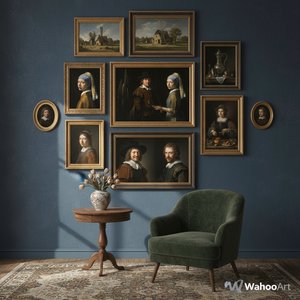
The Legacy of a Master's Protégé
In the vibrant, bustling heart of seventeenth-century Amsterdam, a period defined by unparalleled cultural and economic prosperity, the name Gerbrand van den Eeckhout emerged as a significant voice within the Dutch Golden Age. While history often casts him in the long, dramatic shadow of his mentor, the legendary Rembrandt van Rijn, to view Eeckhout merely as a student is to overlook the profound sensitivity and technical refinement he brought to the canvas. Born in 1621, Eeckhout was shaped by the very atmosphere of the Dutch Baroque, an era where light, texture, and human emotion were captured with a devotion that bordered on the divine. His journey was one of deep connection to the masters of his time, yet it was marked by a persistent effort to find a visual language that was uniquely his own.
The foundation of Eeckhout’s artistry was laid within the walls of Rembrandt’s studio. As an apprentice, he did not simply learn the mechanics of paint application; he absorbed a philosophy of observation. From Rembrandt, he inherited a reverence for the interplay of light and shadow, yet as his career matured, Eeckhout began to diverge from the heavy, dramatic chiaroscuro that defined his teacher's most famous works. Instead, he developed a preference for softer gradations of tone and a more delicate atmospheric perspective. This subtle shift allowed him to create scenes that felt less like theatrical confrontations and more like intimate, quiet moments captured in time, imbuing his subjects with a psychological depth that resonated with the burgeoning middle class of the Netherlands.
Mastery of Portraiture and Genre
Eeckhout’s oeuvre is a testament to his versatility, ranging from the solemnity of formal portraiture to the narrative charm of genre scenes. His portraits are celebrated for their remarkable realism, particularly in the way he rendered the tactile qualities of fabric, lace, and skin. He possessed an uncanny ability to translate the social standing and inner character of his sitters through understated visual cues. In works such as A Young Woman Reading, one can witness his mastery of mood; the light does not merely illuminate the subject but seems to wrap around her, creating a sense of contemplative solitude that draws the viewer into her private world.
Beyond the individual portrait, Eeckhout excelled in capturing the pulse of everyday life. His genre paintings often depicted biblical or historical narratives, yet he grounded these grand themes in the domestic reality of his era. This technique bridged the gap between the epic and the intimate, making the divine feel accessible and human. His ability to compose complex scenes with a sense of naturalistic flow remains one of his most significant achievements. Even when depicting larger groups, there is a rhythmic balance to his compositions that prevents chaos, guiding the eye through a carefully orchestrated landscape of light and shadow.
Historical Significance and Artistic Spirit
The historical importance of Gerbrand van den Eeckhout lies in his role as a bridge between the intense emotionalism of the early Baroque and the more refined, observational style that would characterize later Dutch art. He was an artist who understood the power of nuance. While he could evoke the grandeur of the past, his true strength lay in the subtle: the glint of light on a silver goblet, the soft fold of a linen sleeve, or the fleeting expression of a thought passing through a subject's mind.
Though his life ended in 1674, leaving behind a legacy that continues to fascinate historians and art lovers alike, Eeckhout remains a vital figure for understanding the evolution of Dutch painting. His work serves as a reminder that greatness is not always found in the loudest shadows, but often in the most delicate light. To study his paintings is to experience the soul of the Dutch Golden Age—a period where the boundaries between the mundane and the magnificent were beautifully blurred by the brush of a master.
Otázky a odpovede
Kde nájdem diela umelca Gerbrand Van Den Eeckhout zoradené podľa farebnej palety?
Diela umelca Gerbrand Van Den Eeckhout si môžete prehliadnuť podľa farebnej palety na jeho stránke Podľa palety farieb.
Ako je kariéra umelca Gerbrand Van Den Eeckhout rozdelená do jednotlivých období?
Kariéra umelca Gerbrand Van Den Eeckhout sa na jeho stránke Chronológia odvíja obdobie po období v podobe horizontálnej časovej osi diel, ktoré sú rozdelené do kapitol podľa jednotlivých období jeho tvorby.
Kde a v ktorom roku sa narodil/a Gerbrand Van Den Eeckhout?
Gerbrand Van Den Eeckhout sa narodil v meste Amsterdam v roku 1621.