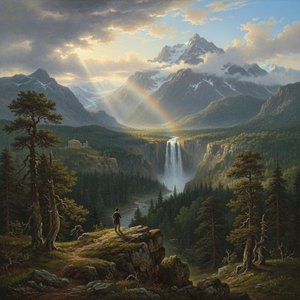
A Life Rooted in the Suffolk Landscape: The World of Leonard Herbert Turland
Leonard Herbert Turland (born 1927, still living) is a name synonymous with the evocative depiction of East Anglia, particularly the shifting light and timeless beauty of his native Suffolk. While not a household name in the grand tradition of Turner or Constable, Turland has cultivated a devoted following for his intensely personal and meticulously rendered paintings that capture the essence of a rural England undergoing profound change. His life story is inextricably linked to the land he portrays; born into a farming family near Woodbridge, he experienced firsthand the rhythms of agricultural life, the changing seasons, and the subtle nuances of the coastal environment – all themes which would dominate his artistic career. Unlike many artists who sought formal training in bustling urban centers, Turland’s education was largely self-directed, nurtured by an innate sensitivity to observation and a deep connection with the natural world. He initially pursued a career in agriculture alongside his family, but the pull of art proved too strong, leading him to dedicate himself fully to painting in the 1950s. This unconventional path instilled in him a unique perspective, grounded in practical knowledge and an intimate understanding of the landscape he so passionately documented.Early Influences & The Development of a Distinct Style
Turland’s artistic development wasn't shaped by adherence to prevailing modern art movements but rather by a quiet absorption of tradition and a commitment to representational painting. He admired, though didn’t directly imitate, the work of earlier Suffolk painters like John Constable and Thomas Gainsborough, appreciating their ability to convey atmosphere and light. However, his influences extended beyond purely artistic sources; the writings of naturalists such as Gilbert White and W.H. Hudson profoundly impacted his understanding of the interconnectedness of nature and informed his meticulous attention to detail.- Constable & Gainsborough: Appreciation for their atmospheric light and representational skill, but not direct imitation.
- Naturalist Writers: Gilbert White and W.H. Hudson influenced his understanding of nature’s interconnectedness.
- Early Works (1950s-60s): Focused on detailed studies of local flora, fauna, and farm buildings, establishing a foundation in observational accuracy.
- Shift Towards Broader Landscapes: Gradual expansion to encompass wider views of marshes, fields, and the coastline, emphasizing atmospheric effects.
Themes & Symbolism in Turland’s Paintings
Turland's paintings are not simply topographical records; they are imbued with a sense of quiet contemplation and a subtle symbolism that reflects his deep connection to the land. The marshes, which feature prominently in his work, represent more than just a physical landscape; they symbolize the passage of time, the resilience of nature, and the enduring spirit of rural life. Abandoned farm buildings, often depicted with poignant detail, evoke a sense of loss and change, hinting at the decline of traditional agricultural practices.- The Marshes: Symbolize passage of time, nature’s resilience, and the enduring spirit of rural life.
- Abandoned Farm Buildings: Evoke loss and change, reflecting the decline of traditional agriculture.
- Coastal Scenes: Represent the power and beauty of the natural world, often with a sense of solitude and introspection.
- Light & Atmosphere: Central to his work; conveys mood, emotion, and the ephemeral quality of experience.
Major Achievements & Historical Significance
While Turland has maintained a relatively low profile throughout his career, he has achieved significant recognition within the art world and among collectors who appreciate his unique vision. His paintings have been exhibited in numerous galleries across East Anglia and beyond, and are held in both public and private collections. He is considered an important representative of British realism, particularly for his ability to capture the essence of a specific place – Suffolk – with such sensitivity and precision.- Exhibitions: Numerous gallery exhibitions across East Anglia and beyond.
- Collections: Paintings held in public and private collections, demonstrating growing recognition.
- British Realism: Considered a key figure representing the essence of Suffolk with sensitivity and precision.
- Documenting Change: His work provides a valuable record of rural England undergoing transformation in the latter half of the 20th century.
Otázky a odpovede
Koľko umelých diel od Leonard Herbert Turland si môžete v katalógu prehliadnuť?
Na stránke Všetky diela umelcov si môžete prelistovať 5 umelých diel diel od umelca Leonard Herbert Turland.
Ako nájdem všetky diela umelca Leonard Herbert Turland v konkrétnej technike?
Ak chcete nájsť všetky diela umelca Leonard Herbert Turland v konkrétnej technike, navštívte jeho stránku Všetky techniky.
Môžem si prehliadať diela umelca Leonard Herbert Turland podľa kľúčových slov?
Stránka Podľa kľúčových slov umelca Leonard Herbert Turland spája diela daného umelca podľa ich kľúčových slov.