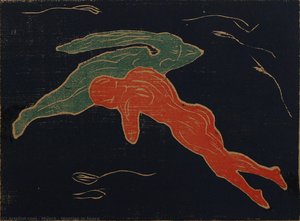
1894. Acrylic On Canvas.

§ 1Catalogue data


§ 2Abstract
Opis zbirateljskega predmeta
 Preberi več
Biografija umetnika
Edvard Munch (1863-1944): norveški slikar, pionir ekspresionizma! Odkrijte 'Krik' in umetnost, ki raziskuje tesnobo, smrt, ljubezen ter psihološke teme. Njegova dela so ikonična izpoved o človeških čustvih.
§ 3Commentary
A Portrait of Unease: Exploring Edvard Munch’s “Separation”
Edvard Munch's "Separation," painted in 1894, transcends mere depiction; it embodies the very essence of Expressionism—a movement that sought to convey inner emotional states rather than objective reality. This monumental canvas housed within Oslo’s Munch Museum isn’t simply a visual record of two figures; it’s a visceral exploration of disconnection and unspoken longing, rendered with masterful technique and steeped in psychological depth. The painting immediately draws the eye to its central duo: a woman gazing outwards towards the sea, her posture conveying a palpable sense of detachment from the man beside her—a figure who stands close but seems unreachable.- Style & Technique: Munch’s signature style is characterized by bold brushstrokes and vibrant colors applied in swirling patterns that mirror the turbulent emotions depicted. The use of tempera on canvas contributes to a textured surface, emphasizing the artist's intention to capture not just what he saw but how he *felt*.
- Historical Context: Created during Munch’s formative years, “Separation” reflects the anxieties prevalent in European intellectual circles at the time—specifically, concerns about psychological instability and the impact of trauma on human experience. It aligns perfectly with the broader Expressionist preoccupation with portraying subjective emotion as opposed to objective observation.
- Symbolism & Composition: The woman’s averted gaze is laden with symbolism; she represents vulnerability and introspection, while her gaze directs our attention away from the man's presence. The sea itself serves as a powerful metaphor for isolation and uncertainty—a vast expanse mirroring the emotional distance between the subjects. Notably, the inclusion of a clock in the upper left corner underscores the relentless passage of time and the inevitability of loss.
- Emotional Impact: “Separation” achieves its profound effect through Munch’s masterful manipulation of color and form. The dominant hues—deep blues and reds—evoke feelings of melancholy and passion, respectively, creating a dramatic interplay that captures the core tension of the scene. It's a painting that lingers in the mind long after viewing, prompting contemplation on themes of intimacy, sorrow, and the complexities of human relationships.
* Google Arts & Culture: https://artsandculture.google.com/asset/-AFoDHxU1msdjw
* WikiArt: https://www.wikiart.org/en/edvard-munch/separation-1894
Vprašanja in odgovori
Kdo prodaja ročno slikane kopije dela "Separation munch museum" avtorja Edvard Munch?
Ročno slikane kopije dela "Separation munch museum" avtorja Edvard Munch so na voljo na spletnem mestu ta spletna stran: ročno slikana oljna reprodukcija na lnenem platnu, kjer jih lahko naročite preko strani Ročno slikana reprodukcija.
V kateri umetnostni smernici in v katero dobo je uvrščeno delo "Separation munch museum" avtorja Edvard Munch?
"Separation munch museum" pripada slogu Expressionist Painting, njegov ustvarjalec pa je deloval v obdobju 19. stoletje.
Kakšen občutek izraža "Separation munch museum" avtorja Edvard Munch?
"Separation munch museum" avtorja Edvard Munch izraža Melancholic občutek znotraj splošnega Dramatic vzdušja.


 Preklop na tiskanine


 Za umetniška dela ali reprodukcije, ki so po katerikoli strani širše od 105 cm (približno 41 palč), bo okvir poslan v razstavljeni obliki kot komplet. Ta metoda zagotavlja varno dostavo in preprečuje poškodbe med transportom.