


 Pregledaj u prostoru
 Podeli
 Podeli
 Detalji
 Vodič
Vodič

 Preuzmi sliku
 Slični predmeti
 Rendgenski snimak
 Automatska prezentacija
 Statistika
untitled (5687)

 Pročitaj više
Giclee štampa / Umetnički otisak
Giclée štampa ili print na platnu muzejskog kvaliteta uz brzu izradu i raznovrsne opcije završne obrade. ( Naručite ručno oslikano reprodukciju Pređi na prodaju digitalnih slika)




P118B дин10

P118H дин10

P118W дин10

P438Z дин10

P508JH дин12

P508YH дин12

P805H дин10

P805Z дин10

P919BZ дин10

P919G дин10

P919XJ дин10

P959ZH дин10

P968JZ дин12

W106C дин8

W218G дин10

W218JH дин8

W218Y дин10

W307PJ дин10

W316G дин10

W316PJ дин8

W316Y дин10

W398PJ дин8

W4111J дин10

W500HY дин15

W500JH дин15

W692G дин12

W849H дин8

W940BG дин15

W953PJ дин8




Izaberite jednu od naših unapred definisanih veličina koje odgovaraju originalnim proporcijama umetničkog dela.

Unesite širinu i visinu koja vam je potrebna, kako bi se uklopili u vaš ram ili na vaš zid. Štampa se može samo iseći, nikada ne može biti veća od originalne slike, stoga format sa drugačijim proporcijama gubi deo slike. Poslaćemo vam digitalni prikaz radi potvrde pre nego što započnemo štampu. Slika prikazana na ovoj stranici ne pokazuje stvarni rez — to pokazuje samo digitalni prikaz.
Dostava širom sveta () za 2 nedelje umesto uobičajenih 4/5 nedelja. (26 октобар)

Besplatna ekspresna dostava širom sveta

Visokokvalitetno laneno platno

Sveobuhvatno osiguranje transporta

Garancija povraćaja carine i uvoznih dažbina

Garancija vernosti boja i autentičnosti pri reprodukciji

Politika povraćaja u roku od 100 dana (samo u slučaju nedostataka)

Garancija povrata 100% novca

Popust pri većoj količini
 Opcija sa staklom dostupna je samo za dimenzije manje od 110 cm

untitled (5687)
Giclee štampa / Umetnički otisak
Veličina reprodukcije
-


Ukupna cena
дин 6600
A Fragmented Portrait of Modern Anxiety
Egon Schiele’s untitled work from 1918 – designated as ‘5687’ within his catalogue – is not merely a depiction of a man, but a visceral embodiment of the anxieties and fragmentation that defined early 20th-century Vienna. Rendered in stark black and white, the piece presents a torso, partially obscured by a jacket seemingly shed rather than removed, surrounded by an unsettling collection of objects: bags, an umbrella, all contributing to a sense of displacement and psychological turmoil. The figure isn’t presented with dignity or composure; instead, he appears vulnerable, almost overwhelmed by his surroundings. This is characteristic of Schiele's oeuvre, which consistently eschewed traditional notions of beauty in favor of raw emotional honesty.
The Expressionist Language of the Body
Schiele was a master of line, and here it’s employed with an almost violent energy. The lines aren’t used to define form in a classical sense; rather, they writhe and twist, mirroring the inner turmoil of his subject. This is quintessential Expressionism – a movement that sought not to depict the external world objectively, but to convey subjective emotion and experience. The monochrome palette intensifies this effect, stripping away any distraction from the stark contrast between light and shadow, emphasizing the figure’s gauntness and the unsettling arrangement of objects around him. The technique itself—likely executed with charcoal or a similar medium—allows for a textural quality that adds to the sense of unease; it feels almost as if the image is dissolving before our eyes.
Vienna's Shadow: Context and Symbolism
To understand this work, one must consider the context in which it was created. Vienna at the turn of the century was a city grappling with profound social and political change. The Austro-Hungarian Empire was crumbling, traditional values were being questioned, and Freudian psychology was beginning to unlock the hidden depths of the human psyche. Schiele’s art reflects this era of uncertainty and introspection. The bags scattered around the figure could symbolize burdens – emotional baggage, societal expectations, or perhaps even the weight of mortality. The umbrella, a symbol of protection, is positioned almost as an afterthought, offering little solace in the face of overwhelming chaos. It's worth noting that 1918 was also the year of Schiele’s own untimely death during the Spanish Flu pandemic, adding another layer of poignancy to this image of vulnerability and precarity.
A Legacy of Emotional Intensity
Schiele’s impact on modern art is undeniable. He pushed boundaries, challenged conventions, and dared to explore the darker aspects of human experience with unflinching honesty. His work continues to resonate today because it speaks to universal themes of alienation, anxiety, and the search for meaning in a chaotic world. ‘Untitled (5687)’ isn’t simply a historical artifact; it's a powerful emotional statement that invites viewers to confront their own vulnerabilities and contemplate the complexities of the human condition. A reproduction of this piece would serve not just as a decorative element, but as a compelling focal point—a conversation starter and a testament to the enduring power of Expressionist art.
Pitanja i odgovori
Mogu li videti „untitled (5687)”, Егон Шиле pod različitim svetlima?
Stranica Rentgenski snimak za delo „untitled (5687)”, Егон Шиле predstavlja interaktivni preglednik koji vam omogućava da prolazite kroz jedanaest optičkih slojeva slike dela, uključujući i prikaz u stilu rendgenskog snimka.
Kako se umetnički pravac i epoha susreću u delu „untitled (5687)”, Егон Шиле?
„untitled (5687)”, Егон Шиле pripada Vienna pravcu, unutar Moderna era ere svog tvorca.
Koja je dominantna nijansa dela „untitled (5687)”, Егон Шиле?
Dominantna nijansa dela „untitled (5687)”, Егон Шиле je Golden Yellow Range. Ova nijansa predstavlja osnovni ton palete.
Srodna umetnička dela


Biografija umetnika
A Life Forged in Expression
Born in 1890 in the Austrian town of Tulln an der Donau, Egon Schiele’s life was a tempestuous journey marked by both extraordinary artistic vision and profound personal hardship. His early years were shadowed by illness and loss; his father succumbed to syphilis when Egon was just fourteen, a tragedy that would deeply resonate within his work, fueling an obsession with mortality and the fragility of existence. Raised initially by his mother and then under the somewhat controlling guardianship of his uncle Leopold Czihaczek, Schiele’s childhood lacked conventional stability but fostered a fiercely independent spirit. Even as a boy, he displayed an intense fascination with trains—a motif that subtly reappeared in later paintings—and a burgeoning talent for drawing, though this was initially met with disapproval from his father who saw it as a distraction from more practical pursuits. The early death of his sister Elvira also cast a long shadow over the young artist’s psyche. These formative experiences instilled within him a sensitivity and an emotional rawness that would become hallmarks of his artistic expression, a constant grappling with themes of life, death, and the human condition.
The Crucible of Vienna: Artistic Development
Schiele's formal artistic training began at the Kunstgewerbeschule (School of Arts and Crafts) in Vienna, but he quickly found himself stifled by its conservative approach. He transferred to the Akademie der bildenden Künste (Academy of Fine Arts), only to become further disillusioned with its rigid academic traditions. This dissatisfaction led him to abandon formal training altogether, choosing instead to forge his own path, a testament to his unwavering artistic conviction. The influence of Gustav Klimt was pivotal during these early years; Schiele admired Klimt’s decorative style and exploration of symbolism, even receiving mentorship from the established artist. However, Schiele soon diverged from Klimt's aesthetic, developing a distinctly individual voice characterized by its stark honesty and psychological intensity. He co-founded the Neues Wiener Kunstgruppe (New Viennese Art Group) in 1909, aligning himself with other progressive artists who challenged the prevailing artistic norms. His early works, often unsettling portraits and self-portraits, began to emerge as powerful statements of emotional turmoil, featuring distorted figures and a palpable sense of vulnerability. These paintings were not merely representations of physical form but explorations of the inner landscape—the anxieties, desires, and fears that haunted the human psyche.
Raw Emotion and Unflinching Truth
Egon Schiele’s art is immediately recognizable for its raw honesty and psychological depth. He fearlessly confronted themes often considered taboo – sexuality, death, anxiety, isolation – with an unflinching gaze. His distinctive style features elongated figures, contorted poses, and expressive lines that convey a sense of unease and emotional intensity. The human form, particularly the nude, became his primary subject, not as an object of idealized beauty but as a vessel for exploring the complexities of human experience. Self-portraits constitute a significant portion of his oeuvre, offering intimate glimpses into his inner world—a world often marked by loneliness and self-doubt. He didn’t shy away from depicting himself in unflattering or vulnerable poses, revealing a profound level of self-awareness and introspection. Beyond self-portraiture, Schiele created numerous portraits of others, capturing their likenesses with an unsettling realism that seemed to penetrate beneath the surface. His landscapes, while less central to his work than his figurative paintings, demonstrate his mastery of form and color, often reflecting the same emotional intensity as his portraits. The use of line is particularly striking in Schiele’s work; it's not merely a tool for defining shape but an expressive force that conveys emotion and psychological tension. Recurring motifs like the *Physalis plant* – symbolizing death and transience with its delicate, papery husk – further underscore this preoccupation with mortality.
A Legacy Cut Short: Achievements & Significance
Despite facing censorship and legal challenges – including a brief imprisonment for allegedly corrupting minors with his art – Schiele gained recognition within Vienna’s avant-garde circles. His work challenged the conventions of the time, provoking both admiration and outrage. By the time of his untimely death during the Spanish flu pandemic in 1918 at the age of twenty-eight, he had established himself as a leading figure in Austrian Expressionism. Significant works such as Self-Portrait with Physalis, Couple Embracing, and Field Landscape (Kreuzberg near Krumau) stand as testaments to his artistic genius. His influence on subsequent generations of artists is undeniable, particularly those interested in exploring psychological themes and challenging conventional artistic norms. Schiele’s bold approach to form and subject matter continues to resonate with audiences today, making him one of the most important and influential figures in early 20th-century art. His paintings are now held in major museum collections worldwide, including the Leopold Museum in Vienna and the Egon Schiele Art Centrum in Český Krumlov, ensuring his artistic legacy endures. He left behind a body of work that is not merely aesthetically compelling but profoundly human—a testament to the power of art to confront the complexities of existence with honesty, courage, and unwavering vision.
- Key Themes: Mortality, sexuality, isolation, psychological turmoil.
- Influences: Gustav Klimt, Viennese Secession, personal trauma.
- Style Characteristics: Elongated figures, contorted poses, expressive lines, raw emotion.
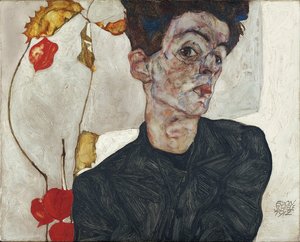
Егон Шиле
1890 - 1918 , Австрија
Brzi pregled
- Artistic Movement Or Style: Ekspresionizam
- Artists Who Influenced This Artist: ['Gustav Klimt']
- Date Of Birth: 1890
- Date Of Death: 1918
- Full Name: Egon Schiele
- Nationality: Austrijski
- Notable Artworks:
- Samoportret sa fizišalijom
- Par ljubavi
- Polje pejzaž
- Place Of Birth: Tulln, Austria
Srodni članci

Dark Masterpieces: 10 Iconic Paintings Dominated by Black Tones |
Explore 10 iconic paintings dominated by black tones, from Rembrandt’s chiaroscuro to Goya's dark expressions. Discover the stories behind these masterpieces & find museum-quality art reproductions for your home at .
Monochrome Visions: Exploring the Aesthetic & Historical Significance of Black & White Photography
Explore the rich history & artistic power of black and white photography. From early techniques to iconic masters like Ansel Adams, discover why monochrome continues to captivate art lovers today. Expert insights for collectors.

White on Canvas: 10 Masterpieces & Timeless Elegance for Your Home Decor
Explore 10 iconic white paintings by Monet, Whistler & Rothko! Discover the stories behind these serene masterpieces and their impact on art history. Find museum-quality reproductions for your home decor at .

Egon Schiele: Expressionism, Anxiety & the Modern Condition – A Comprehensive Exploration
Explore the emotionally charged world of Egon Schiele (1890-1918). Discover his Expressionist masterpieces, psychological themes, and lasting impact on modern art. A comprehensive guide for collectors & enthusiasts.
Egon Schiele: 25 Remek-dela Ekspresionizma za Vaš Dom | AllPaintingsStore
Istražite 25 remek-dela Egona Schielea – ekspresionističkih portreta i slika koje odražavaju duboke emocije. Kupite reprodukcije vrhunskog kvaliteta za dekoraciju enterijera na AllPaintingsStore.com! Otkrijte celu kolekciju online.


