

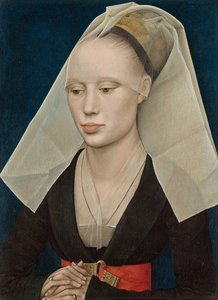
1460. Acrylic On Canvas, 31.0 x 22.0 cm. Metropolitan Museum of Art.

§ 1Katalog podaci

- 31.0 x 22.0 cm


§ 2Apstraktno
Opis predmeta
 Pročitaj više
Biografija umetnika
Roge van der Vejden (1400-1464): Flandrijski majstor rane renesanse poznat po emotivnim religijskim slikama, bogatim bojama i naturalističkim detaljima. Otkrijte 'Zaljubljenost' i još mnogo toga!
§ 3Komentar
A Portrait Steeped in Nobility and Faith: Exploring Rogier van der Weyden’s Francesco d'Este
Rogier van der Weyden’s “Francesco d’Este,” completed around 1460, stands as a testament to the artistic fervor of Early Netherlandish painting—a period characterized by profound spiritual contemplation and meticulous realism. This portrait transcends mere likeness; it embodies the ideals of Renaissance nobility intertwined with devout piety, capturing a moment frozen in time with remarkable sensitivity.
Subject Matter and Composition: The Dignified Heir
The subject is Francesco d’Este, son of Leonello d'Este, Duke of Modena. Commissioned during his formative years, the painting depicts him as a young man embarking on military training—a common practice for aristocratic princes at the time—yet radiating an aura of composure and intellectual curiosity. Van der Weyden skillfully arranges the figure within a richly decorated interior space; Francesco occupies the central position, gazing directly at the viewer with an intense gaze that conveys both confidence and introspection.
Stylistic Innovation: Mastering Detail and Emotion
Van der Weyden’s signature style—renowned for its unparalleled attention to detail and expressive portrayal of human emotion—is vividly evident in “Francesco d’Este.” Like many of his contemporaries, he adhered to the principles of naturalism championed by Filippo Brunelleschi and Donatello, striving to represent reality with unwavering accuracy. However, unlike purely observational depictions, Van der Weyden infused his canvases with psychological depth, conveying not just what was seen but also what was felt.
Technique: The Alchemy of Color and Texture
The painting’s remarkable luminosity stems from Van der Weyden's masterful use of oil paint—a relatively new medium at the time—allowing for subtle gradations of color and a velvety texture that imbues the scene with palpable warmth. Observe how he renders the folds of Francesco’s shirt with painstaking precision, capturing the interplay of light and shadow to create an illusion of three-dimensionality. The textured wall behind him serves as a counterpoint to the figure's stillness, adding visual interest and reinforcing the painting’s overall sense of grandeur.
Symbolism: Faith and Patronage
Beyond its formal beauty, “Francesco d’Este” carries symbolic significance reflecting the cultural milieu of its time. The inclusion of a ring—a symbol of marital status and social standing—underscores Francesco's noble lineage and aspirations. Furthermore, the serene setting evokes biblical imagery, hinting at the spiritual values upheld by the Este family and highlighting Van der Weyden’s commitment to conveying moral virtue through art.
Concluding Reflection: An Enduring Legacy
“Francesco d’Este” remains a cornerstone of Early Netherlandish painting—a masterpiece that continues to inspire admiration for its technical brilliance and emotional resonance. Its enduring appeal lies in Van der Weyden's ability to capture not just the outward appearance of his subject but also the inner spirit, cementing his place as one of the most influential artists of the fifteenth century.
Pitanja i odgovori
Gde se "Francesco d'Este" nalazi u okviru opusa umetnika Roge Van Der Vejden?
„Francesco d'Este“ pripada Early Netherlandish Renaissance periodu stvaralaštka umetnika Roge Van Der Vejden, čije su upečatljive teme obuhvatale religious devotion, flemish style, human dignity, aristocratic portrait, medieval tradition, meticulous detail, emotional realism, artistic legacy.
Ko je autor dela "Francesco d'Este"?
Delo "Francesco d'Este" je kreirao/la Roge Van Der Vejden. Informacije na ovoj stranici opisuju originalno delo umetnika Roge Van Der Vejden.
Koja veličina štampe za "Francesco d'Este" bi najbolje odgovarala mojoj prostoriji?
Preporučena kombinacija za „Francesco d'Este”, autor Roge Van Der Vejden: štampa dimenzija Large u prostoriji tipa Living Room.


 Pređi na štampu


 Za umetnička dela ili reprodukcije čija je bilo koja strana veća od 105 cm (približno 41 inč), okvir će biti isporučen u obliku rastavljenog seta za sklapanje. Ovaj metod osigurava bezbednu dostavu i sprečava oštećenja tokom transporta.


