Digital.

§ 1Catalogue data


Ovo umetničko delo je zaštićeno autorskim pravima
Umetničko delo prikazano na ovoj stranici zaštićeno je autorskim pravima, što znači da zakonski nismo u mogućnosti da kreiramo niti prodajemo identičnu reprodukciju. Ova zaštita se sprovodi u skladu sa međunarodnim sporazumima kao što su Bernska konvencija i nacionalnim zakonima, uključujući i one koji su definisani u Američki zakon o autorskom pravu – Naslov 17.
Kao poštovana i legalna alternativa, nudimo prilagođene, ručno oslikane umetničke radove inspirisane originalom. Naši stručni i profesionalni umetnici pažljivo proučavaju stil, ambijent i umetničku suštinu originala kako bi kreirali novo, unikatno delo koje budi istu emociju – ostajući pritom potpuno autentično stvaranje.
Ovaj metod je u potpunosti usklađen sa regulativama o autorskim pravima jer ne podrazumeva kopiranje ili dupliranje zaštićenih umetničkih dela. Umesto toga, reč je o kreativnoj reinterpretaciji – novom slikarskom delu koje je inspirisano originalom, ali nije identično njemu.
 Pročitajte više
§ 2Abstract
Opis predmeta
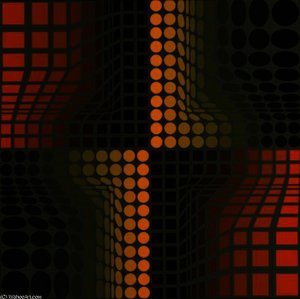
Explore Victor Vasarely’s ‘Obor,’ a mesmerizing Op Art abstraction of geometric shapes & vibrant colors. Discover its layered design & digital rendering style.
Biografija umetnika
Otkrijte fascinantan svet Viktora Vaserelija (1906-1997), pionira Op Art! Istražite njegove geometrijske apstrakcije, optičke iluzije i trajni uticaj na modernu umetnost i dizajn.
§ 3Commentary
A Symphony of Perception: The Vibrating World of Obor
To encounter Victor Vasarely’s “Obor” is to step away from the stillness of traditional viewing and enter a realm where the canvas itself seems to breathe, pulse, and shift beneath one's gaze. This masterpiece of Op Art does not merely sit upon a wall; it interacts with the eye, challenging our very understanding of depth, stability, and movement. At its core, “Obor” is a profound exploration of geometric harmony, where the rigid discipline of mathematical precision meets the fluid, unpredictable nature of human perception. The artwork presents a deceptively simple composition of overlapping rectangles of vibrant hues, yet beneath this apparent austerity lies an intricate system designed to stimulate the viewer’s eye and create a convincing illusion of three-dimensionality.
The foundation of this visual dance is a meticulously structured hexagonal grid. This geometric scaffolding serves as more than just structural support; it actively guides the gaze across the canvas, reinforcing a sense of spatial recession through the careful layering and positioning of shapes. As the eye wanders through the composition, it experiences a rhythmic vibration, a hallmark of Vasarely’s signature style. This technique, deeply rooted in the Bauhaus principles of functional design, allows the artist to manipulate form and color to evoke deep emotional responses, turning a flat surface into a kinetic experience that feels as though it is moving within our own space.
The Chromatic Dance and Emotional Resonance
The color palette employed in “Obor” is far from accidental; it is a carefully engineered emotional journey. The composition begins with the warmth of sun-drenched yellows and oranges at its upper reaches, gradually transitioning downwards into the tranquil, cooler tones of blues and greens. This chromatic progression mirrors a natural cycle, much like the transition from bright daylight to the soft twilight of evening. Such a deliberate use of color does more than please the eye; it operates on a psychological level, subtly influencing the viewer's emotional state by capturing the fleeting sensations of light and atmosphere.
For the discerning collector or interior designer, “Obor” offers an unparalleled opportunity to introduce dynamic energy into a space. The artwork’s ability to create depth through the illusion of receding planes makes it a transformative piece for any high-end environment. Whether placed in a contemporary gallery setting or as a focal point in a sophisticated residential lounge, the painting acts as a window into a world of engineered energy. It provides a sense of intellectual stimulation and visual luxury, inviting guests to linger and lose themselves in its complex, layered geometry.
A Legacy of Innovation
Born Károly Vaszary in 1906 in Pécs, the artist’s journey was one of radical transformation. Having initially pursued medical studies, Vasarely eventually abandoned the biological sciences to master the science of sight. His work stands as a testament to his lifelong pursuit of "art for all," a philosophy that sought to democratize the aesthetic experience through the universal language of geometry. In “Obor,” we see the culmination of this vision—a piece where mathematics and magic converge, creating a lasting legacy of innovation that continues to inspire those who seek beauty in precision and movement in stillness.
Pitanja i odgovori
Da li je „Obor”, autor Viktor Vasereli svetlo ili tamno umetničko delo?
Sveukupno, "Obor" je zabeležen kao shadow. Percepcija osvetljenosti opisuje koliko delo deluje svetlo ili tamno.
Postoje li dela slična delu "Obor"?
Radovi slični delu „Obor“ možete pronaći na stranici Slična dela ovog umetničkog dela.
Da li „Obor”, autor Viktor Vasereli koristi jake kontraste ili nežne harmonije?
Koloristička kompozicija dela „Obor”, autor Viktor Vasereli spaja Statement kontrast sa Discordant Palette harmonijom.


 Pređi na štampu


 Za umetnička dela ili reprodukcije čija je bilo koja strana veća od 105 cm (približno 41 inč), okvir će biti isporučen u obliku rastavljenog seta za sklapanje. Ovaj metod osigurava bezbednu dostavu i sprečava oštećenja tokom transporta.