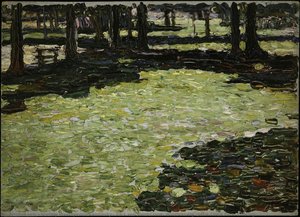
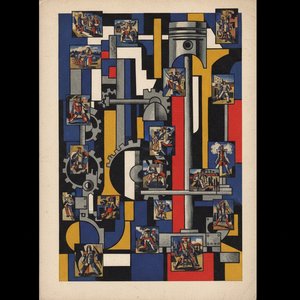
1912. Akril na platnu, 107.0 x 97.0 cm. Lenbachhaus.

§ 1Catalogue data
 Akril na platnu
- Zidna umetnost
- Abstract Expressionism
 1912
1912 107.0 x 97.0 cm
 Lenbachhaus
§ 2Abstract
Opis predmeta
Experience the vibrant energy of Wassily Kandinsky's 'Improvisation 26 (Rowing)' – a monumental abstract painting exploring color and form with striking yellow circles and dynamic red & blue lines.
 Pročitaj više
Biografija umetnika
Откријте Василија Кандиског – револуционарно дело апстрактне уметности! Динамичне форме, ярке боје и духовна резонанца у једном мајсторија платног. Овај руски сликар оставио је трајан утицај на светску уметност.
§ 3Commentary
A Symphony in Color: Exploring Kandinsky’s Improvisation 26
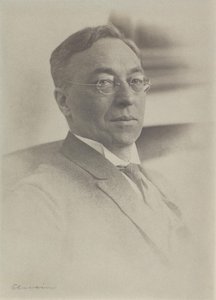
Wassily Wassilyevich Kandinsky stands as an undeniable titan of modern art, a figure whose audacious embrace of abstraction fundamentally reshaped the artistic landscape and continues to inspire awe centuries later. His journey toward this groundbreaking vision wasn't paved with conventional academic pursuits; initially drawn to law and economics at Moscow University—a path deemed respectable by societal expectations—it was a transformative encounter with Claude Monet’s “Haystacks” that sparked his initial fascination with Impressionism, capturing the fleeting beauty of light and atmosphere. Yet, it was an even more profound experience witnessing Wagner's opera "Lohengrin" – a visceral immersion in music and drama – that truly unlocked Kandinsky’s inner artist, propelling him toward a radical departure from representational art. Around thirty years old, he abandoned his legal aspirations for the fervent pursuit of painting, embarking on a path marked by relentless experimentation and unwavering conviction.- Early Influences: Russian Folk Art
- The Academy of Fine Arts in Munich
- Franz von Stuck’s Guidance
Analyzing Improvisation 26: Style and Technique
“Improvisation 26 (Rowing),” created in 1912, exemplifies Kandinsky’s signature style – Abstract Expressionism – characterized by its deliberate rejection of illusionistic representation. The painting abandons any attempt to mimic the visual world, instead prioritizing color and form as primary expressive elements. Kandinsky employed a technique he termed “Gesture Painting,” applying paint with energetic brushstrokes—often impulsive and spontaneous—to create textured surfaces that convey emotional intensity. He utilized a vibrant palette dominated by yellows, reds, and blues, meticulously layering colors to achieve luminous effects and conveying a sense of dynamism and movement. The concentric circles at the center – two prominent yellow discs surrounded by radiating red and blue lines – serve as focal points, drawing the viewer’s eye inward while simultaneously suggesting an outward expansion of energy.Symbolism Within Abstraction
Beyond its formal qualities, “Improvisation 26” is laden with symbolic significance. The circles represent wholeness and unity—a concept central to Kandinsky's spiritual worldview—while the radiating lines symbolize aspiration and transcendence. The juxtaposition of yellow and red – traditionally associated with optimism and passion – underscores the painting’s emotional core, conveying a feeling of exhilaration and vitality. Kandinsky believed that colors possessed inherent psychological properties, capable of evoking specific moods and sensations; he meticulously selected hues to align with his intention to communicate profound spiritual truths.Emotional Impact and Legacy
“Improvisation 26” transcends mere visual aesthetics, resonating deeply within the viewer’s psyche—a testament to Kandinsky's masterful ability to translate inner experience into tangible form. The painting captures a moment of spontaneous creativity—a celebration of color and gesture—that embodies the spirit of artistic liberation. Its influence extends far beyond its own time, shaping subsequent generations of artists who embraced abstraction as a means of conveying emotion and exploring spiritual dimensions. Today, “Improvisation 26” remains a cornerstone of Abstract Expressionism, serving as an enduring emblem of Kandinsky’s pioneering vision and his unwavering commitment to artistic innovation—a symphony in color that continues to captivate audiences worldwide.Pitanja i odgovori
Koliko su boje dela "Improvisation 26 (Rowing)" međusobno u harmoniji?
Boje dela „Improvisation 26 (Rowing)”, autor Василий Васильевич Кандинский odražavaju Nekompatibilna paleta boja harmoniju. Harmonija opisuje međusobni odnos boja.
Gde se mogu kupiti ručno oslikane kopije dela „Improvisation 26 (Rowing)”, autor Василий Васильевич Кандинский?
Ručno oslikanu reprodukciju dela „Improvisation 26 (Rowing)”, autor Василий Васильевич Кандинский možete naručiti direktno na njegovoj stranici Ručno oslikana reprodukcija ulja na platnu: ručno oslikana uljana reprodukcija na lanenom platnu, izrađenu po porudžbini.
Koja su tehnika i dimenzije dela „Improvisation 26 (Rowing)”, autor Василий Васильевич Кандинский?
Originalno delo „Improvisation 26 (Rowing)”, autor Василий Васильевич Кандинский je rad u tehnici Akril na platnu dimenzija 107 x 97 cm. Tehnika i dimenzije se odnose na originalni predmet.


 Pređi na štampu


 Za umetnička dela ili reprodukcije čija je bilo koja strana veća od 105 cm (približno 41 inč), okvir će biti isporučen u obliku rastavljenog seta za sklapanje. Ovaj metod osigurava bezbednu dostavu i sprečava oštećenja tokom transporta.