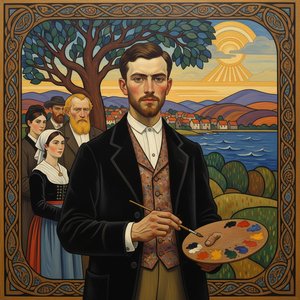
The Life and Background of Frederick Benjamin Barlin
The story of Frederick Benjamin Barlin begins within the close-knit community of the Chatham synagogue, where his father, Berliner, served as the chazzan. This lineage of religious service provided a distinct upbringing for the young man who would eventually find his calling not in the pulpit, but before the easel. Moving toward the bustling heart of London, Barlin sought to establish himself as a painter of men, focusing his talents on the art of portraiture.
His presence in the London art scene was marked by a period of intense activity during the early years of the nineteenth century. Between 1802 and 1807, he made his mark by exhibiting his work at the Royal Academy, a significant achievement for any artist of that era. These exhibitions allowed his hand to be recognized by the public and the establishment alike, cementing his place among the English portrait painters of his time.
Though his years of active practice were concentrated in a relatively brief window, his contributions to the visual record of his community were substantial. He moved through the social and religious circles of London with a purpose, capturing the likenesses of prominent figures with a steady hand. His life remains a quiet chapter in the history of English art, defined by his specific devotion to the faces of his contemporaries.
Notable Portraits and Engravings
The artist found his way to the Royal Academy, where his works were exhibited in 1802 and 1807. His hand was often called upon to capture the likenesses of significant religious figures, moving through the circles of London's prominent communities. He sought to record the faces of those who held spiritual authority, translating their presence onto canvas with a sense of dignity. One such subject was Solomon *Herschel, who served as the chief rabbi of the Ashkenazi Jews in England. Through his brush, the weight of leadership was given a visual form.
His brush also turned toward Raphael *Meldola, a Sephardi haham. In this portrait, Barlin chose to depict the subject wearing a three-cornered hat, a detail that lent the work a courtly and elegant character typical of the English style of that era. The likeness of Meldola proved so striking that it moved beyond the original painting; an engraving of the portrait was later published by Joshua Lopez, allowing the image to reach a wider audience than the canvas alone could manage.
The artist's influence extended into the realm of drawing and printmaking, where his sketches provided the foundation for others to follow. He produced an original drawing of Rabbi Solomon Hirschell, a man who would go on to be the Chief Rabbi of Great Britain. This particular work was so well received that W. Holl later created an engraving based upon Barlin's original drawing, ensuring the likeness of the rabbi remained in the public memory.
Pitanja i odgovori
Gde mogu da vidim koloristički profil radova umetnika Frederick Benjamin Barlin?
Kolorit dela umetnika Frederick Benjamin Barlin možete videti na njegovoj stranici Genom palete.
Pod kojim drugim imenima je Frederick Benjamin Barlin poznat/a?
Frederick Benjamin Barlin se pojavljuje i pod drugim imenima: F. B. Barlin.
Mogu li da pregledam dela umetnika Frederick Benjamin Barlin prema raspoloženju?
Na stranici Soba po raspoloženju umetnik Frederick Benjamin Barlin prikazuje svoja dela poređana prema njihovoj atmosferi.
Mogu li da pregledam dela umetnika Frederick Benjamin Barlin prema umetničkom pravcu?
Stranica Svi umetnički pravci grupiše dela umetnika Frederick Benjamin Barlin prema umetničkom pravcu.