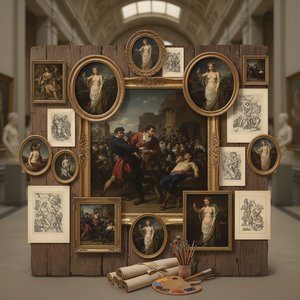
The Neapolitan Visionary: The Rise of Paolo de Matteis
In the vibrant, sun-drenched landscape of seventeenth-century Italy, a new light began to emerge from the humble surroundings of Piano Vetrale. Paolo de Matteis, an artist whose name would become synonymous with the opulent grandeur of the Baroque, embarked on a journey that would reshape the visual identity of Naples and Rome. His early years were defined by rigorous training under Francesco di Maria, yet it was his profound apprenticeship with the legendary Luca Giordano that truly ignited his creative spirit. From Giordano, de Matteis inherited a mastery of illusionistic painting, learning to manipulate light and shadow—the dramatic chiaroscuro—to create immersive worlds that seemed to breathe within their frames.As he navigated the complexities of the Spanish Viceroyalty's court, his work began to reflect a unique synthesis of theatricality and grace. He did not merely paint scenes; he constructed spectacles. His ability to weave intricate narratives through movement and perspective allowed him, through his brush, to capture the very essence of the era’s devotion and drama.
A Continental Evolution: From Baroque Drama to Rocaille Elegance
The trajectory of de Matteis' career was significantly altered by his transformative sojourn in Paris between 1702 and 1705. This period of international exposure acted as a crucible for his style, as he absorbed the burgeoning trends of the French art scene. The heavy, dramatic weight of the traditional Baroque began to soften, making way for a more refined, delicate sensibility that hinted at the approaching Rocaille era. This evolution is beautifully captured in works such as Apollo and Daphne, where the mythological tension of Ovid’s tale is rendered with both energetic movement and an increasingly sophisticated lightness.Upon his return to Naples, de Matteis brought with him a reinvigorated vision. He dedicated himself to monumental decorative schemes that transformed sacred spaces into celestial visions. His work on the magnificent vault of San Ignazio in the Gesù Nuovo stands as a testament to this period, where his brushwork turned stone and plaster into a breathtaking expanse of divine light.
A Legacy Etched in Gold and Light
The enduring significance of Paolo de Matteis lies in his role as a bridge between two great artistic epochs. He possessed the rare ability to honor the dramatic intensity of his predecessors while embracing the elegance of the future. His religious compositions, such as Our Lady of Sorrows, continue to resonate with their rich textures and symbolic depth, inviting viewers into a state of profound contemplation.- Mastery of illusionistic fresco techniques that expanded architectural boundaries.
- A pivotal role in transitioning Neapolitan art from Baroque theatricality to Rocaille refinement.
- The creation of enduring mythological and religious icons that defined the eighteenth-century aesthetic.
Pitanja i odgovori
Gde mogu da vidim dela umetnika Paolo Di Matteis poređana hronološkim redom?
Stranica Hronologija dela umetnika prikazuje dela umetnika Paolo Di Matteis poređana hronološki, godinu po godinu.
Gde mogu da vidim dela umetnika Paolo Di Matteis poređana prema atmosferi?
Radove umetnika Paolo Di Matteis možete pregledati prema raspoloženju na njegovoj stranici Soba raspoloženja, koja je organizovana tako da prikazuje dela prema njihovom raspoloženju.
Mogu li da proučim način na koji Paolo Di Matteis koristi boju u svim svojim delima?
Genom palete umetnika Paolo Di Matteis je stranica koja predstavlja koloristički profil celokupnog umetničkog dela ovog autora.